
How solar manufacturers can connect material receipts, production consumption, batch traceability and finished-goods inventory
A solar panel plant can show sufficient raw material in its stock report and still struggle to complete a production order.
The reason may be that some materials are already allocated to another production run, a supplier batch is awaiting quality inspection, or the physical stock does not match the quantity recorded in the system. Meanwhile, production, procurement and warehouse teams may each be working from a different spreadsheet.
The problem is not always a shortage of material. Sometimes, it is a lack of visibility into what is available, what can be used, what has been consumed and what has actually been produced.
For solar module manufacturers, this distinction matters because inventory moves through several connected stages: procurement, goods receipt, quality inspection, storage, production, finished-goods handling and dispatch. Each stage creates information that the next team needs.
When those records are disconnected, inventory becomes harder to reconcile, production planning becomes less reliable and product traceability becomes more difficult.
Inventory management for solar panel plants is not simply about counting stock. It is about maintaining a reliable record of material as it moves through the manufacturing process.
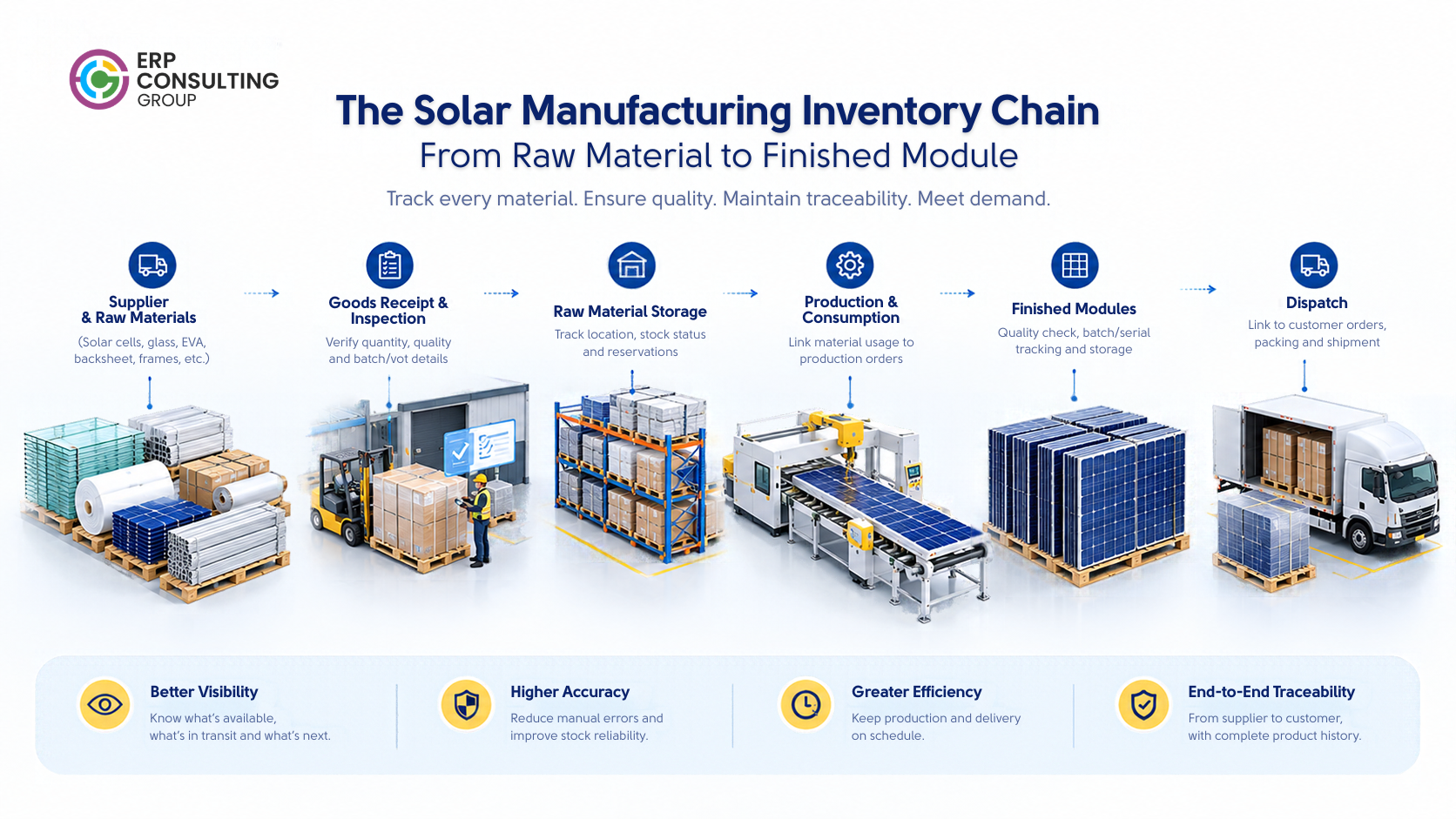
The Solar Manufacturing Inventory Chain
A solar module contains multiple components, and the exact material list depends on the manufacturer's technology, product design and bill of materials (BOM).
Depending on the product, these may include solar cells, glass, encapsulant materials such as EVA or POE, backsheets where applicable, aluminium frames, junction boxes, connectors and other electrical components.
Each item enters the business through procurement, but its inventory journey does not end when the warehouse receives it.
A connected workflow follows the material through the plant:
Supplier → Goods Receipt → Quality Inspection → Raw Material Storage → Production Allocation → Material Consumption → Finished Module → Quality Release → Finished-Goods Storage → Dispatch
Every transition should answer a basic question: what moved, in what quantity, from where, to where, and against which transaction or production order?
When these details are captured consistently, warehouse teams can reconcile stock, production planners can assess material availability, and quality teams can investigate the history of a batch when necessary.
The challenge is keeping that information connected across departments rather than recording each stage independently.
Where Inventory Visibility Typically Breaks
1. Raw Material Receipt: The Purchase Order Is Not the Same as Available Stock
A purchase order tells the business what it has ordered. It does not, by itself, confirm what has arrived, what quantity was accepted or whether the material is ready for production.
Consider a shipment of solar cells arriving at the plant. The purchase order may specify 50,000 cells, but the warehouse still needs to record the actual receipt, identify the relevant supplier batch and document any discrepancy or inspection requirement.
If the purchase order, goods receipt and physical stock records are maintained separately, the procurement team may see an order as completed while the warehouse is still reconciling the delivery.
The same issue occurs when material arrives in multiple shipments against one purchase order.
A controlled receiving workflow should connect:
- Purchase order and supplier details
- Expected and actually received quantities
- Supplier batch or lot identifiers, where applicable
- Inspection status and accepted or rejected quantities
- Storage location and receipt date
- Supporting documents and relevant certificates
Material that requires inspection or approval should be distinguishable from stock that is released for production. Otherwise, the quantity physically present can be mistaken for the quantity that is actually usable.
2. Raw Material Storage: Physical Stock Does Not Always Mean Available Stock
A warehouse may contain thousands of components without all of them being available for the next production run.
Some material may be reserved against confirmed production orders. Some may be under inspection, rejected, damaged or held for investigation. Other quantities may already be committed to a different product configuration.
A stock report showing only the total quantity can hide these differences.
For example, imagine a plant records 20,000 units of a component in its inventory. Of those, 12,000 are allocated to an existing production order, 3,000 are awaiting inspection and 5,000 are available for new requirements.
The total stock is 20,000 units, but only 5,000 are currently available for fresh allocation.
This is an illustrative example, not an industry benchmark.
The practical solution is to distinguish physical quantity from usable and unallocated stock. Inventory records should reflect reservations, quality holds, storage locations and committed requirements.
That gives procurement and production a more realistic picture of what the plant can use without creating a shortage elsewhere.
3. Production Allocation: The BOM and Actual Material Consumption Drift Apart
A bill of materials defines the components and quantities required to manufacture a product. A production order uses that information to plan a particular manufacturing run.
Visibility breaks when the planned quantities and actual material movements are not connected.
Suppose a production order requires a defined quantity of solar cells, glass, encapsulant and frames. During production, the team may issue materials in stages, replace a damaged component or record additional consumption following rework.
If these changes are written in a separate log and inventory is updated later, the production team and warehouse can end up working with different figures.
A connected workflow should associate material issues and consumption with the relevant production order. Actual usage, scrap, returns and approved substitutions should be recorded according to the plant's process.
This helps the manufacturer compare planned and actual consumption, investigate variances and understand whether the next production run has sufficient materials.
It also creates a clearer relationship between the materials received from suppliers and the finished modules produced from them.
4. Batch Traceability: Knowing the Quantity Is Not the Same as Knowing Its Origin
Quantity tracking answers how much material is present. Batch or lot tracking helps answer which specific group of material is present and where it has moved.
This distinction becomes important when a supplier reports a quality issue or a manufacturer needs to investigate a production defect.
If incoming material is recorded only by product name and quantity, the plant may know that it used solar cells from a particular supplier without being able to identify the relevant supplier lot.
A traceable workflow can connect the supplier, incoming batch, receipt, quality result, production order and relevant finished output.
For solar module manufacturing, the required level of traceability depends on the component, manufacturing process, product requirements and applicable obligations. A manufacturer should define which materials require lot tracking, which finished products require individual serial numbers, and what supporting records must be retained.
The goal is not to assign unnecessary tracking requirements to every item. It is to preserve enough information to investigate a problem without reconstructing the production history from multiple disconnected files.
5. Finished-Goods Inventory: Production Completion Does Not Automatically Mean Stock Is Ready to Ship
Once a production run is complete, the resulting modules still need to pass the applicable inspection and release process before they can be treated as available finished goods.
If production completion, quality release and warehouse receipt are recorded separately, the inventory report may not clearly distinguish completed modules from those awaiting inspection, rework or final approval.
This creates two risks. Sales or dispatch teams may work with an inaccurate view of available stock, while quality teams may struggle to identify which output remains on hold.
A controlled workflow should connect the production order to the finished product, its batch or serial identity where applicable, the recorded quality status and the finished-goods location.
Only the appropriate released quantity should be made available for allocation and dispatch.
The same record should support subsequent stock movements so that the plant can identify which modules remain in storage and which have already been assigned to customer orders.
6. Dispatch: The Inventory Record Loses the Connection to the Customer Order
The inventory chain does not end when a module leaves the production line.
Finished modules may be allocated to different customer orders, packed onto different pallets and dispatched in multiple shipments. If the serial numbers, pallet details, dispatch documents and customer records are maintained independently, the manufacturer may struggle to establish exactly which products were sent to which customer.
A connected dispatch workflow should link the released finished goods to the relevant order, selected quantities or serial numbers, packing records and shipment transaction.
This provides a usable history from material intake through manufacturing to delivery. It also gives customer service and warranty teams a stronger starting point when investigating a complaint later.
For a deeper look at why individual module records matter, see our related guide on solar panel serial-number traceability.
What a Connected Inventory Workflow Should Record
The objective is not to collect the maximum amount of data. It is to capture the right information at each movement and preserve the links between records.
Inventory stage | Information to connect | Operational purpose |
Procurement | Supplier, purchase order, component and expected quantity | Understand incoming supply |
Goods receipt | Received quantity, receipt date, batch or lot and location | Reconcile deliveries with orders |
Quality inspection | Inspection result, accepted quantity and hold status | Separate usable stock from restricted stock |
Raw material storage | Location, physical quantity, reservations and availability | Identify stock that can actually be allocated |
Production issue | Production order, BOM, material batch and issued quantity | Connect material movement to manufacturing demand |
Consumption and returns | Actual usage, scrap, unused returns and variances | Reconcile planned and actual consumption |
Finished goods | Production order, output quantity, quality release and batch or serial details | Establish the status and identity of completed modules |
Dispatch | Customer order, released quantity, serials where required and shipment record | Preserve the link between inventory and delivery |
The fields shown are a practical workflow framework. The exact records required depend on the manufacturer's processes, product specifications and applicable compliance requirements.
How ERP Connects Raw Materials to Finished Modules
A manufacturing ERP can bring procurement, inventory, production, quality, sales and finance into one connected workflow.
Instead of each department maintaining an independent version of stock, the system records the transactions that move material through the plant.
A practical implementation can include the following controls.
Material planning: Production demand and the bill of materials help identify required components. The system can compare requirements with available stock and incoming supply to highlight shortages.
Controlled receipts: Purchase orders, goods receipts, supplier batches and inspection status can be connected so that material is not treated as available simply because it has arrived at the premises.
Production-linked inventory: Material issues, consumption, returns and finished output can be associated with production orders, providing a clearer view of what was used and what was produced.
Batch and serial traceability: Where configured and appropriate, material lots can be linked to production records and finished products. Serial-level tracking can identify individual modules and connect them to their subsequent movements.
Finished-goods and dispatch control: Released products can move into finished-goods inventory and then into customer-order allocation and dispatch, preserving the transaction history.
For example, Odoo's official documentation explains how lot and serial-number tracking can be configured for products and used to follow their inventory movements and product history. The precise setup required for a solar manufacturing plant depends on its BOM structure, quality process, production equipment and traceability requirements.
Read the official documentation on Odoo lot tracking and Odoo serial-number tracking.
Why Inventory Visibility Also Matters for Compliance
Inventory records are operational records, but they can also support quality investigations and compliance-related documentation.
India's Ministry of New and Renewable Energy maintains the Approved List of Models and Manufacturers (ALMM) framework for solar PV modules and publishes relevant orders, updates and supporting documents. The Ministry explains that the framework is intended, among other things, to support confidence that products are manufactured at the facilities represented in the relevant records.
For manufacturers, this reinforces the value of maintaining reliable production and product records. However, inventory software alone does not establish ALMM eligibility, BIS compliance or fulfilment of any particular regulatory obligation. Those requirements must be verified against the applicable rules and the manufacturer's specific circumstances.
A connected inventory workflow can help maintain relationships among supplier records, incoming components, production batches, finished products and dispatch information. It can also reduce the effort involved in retrieving relevant records when an investigation or review requires them.
For a broader discussion of how manufacturing records support compliance workflows, read our guide to ALMM, BIS and PLI compliance for solar panel manufacturers.
The Old Way vs. a Connected Manufacturing ERP
Operational question | Disconnected process | Connected ERP workflow |
What arrived from the supplier? | Purchase and receipt records reconciled separately | Receipt linked to the purchase order |
Which material is usable? | Warehouse staff check inspection records manually | Stock status reflects configured inspection and hold processes |
What is reserved for production? | Allocation maintained in separate planning sheets | Reservations linked to production requirements |
What did the production run consume? | Actual usage recorded separately from inventory | Material movements linked to the production order |
Where did the batch go? | Team searches receipts, issue slips and spreadsheets | Lot history can show recorded movements |
Which modules are ready to ship? | Production and quality teams confirm availability manually | Finished-goods availability reflects the configured release workflow |
Which customer received a module? | Packing lists and dispatch records reconciled separately | Product identity linked to order and dispatch records where configured |
The difference is not simply that more information is stored digitally. It is that inventory movements create a connected history that teams can use to make operational decisions.
How RENEWvate Fits the Solar Manufacturing Workflow
RENEWvate is ERP Consulting Group's Odoo-based solution positioned for renewable-energy businesses, including solar manufacturers.
The starting point should be the manufacturer's actual workflow: how components are purchased, received, inspected, stored, issued to production, consumed, converted into finished modules and dispatched.
From there, the relevant Odoo capabilities can be configured and, where necessary, extended or integrated to support the required inventory and traceability process.
A practical implementation follows:
Understand → Map → Configure → Customize → Integrate → Migrate → Support
This approach helps identify where existing stock records, production systems and quality processes need to connect. It also helps avoid implementing tracking fields or additional steps that do not serve a real operational requirement.
For the broader picture, explore The Complete Guide to ERP for Solar Panel Manufacturers, which explains how production, inventory, traceability, compliance, finance and dispatch fit into one manufacturing workflow.
Frequently Asked Questions
1. What is inventory management in solar panel manufacturing?
It is the process of tracking materials and products as they move from procurement and goods receipt through storage, production consumption, finished-goods inventory and dispatch. A connected system also helps track reservations, quality holds and relevant batch or serial details.
2. Why is batch tracking important for solar panel plants?
Batch tracking helps identify groups of material or products that share a production or supplier history. When a quality issue occurs, a manufacturer can use the recorded relationships to investigate affected material and related production output instead of searching across separate records.
3. What is the difference between batch tracking and serial-number tracking?
Batch tracking identifies a group of items associated with a common lot or production context. Serial-number tracking identifies an individual product. Solar manufacturers may use both: batch records to understand production context and individual module serial numbers to connect a specific product to its recorded history.
4. Can an ERP prevent raw material shortages?
An ERP can help identify potential shortages by comparing production requirements with available, reserved and incoming stock. This supports earlier procurement decisions, but the quality of the result depends on accurate inventory transactions, realistic planning data, supplier information and timely updates from the plant.
Executive Summary
- Connect the inventory chain: Link purchase orders, goods receipts, storage, production consumption, finished goods and dispatch so material movements remain traceable.
- Separate stock quantity from stock availability: Account for reservations, quality holds and production requirements before treating inventory as ready for use.
- Preserve product history: Use appropriate batch and serial-number controls to connect incoming materials, production records, quality status and finished modules.
A solar manufacturing plant does not gain visibility simply by maintaining more spreadsheets. It gains visibility when the records created by procurement, warehouse, production, quality and dispatch remain connected.
When teams can trace what arrived, what was used, what was produced and what was shipped, they have a stronger foundation for inventory control, production planning and product investigations.
How ERP Consulting Group Can Help
Every solar manufacturing plant has its own product mix, production process, inventory structure and traceability requirements. ERP Consulting Group can help assess those workflows and implement an Odoo-based ERP approach around the manufacturer's operational needs, from material planning and inventory management to production, quality, traceability and dispatch. Want to identify where inventory visibility breaks in your plant? Contact info@erpconsulting24.com to discuss your current workflow and where a connected manufacturing ERP may help. |
 Recent Posts




 Free Consultation