How connecting production records, inventory, dispatch and financial data can reduce invoice mismatches and manual reconciliation
Solar panel manufacturing does not end when a module passes quality inspection. The finished product must be recorded, allocated to an order, packed, dispatched and invoiced with the correct commercial and tax details.
When these activities are managed in separate spreadsheets or software systems, production may show one quantity, the warehouse another, and the finance team a different figure. The result is additional reconciliation work, delayed invoice preparation and difficulty tracing the source of discrepancies.
For solar panel manufacturers handling multiple models, production batches, customer orders and dispatches, the challenge is to connect operational records with financial documentation without confusing production progress with the legal requirements for issuing a GST invoice.
The central principle is simple: production establishes what has been manufactured; inventory establishes what is available; dispatch records establish what has moved; and invoicing records the taxable transaction in accordance with applicable GST rules.
1. Why GST Invoicing Becomes Difficult for Solar Panel Manufacturers
Solar module manufacturing involves several connected stages:
- Production planning and work orders
- Cell and component consumption
- Module assembly and testing
- Quality inspection and finished-goods acceptance
- Batch, model and serial-number recording
- Customer-order allocation
- Packing, dispatch and transport documentation
- GST invoicing, accounting and return reporting
Each stage generates information that the next team needs.
For example, production may report that 2,000 modules have passed inspection. However, some may be reserved for one customer, some may be awaiting quality clearance, and others may already be allocated to a different order. Finance cannot safely treat the entire production quantity as an invoice-ready quantity without checking the underlying transaction and dispatch position.
The difficulty increases when the production system, warehouse register and accounting software do not share consistent records.
A production report may use a batch number, the warehouse may record cartons or pallets, and the invoice may describe the goods by product model and quantity. If these references cannot be reconciled, employees must manually determine whether the records relate to the same goods and transaction.
This is not simply an accounting problem. It is a workflow and data-control problem that spans production, inventory, logistics and finance.
2. What GST Rules Actually Require for Invoicing Goods
Before connecting production to invoicing, manufacturers must distinguish between internal production milestones and the statutory events that determine invoice timing.
When must a tax invoice be issued?
Section 31(1) of the Central Goods and Services Tax (CGST) Act, 2017, generally requires a registered supplier making a taxable supply of goods involving movement to issue the tax invoice before or at the time of removal of the goods. Where the supply does not involve movement, the invoice is generally required before or at the time the goods are delivered or made available to the recipient.
This means completion of production is not, by itself, a universal GST tax-invoice trigger for manufactured goods. The applicable requirement depends on the nature and timing of the supply and the relevant provisions of the law.
For solar module manufacturers, production completion, quality approval, order allocation and dispatch readiness are important operational events. They help determine whether goods are ready to fulfil an order, but they must not be confused with the legal time for issuing the invoice.
What information must the invoice contain?
Rule 46 of the CGST Rules specifies particulars for a tax invoice. These include, subject to applicable provisions and exceptions:
- Supplier name, address and GSTIN
- A consecutive invoice number unique for the financial year
- Invoice date
- Recipient details, including GSTIN where applicable
- HSN code and description of the goods
- Quantity and unit or Unique Quantity Code
- Total and taxable values
- Applicable tax rate and tax amount
- Place of supply and delivery address where required
- Reverse-charge information, where applicable
For solar panel manufacturers, the product description, HSN classification, quantity, taxable value, applicable tax rate and customer details should be validated before invoice finalisation. The correct classification and tax treatment should be confirmed for the specific product and transaction rather than assumed to be identical for every solar-related supply.
A serial number or manufacturing batch reference can also be maintained in the company's internal records and linked to dispatch documentation where operationally appropriate. However, that does not mean every individual module serial number is a universally mandatory field on every GST tax invoice under Rule 46.
What about e-invoicing and e-way bills?
Two additional requirements may apply, depending on the transaction and the manufacturer's circumstances.
GST e-invoicing: The e-invoicing system requires covered taxpayers to report applicable invoice details to an Invoice Registration Portal (IRP), which generates an Invoice Reference Number (IRN) and a signed QR code. The reported details are also made available for auto-population into relevant GSTR-1 tables.
The e-invoicing mandate has been extended in phases. Manufacturers should verify the current aggregate annual turnover threshold, applicable financial years, notified exclusions and any other conditions relevant to their business.
E-way bills: Rule 138 of the CGST Rules generally requires prescribed information to be furnished before movement of goods where the consignment value exceeds ₹50,000, subject to the rule's conditions, exceptions and other applicable requirements.
For a manufacturer, the invoice, dispatch details, transport information and applicable e-way bill should correspond to the actual movement. An internal production completion report is not a substitute for these documents.
3. Production-Linked Billing vs. Standard Invoicing: Where the Mismatch Occurs
The phrase production-linked billing can describe an internal process that uses production milestones to prepare or review billing records. It does not automatically establish when GST becomes payable or when the tax invoice must be issued.
A manufacturer may use stages such as production completion, quality clearance, packing, dispatch readiness and customer delivery to manage order fulfilment. The invoice, however, must follow the applicable GST provisions and the actual terms and circumstances of the supply.
This connection between operational progress and financial records is also important in project-based businesses. Our related guide on Solar EPC project cost and milestone management explains why operational milestones and financial visibility need to work together rather than remain in separate records.
Consider the following illustrative example.
A solar manufacturer receives an order for 1,000 modules. Production completes 1,000 modules, but quality inspection clears only 950. Of those, 700 are allocated to the order, and 500 are ready for the planned dispatch.
If production, warehouse and finance records are updated independently, several questions arise:
- Does the production report represent completed units or quality-approved units?
- Does the inventory figure include modules awaiting inspection?
- Have the modules allocated to the customer been reserved against the correct order?
- Does the dispatch record agree with the quantity and value being invoiced?
- Have any partial dispatches or invoice amendments been recorded correctly?
These questions cannot be answered reliably by treating every production milestone as an invoice event.
Business record | What it establishes | What finance needs to verify |
Production report | Quantity manufactured | Whether the units have completed the required production stage |
Quality inspection | Quantity accepted or rejected | Which units are cleared for sale or dispatch |
Finished-goods inventory | Quantity recorded as available | Whether stock is available, reserved or otherwise restricted |
Customer-order allocation | Goods assigned to an order | Whether the allocation matches the correct customer and product |
Dispatch record | Quantity actually dispatched | Whether the movement agrees with the applicable transaction documents |
GST invoice | Details of the taxable supply | Whether invoice timing, classification, value and tax treatment are correct |
Accounting and GST returns | Financial and tax reporting records | Whether reported information agrees with the underlying documents |
The purpose of these checks is not to force every record to contain identical quantities. Production, available stock, allocated stock and dispatched stock represent different stages and can legitimately differ.
The objective is to make every difference explainable and traceable.
4. How Disconnected Records Create Reconciliation Work
When production and finance use separate records, reconciliation usually involves four recurring problems.
Quantity differences
Production records may include all units manufactured during a shift, while warehouse records include only units accepted into finished-goods stock. Dispatch records may then show a smaller quantity because the order is being fulfilled in stages.
If the systems do not preserve these distinctions, finance must investigate the difference manually before finalising the relevant documents.
Product and order mismatches
A manufacturer may produce several module models or power ratings for different customers. If the product code used in production differs from the code used in the sales order or invoice, employees may need to verify that the goods being dispatched match the goods ordered.
Consistent item masters, order references and unit-of-measure controls help prevent such mismatches.
Invoice and dispatch differences
A dispatch can involve a partial quantity, multiple deliveries or a change in the planned shipment. If invoice preparation relies on an outdated spreadsheet, the invoice may not reflect the actual transaction.
The appropriate correction depends on the circumstances and applicable GST provisions. Teams should not simply overwrite historical records or assume that every difference can be resolved by issuing a fresh invoice.
Delayed month-end reconciliation
If discrepancies are discovered only during accounting close or GST return preparation, finance may have to trace transactions across production logs, stock registers, dispatch documents and accounting entries.
The time spent depends on transaction volume, record quality and the number of exceptions. There is no universal, verified number of hours that every solar manufacturer loses to this problem.
A more useful measure is to track how many transactions require manual investigation, how long each investigation takes, and which type of mismatch causes the most rework.
5. Connecting Production, Inventory and GST Invoicing
A connected workflow gives production, warehouse, dispatch and finance teams access to consistent transaction references while preserving the purpose of each record.
A practical workflow can look like this:
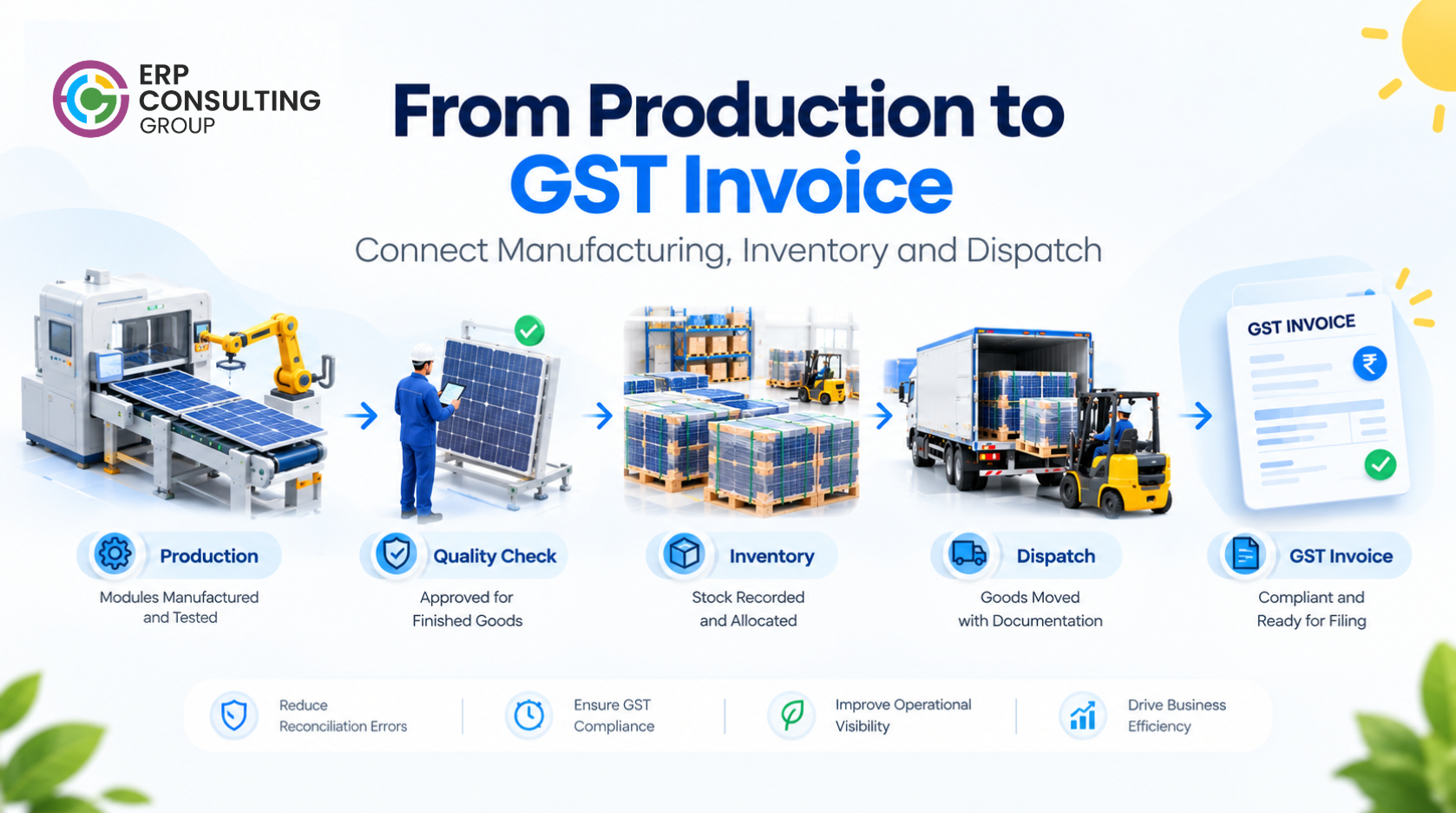
Sales Order → Production Work Order → Quality Clearance → Finished-Goods Inventory → Order Allocation → Dispatch Preparation → GST Invoice Validation → Accounting and GST Reporting
Each step should update or reference the relevant business record rather than creating an unrelated spreadsheet entry.
Step 1: Connect the sales order to production
The customer order should identify the product model, ordered quantity, agreed commercial terms and delivery requirements.
Production planning can then create the relevant work order and record the output against that requirement. If production serves multiple orders, the allocation process should make it clear which goods are intended for which customer.
Step 2: Record quality-approved output
Manufactured quantity and saleable quantity should not automatically be treated as the same number.
Quality records should identify accepted, rejected and pending-inspection units. Only the appropriate quantities should become available for allocation, according to the manufacturer's inventory and quality procedures.
Step 3: Maintain finished-goods inventory
The inventory record should show the relevant product, quantity, location and stock status. Where batch or serial-level tracking is used, the identifiers should remain linked to the corresponding product and stock movement.
This allows the warehouse to distinguish available inventory from stock already reserved for a customer or allocated to another order.
Step 4: Validate dispatch quantities
Before dispatch, the team should confirm that the goods, order, delivery destination and dispatch quantity agree.
For example, if a customer order is for 1,000 modules but the first shipment contains 500, the system should preserve the relationship between the original order, the first dispatch and the remaining balance. The invoicing treatment must then follow the actual transaction and applicable GST rules.
Step 5: Validate the GST invoice
Invoice preparation should use the appropriate customer, item, quantity, value and tax information from the relevant records.
The system should validate the invoice against the applicable GST requirements, including invoice numbering, HSN classification, place of supply, tax calculation and e-invoicing requirements where applicable.
Automation can reduce repeated data entry, but it does not replace the need to establish the correct tax treatment or review exceptional transactions.
Step 6: Reconcile reporting records
The completed invoice should remain linked to the relevant accounting entry and, where applicable, e-invoice and GSTR-1 records.
The GST Portal explains that e-invoice details reported through the IRP can be auto-populated into relevant GSTR-1 tables. Those records should still be reviewed, especially where changes, amendments or exceptions are involved.
6. Why Batch and Serial Traceability Matters Beyond Invoicing
A GST invoice primarily records the supply transaction. Production traceability answers a different question: which products were manufactured, which batch or serial identifiers belong to them, and where those products went?
For solar module manufacturers, connecting these records can support several operational needs:
- Order fulfilment: Confirm which products and quantities were allocated to a customer.
- Dispatch verification: Trace the goods recorded in dispatch documentation back to finished-goods inventory.
- Warranty support: Identify the relevant product and manufacturing history when a customer reports a problem.
- Quality investigations: Locate affected batches or serial-number ranges when a defect is identified.
- Audit readiness: Retrieve the records that explain the relationship between production, inventory, dispatch and sales.
These are operational benefits of a well-designed traceability process. They should not be confused with a claim that every GST invoice must contain every module serial number, or that batch-level traceability alone satisfies every applicable regulatory requirement.
The same principle applies to warehouse operations. Our guide to multi-site solar inventory and material tracking explains how linking material movements, stock locations and project allocations improves visibility and accountability.
For a manufacturer, the equivalent workflow connects finished modules with their batch or serial records, customer orders, dispatch documents and invoices.
For ALMM-related matters, manufacturers should separately verify the current MNRE order, applicable model and manufacturer listing, and relevant documentation requirements. GST invoicing controls and ALMM compliance controls may share supporting records, but they serve different legal and operational purposes.
7. How an ERP System Can Reduce Manual Reconciliation
An Enterprise Resource Planning (ERP) system can connect sales orders, production, quality, inventory, dispatch, accounting and invoicing within a coordinated workflow.
For example, when quality-approved modules enter finished-goods inventory, the system can make the eligible quantity visible for order allocation. When a dispatch is prepared, the relevant order and stock records can be checked before invoice finalisation. Once an invoice is issued, the corresponding financial records can be maintained alongside the original transaction references.
The exact automation depends on the system configuration, integrations, business rules and applicable tax requirements. A manufacturer should not assume that installing an ERP automatically makes every invoice compliant.
ERP Consulting Group works with Odoo-based business workflows. For solar manufacturers, the implementation objective should be to map how production, stock movements, dispatches and financial transactions currently work, identify where information is duplicated or lost, and configure the appropriate controls.
The priority is not simply to generate invoices faster. It is to make the invoice traceable to the underlying business transaction.
8. A Practical Checklist for Solar Panel Manufacturers
Before improving the invoicing workflow, review the following controls:
- Customer orders use consistent product codes and units of measure.
- Production output is distinguished from quality-approved output.
- Finished-goods inventory reflects accepted stock and its status.
- Batch or serial identifiers are linked to the relevant product records where used.
- Order allocations and partial dispatches are recorded consistently.
- Dispatch documents are checked against the actual movement of goods.
- GST invoices are validated against applicable statutory particulars and timing requirements.
- E-invoicing and e-way bill applicability is assessed for the transaction and taxpayer.
- Accounting entries and GST return data can be traced to their source invoices.
- Exceptions, amendments and credit or debit notes retain an auditable link to the original transaction.
- Manual reconciliation time and recurring mismatch types are measured.
A manufacturer can start with a small review of recent transactions. Select a sample of orders and trace each one from production output through quality clearance, stock allocation, dispatch, invoicing and accounting. Record where the chain breaks and how much manual investigation is required.
This creates a practical baseline for deciding which controls should be standardised or automated first.
Executive Summary
- Separate production from invoicing: Manufacturing milestones help manage operations, but GST invoice timing must follow the applicable legal requirements for the supply.
- Connect the records: Linking quality-approved output, inventory, order allocation, dispatch and invoicing helps identify and investigate discrepancies.
- Measure reconciliation effort: Consistent records, appropriate validation and connected workflows can reduce manual rework and improve transaction traceability.
Frequently Asked Questions
1. Should a GST invoice be generated as soon as solar modules finish production?
Not automatically. Production completion is an internal operational milestone. For taxable goods involving movement, Section 31 of the CGST Act generally requires the invoice before or at the time of removal; different circumstances may have different requirements. Manufacturers should apply the relevant GST provisions to the actual transaction.
2. Is production-linked billing the same as GST-compliant invoicing?
No. Production-linked billing can describe an internal workflow that uses production or order milestones to prepare billing records. GST compliance depends on the applicable rules governing the supply, invoice timing, required particulars and tax treatment.
3. Must every solar panel serial number appear on the GST invoice?
Rule 46 specifies the required tax-invoice particulars. It does not establish a universal requirement for every individual module serial number to appear on every invoice. Serial-level records may still be valuable for dispatch traceability, warranty support and quality investigations, and other applicable contractual or regulatory requirements should be checked separately.
4. How does e-invoicing help reduce reconciliation work?
For taxpayers and transactions covered by the mandate, e-invoicing creates an IRN and signed QR code through the IRP. Invoice details can also be auto-populated into relevant GSTR-1 tables. This can reduce duplicate entry, but incorrect source data and subsequent changes still need appropriate controls and review.
Connect Production to Financial Control
GST invoicing should not operate as an isolated activity at the end of manufacturing. When production, inventory, dispatch and finance share consistent records, teams can explain quantity differences, validate transactions and retrieve the supporting documentation more efficiently. ERP Consulting Group helps businesses evaluate and connect their operational workflows through Odoo consulting, implementation, customization and integration. Explore the wider Solar ERP workflow:The Complete Guide to Solar Business Management Software. To discuss your production-to-invoice process, contact info@erpconsulting24.com. |
Sources and References
- Central Board of Indirect Taxes and Customs (CBIC). Central Goods and Services Tax Act, 2017 - Section 31, tax invoice.
https://cbic-gst.gov.in/hindi/CGST-bill-e.html - CBIC. GST Invoice Rules - Rule 46, particulars of a tax invoice.
https://cbic-gst.gov.in/gst-invoice-rules.html - Goods and Services Tax Network (GSTN). E-invoicing Mandate - applicability and implementation timeline.
https://einvoice6.gst.gov.in/content/einvoice-mandate/ - GST Portal. GSTR-1 User Guide - outward-supply reporting and e-invoice data auto-population.
https://tutorial.gst.gov.in/userguide/returns/GSTR_1.htm - CBIC. Central Goods and Services Tax Rules, 2017 - Rule 138, information required before movement of goods and e-way bills.
https://cbic-gst.gov.in/pdf/10112020_CGST-Rules-2017-Part-A-Rules.pdf - Ministry of New and Renewable Energy (MNRE). Approved List of Models and Manufacturers (ALMM) - official orders, lists and related documents.
https://mnre.gov.in/en/approved-list-of-models-and-manufacturers-almm/
Editorial note: GST provisions, notifications, thresholds, exemptions and portal procedures can change. Verify the current applicable law and official guidance before using this article to make tax or compliance decisions. This article provides general information and is not a substitute for professional tax advice.
 Recent Posts



 Free Consultation