
For a solar panel manufacturer, compliance does not end when a module leaves the production line.
The plant also needs to prove where its components came from, whether those components meet applicable approval requirements, what was actually produced, and what was actually sold or dispatched when preparing a PLI claim.
The information needed for this already exists inside most manufacturing operations -purchase orders, vendor certificates, BOMs, production records, batch details, and dispatch data. The problem is that these records often sit across different spreadsheets, systems, and departments.
That creates a compliance gap.
A connected ERP workflow can bring these records together so manufacturers can trace approved components, production batches, and dispatch data from one operational system.
Why ALMM & PLI Compliance Is an Operational Challenge
ALMM and PLI requirements affect different parts of the manufacturing process, but the data behind them is closely connected.
On one side, procurement needs to verify that incoming components meet the required approval and certification conditions.
On the other, finance and management need production and sales information that accurately reflects what was manufactured and dispatched when preparing incentive claims.
A disconnected process can look like this:
Purchase Order → Vendor Certificate → Goods Receipt → Production Record → Dispatch Record → PLI Claim
Each stage may exist in a different file or system.
The result is repeated reconciliation, manual checking, and greater difficulty proving how one record connects to another.
For a growing manufacturing plant, the question is no longer simply:
“Do we have the document?”
It becomes:
“Can we prove which approved component went into which production batch, what was produced, what was dispatched, and how those numbers support the claim?”
The PLI Side: Production and Dispatch Data Must Match
PLI reconciliation can become more complicated than it appears because the claim depends on verified production and sale volume.
The finance team preparing a claim needs numbers that match what actually moved through production and dispatch - not only what was planned or recorded in a production schedule.
When production data sits separately from sales and dispatch records, the reconciliation process often becomes a manual end-of-period exercise.
Teams may have to compare:
- Production quantities
- Finished-goods records
- Sales orders
- Dispatch records
- Customer invoices
- Product or module details
- Claim-related documentation
The problem is not necessarily a lack of data.
The problem is that the data is not connected.
A connected manufacturing ERP can create a clearer relationship:
Production → Finished Goods → Sales Order → Dispatch → Invoice → PLI Reconciliation
This gives finance and management a more reliable operational trail when preparing incentive-related records.
The Incoming Side: Tracking ALMM & BIS-Approved Components
Compliance also begins before production.
A manufacturer may source cells, EVA, backsheets, junction boxes, glass, frames, and other components from multiple vendors. Each incoming purchase can carry its own documentation, certification information, supplier details, and approval status.
If these records are maintained separately, procurement may verify a supplier when the purchase is made but have difficulty confirming the status later when the material is actually received or used.
The risk becomes greater when approved lists and certification requirements change.
A stronger workflow is to connect the supplier, component, purchase order, approval information, and goods receipt.
For example:
Approved Vendor → Purchase Order → Component → Goods Receipt → Batch → Production
This gives the plant a traceable record instead of relying on a certificate stored in a separate folder.
What a Connected Compliance Workflow Should Track
A practical system does not need to create another standalone “compliance database.”
Instead, compliance information should become part of the records the manufacturing team already uses.
1. Approved Vendor & Component Records
Procurement should be able to associate approved-vendor and certification information with the relevant component.
This can help teams verify requirements before material reaches production.
2. BOM & Component Traceability
The BOM should identify which components are required for a finished module and maintain the relationship between the finished product and the materials consumed.
This becomes especially useful when production involves multiple batches or component suppliers.
3. Batch-Level Production Records
Production records should identify what was manufactured, when it was manufactured, and which materials were used.
This creates a traceable link between incoming material and finished modules.
4. Dispatch & Sales Records
Finished products should move from production into inventory and then into sales and dispatch records without requiring the same information to be entered again.
This gives finance a stronger basis for reconciling production and sales volumes.
5. PLI Claim Preparation
Instead of rebuilding the numbers at the end of a reporting period, finance can work from connected production, inventory, sales, and dispatch records.
The workflow becomes:
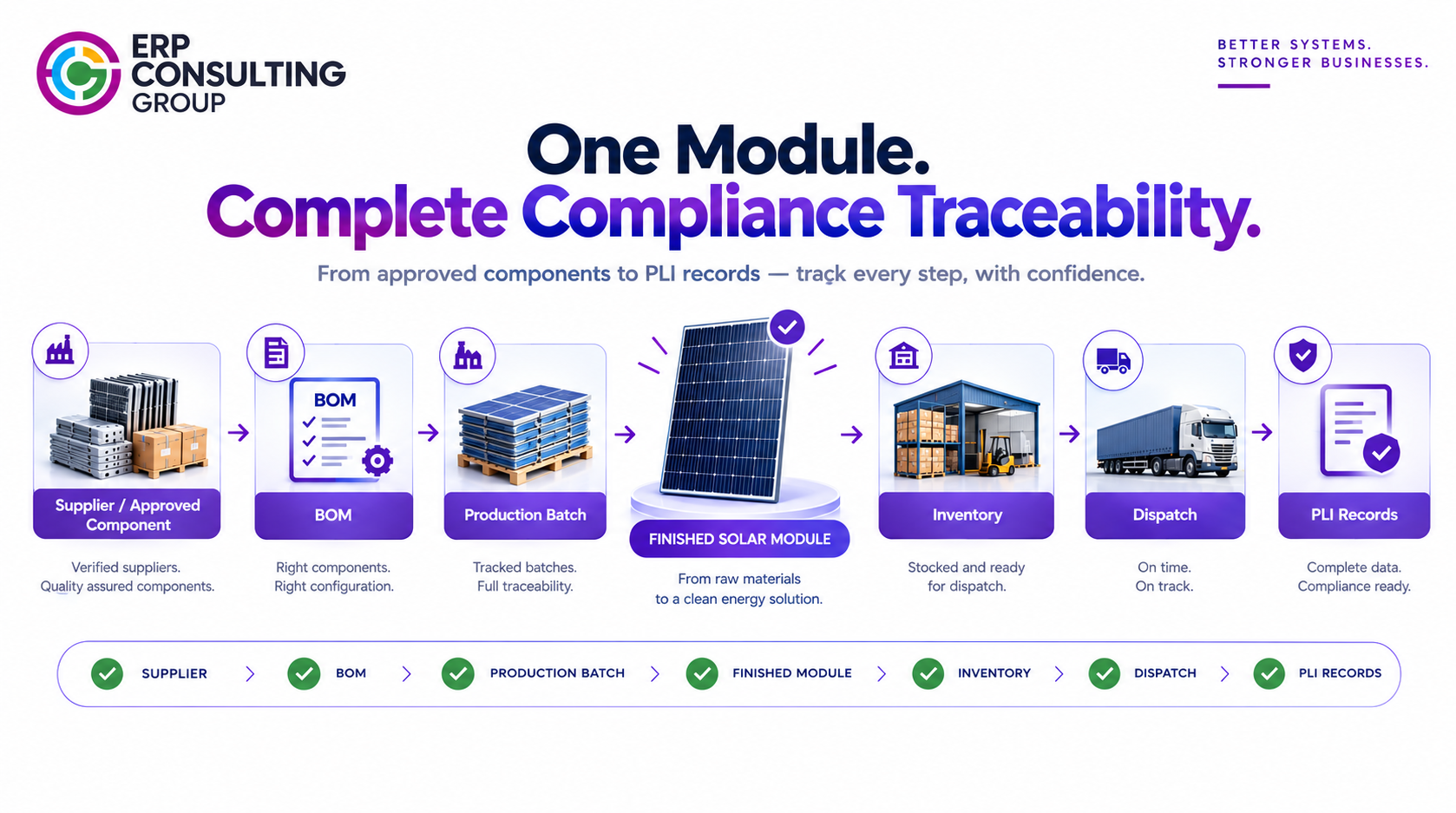
Approved Components → Production Batch → Finished Modules → Sales → Dispatch → Claim Data
The objective is not simply to store more documents.
It is to make the relationship between those documents visible.
The Old Way vs. a Connected Manufacturing ERP
Compliance Activity | Disconnected Process | Connected ERP Workflow |
Vendor verification | Certificates stored separately | Approval information linked to vendor/component |
Purchase | PO and compliance documents maintained separately | Component and supplier records connected to purchase |
Goods receipt | Material received without complete traceability | Receipt linked to component and supplier records |
BOM | Component information maintained separately | BOM connected to production records |
Production | Batch information recorded independently | Batch linked to consumed materials |
Finished goods | Production and inventory reconciled manually | Production automatically updates inventory |
Dispatch | Dispatch data maintained separately | Finished goods linked to sales and dispatch |
PLI preparation | Production and sales reconciled manually | Connected records support reconciliation |
Audit preparation | Documents collected from multiple sources | Traceable records available through the workflow |
Management visibility | Compliance status checked across files | Centralized operational view |
The difference is not simply automation.
It is traceability.
How RENEWvate Fits Into the Manufacturing Workflow
RENEWvate is designed around the idea that solar manufacturing processes should not operate as isolated departments.
Procurement, inventory, manufacturing, sales, dispatch, and finance can work from connected records rather than maintaining separate versions of the same information.
For compliance-related workflows, this means the ERP can connect:
Supplier → Component → BOM → Production → Batch → Inventory → Sales → Dispatch → Finance
This is important because compliance information is rarely useful when it exists by itself.
A vendor certificate matters because it relates to a component.
The component matters because it is part of a BOM.
The BOM matters because it is used in production.
The production record matters because it creates finished goods.
The finished goods record matters because those products are eventually sold and dispatched.
That is where an ERP becomes more useful than a standalone compliance tracker.
For a broader overview of how ERP connects the key processes across solar manufacturing, explore our Solar Manufacturing Guide.
Executive Summary
- Strengthen component traceability: Connect suppliers, approval information, purchases, BOMs, and production batches so manufacturers can identify what went into each finished product.
- Simplify PLI reconciliation: Connect production, finished goods, sales, dispatch, and finance records instead of rebuilding claim data manually at the end of a reporting period.
- Build compliance into the workflow: Treat ALMM, BIS, production, and PLI-related information as connected manufacturing data rather than separate compliance files.
A solar manufacturing plant does not necessarily need another standalone compliance tool.
It needs the information it already generates to stay connected.
When procurement can verify components, production can trace batches, dispatch can confirm what actually left the plant, and finance can reconcile the same records, compliance becomes part of the manufacturing workflow instead of an end-of-period exercise.
Frequently Asked Questions
How often does the ALMM List change?
The ALMM List is updated periodically by MNRE. Manufacturers should therefore treat approval status as information that needs regular verification rather than a one-time supplier check.
The exact checking frequency should follow the applicable regulatory requirements and the manufacturer's internal compliance process.
Can PLI claims be prepared without a connected ERP system?
Yes. Many manufacturers can prepare claims using spreadsheets and separate production, sales, and finance records.
The tradeoff is the amount of manual reconciliation involved.
When production and dispatch information are maintained separately, teams have to repeatedly validate whether the numbers match. A connected ERP reduces this reconciliation work by keeping the underlying operational records linked.
Can an ERP replace ALMM or BIS verification?
No.
An ERP can help record, track, and connect approval and certification information, but it does not replace the manufacturer's responsibility to verify the applicable regulatory requirements or the validity of certifications.
The ERP should support the compliance process rather than be treated as the compliance authority.
What happens if a component's approval or certification status changes?
The impact depends on the applicable requirement and when the material was purchased, received, consumed, or used in production.
A connected system makes the affected supplier, component, purchase, batch, and production records easier to identify and review.
This is much more useful than discovering the issue later through a manual document search.
What This Means for Your Plant?
If ALMM documentation, component verification, production records, or PLI claim preparation currently depend on spreadsheets and manual reconciliation, the issue may not be the amount of data your plant has. It may be the way that data is connecte Understand how solar manufacturers can connect ALMM, BIS, production, inventory, dispatch, and PLI records to improve compliance traceability and simplify incentive claim preparation. d. ERP Consulting Group can help map your manufacturing workflow and identify where compliance, production, inventory, and finance records can be connected through an Odoo-powered RENEWvate setup. Start with your manufacturing process - not another disconnected compliance tracker. Email: info@erpconsulting24.com |
 Recent Posts



 Free Consultation