Solar manufacturing is scaling, but the operational challenge is not just producing more modules. More production means more materials, SKUs, production records, quality checks, serial numbers, inventory movements, dispatches and financial transactions to keep aligned.
When these activities are managed through Excel, WhatsApp, accounting software and separate production records, each department may have its own version of what is happening.
The result is familiar: production knows one number, inventory another, finance another, and management spends time reconciling them.
An ERP system brings these workflows together.
This guide explains what ERP should actually manage for a solar panel manufacturer, where generic manufacturing ERP may fall short, and what to look for when evaluating a system.
Why Solar Manufacturing Needs More Than a Generic Manufacturing ERP
A standard manufacturing ERP can manage core processes such as:
- Bills of materials
- Production orders
- Procurement
- Inventory
- Quality
- Sales
- Accounting
Solar manufacturing adds another layer of operational requirements around traceability, compliance, serialization and long-term warranty responsibility.
A finished module is not simply a quantity of stock. The manufacturer may need to know:
What materials went into it? → When was it produced? → Which quality checks were completed? → Where was it dispatched? → Which customer received it?
That makes the connection between manufacturing data and product history especially important.
The goal is not necessarily to use a completely different type of ERP. It is to have a manufacturing system configured around the actual workflow of a solar manufacturer.
The Solar Manufacturing Workflow
The easiest way to understand the role of ERP is to follow a module through the business:
Customer Order → Material Planning → Procurement → Material Receipt → Production → Quality → Serialisation → Finished Goods → Dispatch → Invoice → Warranty
In a disconnected setup, each stage may live in a different spreadsheet, application or department.
In a connected ERP, information can move with the product.
For example, a confirmed order can create production demand. Production demand can influence material requirements. Material consumption becomes part of the production record. Completed modules enter finished-goods inventory. Dispatch updates stock and feeds the commercial process.
That connection is where ERP creates value.
The Solar Manufacturing ERP Content Series
The Solar Manufacturing ERP content series explores the key operational areas where manufacturers need connected visibility from compliance and traceability to inventory, finance, systems, production scheduling and material planning.
1. Managing ALMM, BIS & PLI Compliance Through ERP
Compliance cannot be completely separated from manufacturing operations.
ALMM, BIS requirements and PLI-related processes can involve information connected to products, production, suppliers, sales and documentation. An ERP can help keep relevant operational records connected so that compliance information is based on actual manufacturing and business data rather than being reconstructed manually later.
As production grows, maintaining accurate and retrievable records becomes increasingly important.
2. Maintaining Product Traceability from Production to Customer
Solar modules can have long operating and warranty lives, making traceability important well beyond the production line.
A connected system can establish a relationship between:
Material Batch → Production Order → Quality Check → Module Serial Number → Dispatch → Customer
If a quality issue appears later, the manufacturer can investigate the relevant production and product history instead of searching across multiple records. The same information can support warranty management years after the original sale.
3. Connecting GST, Invoicing & Manufacturing Finance
Manufacturing creates financial information throughout the operational process. Materials have costs, production consumes those materials, finished products are sold, and dispatch leads to invoicing.
A connected workflow looks like:
Purchase → Material Cost → Production → Finished Goods → Dispatch → GST Invoice → Accounting
This helps finance work with information generated from operations rather than repeatedly rebuilding the manufacturing story from separate records.
The key question becomes: Do we know what was produced, what it cost, what was sold and what has been invoiced?
4. Managing Materials from Raw Stock to Finished Modules
Inventory is more than knowing how many units are physically present.
A manufacturer needs visibility into what is available, reserved, allocated to production, in transit, consumed or ready for dispatch. A connected inventory workflow can follow materials from supplier → warehouse → production → finished goods → dispatch.
This reduces the need to reconcile separate stock sheets whenever production or management needs an updated picture.
5. Tally vs Manufacturing ERP: Knowing When to Move Beyond Accounting Software
Many manufacturers already use Tally or another accounting-focused system. The question is not whether accounting software is useful. The question is whether it is enough for the operational complexity of the plant.
Requirement | Accounting-focused setup | Connected Manufacturing ERP |
Accounting & GST | Strong | Strong |
Purchasing | Yes | Connected to planning and inventory |
Inventory | Available | Connected to production and procurement |
Production planning | Often separate | Integrated |
MRP | Usually separate | Integrated |
Traceability | May require additional processes | Connected to production |
Quality | Often separate | Connected to manufacturing |
Dispatch visibility | Manual reconciliation | Connected to orders and inventory |
Manufacturing cost visibility | Requires reconciliation | Connected to operational data |
For a smaller operation, an accounting-focused setup may continue to work. The tipping point comes when production, inventory, compliance and finance increasingly depend on separate tools and manual reconciliation.
6. Keeping Production Scheduling and Dispatch in Sync
Production and dispatch should not operate as two separate conversations.
A useful connected workflow is:
Customer Order → Production Plan → Production Completion → Quality Clearance → Finished Goods → Dispatch → Invoice
This gives sales, production, warehouse and finance a shared view of order status. Instead of separately checking what has been produced, what has passed quality, what is ready to ship, what has already been dispatched and what should be invoiced, the information can remain connected through the same order and product records.
7. Connecting Demand, Materials & Production with MRP
Production planning starts with knowing what needs to be produced and whether the required materials are available.
An ERP can connect customer demand, production orders, bills of materials, current stock and procurement requirements:
Demand → Production Plan → BOM → Material Requirement → Stock Check → Procurement → Production
This helps planners identify material shortages before they become production stoppages.
MRP provides a structured way to connect demand, material availability and production requirements instead of relying on separate calculations across spreadsheets.
What Happens When These Systems Are Disconnected?
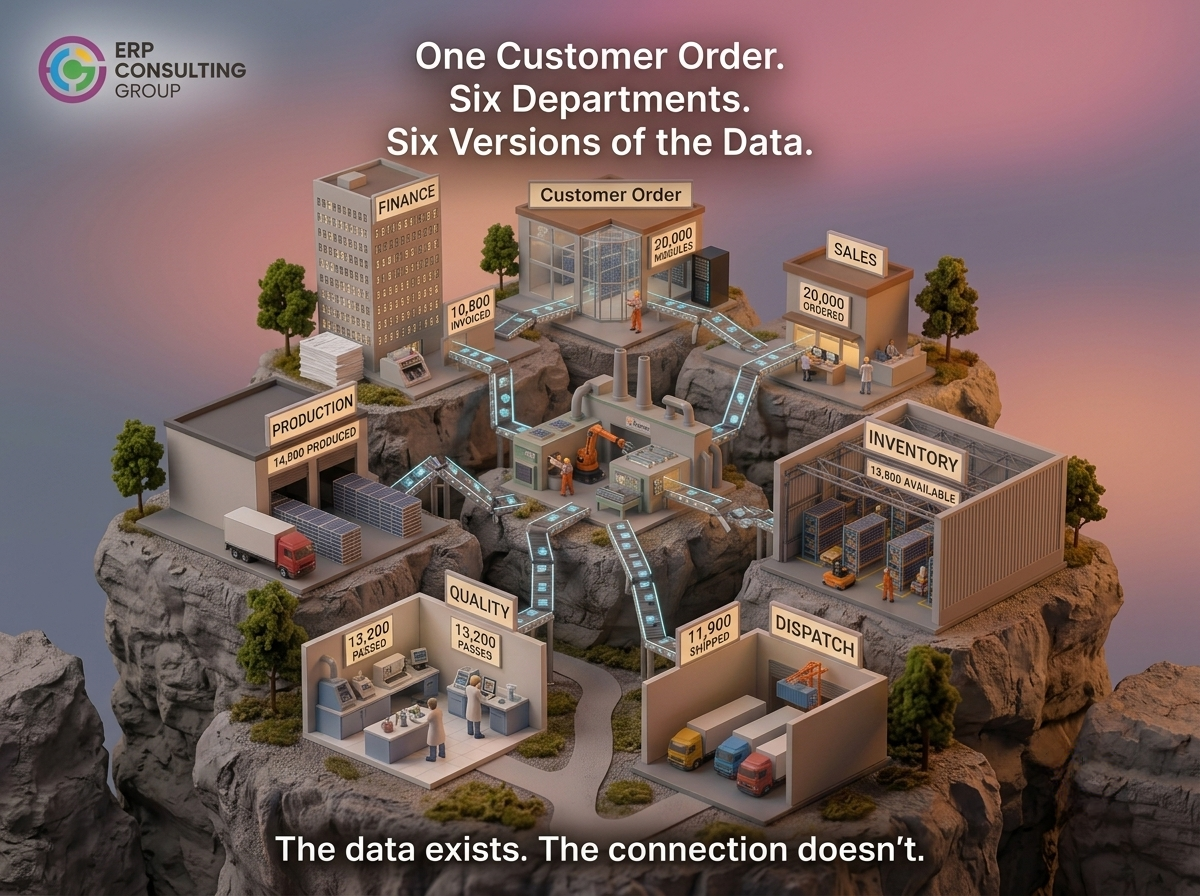
Consider a customer order for 20,000 modules. Sales may have the confirmed order while production maintains the schedule, stores manages inventory records, quality maintains inspection information, dispatch tracks finished goods and finance handles the invoice. All the information exists, but when these systems are disconnected, someone still has to connect the pieces.
As production grows, this makes seemingly simple questions time-consuming: Do we have enough material for the next production run? How much of the order is actually ready? Which serial numbers were dispatched? Does production match dispatch? Has the corresponding invoice been raised? Can we trace a module back to its production history?
ERP does not remove the need for people to manage these processes. It removes much of the manual reconstruction between them.
What Should You Look for in Manufacturing ERP Software?
Don't start with a list of features. Start with the workflow.
A suitable system should be able to connect:
Orders
Can customer demand flow into production planning?
Materials
Can the system identify requirements against available and incoming stock?
Production
Can BOMs, production orders and material consumption be tracked?
Quality & Traceability
Can batches, serial numbers and quality records remain connected?
Finished Goods & Dispatch
Can completed modules move into available inventory and then into dispatch?
Finance
Can purchasing, production, sales and invoicing contribute to one financial picture?
After-Sales
Can product and customer history remain available for future warranty requirements?
The strongest ERP evaluation is therefore not:
“How many modules does this software have?”
It is:
“Can this system follow our product and our order from beginning to end?”
When Has a Solar Manufacturer Outgrown Disconnected Systems?
There is no single production-volume number that determines when ERP becomes necessary.
A better indicator is operational complexity.
ERP becomes worth evaluating when questions such as these require multiple people or systems to answer:
- What is available in stock?
- What is committed to production?
- What is currently being produced?
- Which finished modules are ready for dispatch?
- Which products were sent to a particular customer?
- What did a particular production run consume?
- What information does finance need from operations?
If the answer requires checking several spreadsheets and reconciling different versions of the data, the business may have outgrown its current system structure.
How RENEWvate Fits the Solar Manufacturing Workflow
RENEWvate is built on Odoo and positioned for renewable-energy businesses, including solar manufacturing.
The focus is not simply on providing separate Manufacturing, Inventory, Purchase, Sales or Accounting modules.
The value comes from configuring those capabilities around the manufacturer's actual workflow.
A typical implementation approach is:
Understand → Map → Configure → Customize → Integrate → Migrate → Support
This allows the system to be designed around existing processes rather than forcing the business into a generic workflow.
For a manufacturer evaluating ERP, that process understanding is just as important as the software itself.
Executive Summary
1. ERP connects the entire manufacturing journey.
From material planning and production to traceability, dispatch and finance, the value lies in connecting the workflows.
2. Solar manufacturing needs more than basic production management.
Traceability, compliance, serialisation and long-term product history can become critical as operations scale.
3. Choose ERP around the workflow, not the feature list.
The right system should help the business follow an order and a product from beginning to end.
Frequently Asked Questions
What is ERP in the manufacturing industry?
ERP is a connected business management system that brings functions such as procurement, inventory, production, quality, sales and finance into one workflow.
For solar manufacturing, it can also support traceability, compliance-related records and warranty history.
Why does a solar panel manufacturer need ERP?
Because production, materials, quality, inventory, dispatch and finance are closely connected. ERP helps maintain visibility across those processes instead of managing each one separately.
What is the difference between generic manufacturing ERP and solar manufacturing ERP?
The foundation may be similar, but solar manufacturing can require additional workflows around module traceability, serialization, compliance and long-term warranty management.
Is Tally enough for a solar manufacturing company?
It can be sufficient for accounting-focused requirements. The question is whether the business also needs production, MRP, inventory, quality and traceability connected to finance.
Can ERP support solar module traceability?
Yes. A suitably configured manufacturing ERP can connect material batches, production orders, quality checks, serial numbers, finished goods and customer dispatch information.
When should a solar manufacturer implement ERP?
When disconnected systems begin making production planning, inventory control, traceability, dispatch or financial reconciliation difficult to manage efficiently.
Is Odoo suitable for solar panel manufacturing?
Odoo provides manufacturing, inventory, purchase, sales, accounting and other ERP capabilities. Its suitability depends on how those capabilities are configured around the manufacturer's actual workflow and industry requirements.
How ERP Consulting Group Can Help
Every manufacturing operation has its own production process, product mix, supply chain and system maturity. ERP Consulting Group can help evaluate and implement an Odoo-based ERP approach around those requirements from process mapping and implementation to customization, integration, migration and ongoing support. Want to understand where ERP could fit into your current manufacturing workflow? Reach us at info@erpconsulting24.com for a practical discussion about your setup. |
 Recent Posts
 Free Consultation