A property sale passes through a dozen hands before anyone gets paid. Each handover is a chance to lose a lead, miss a compliance check or argue over a commission split. This guide shows where those leaks happen and how to close them. For the product overview, see the Real Estate Broker Solution.
Most brokerages do not lose money because they lack buyers or stock. They lose it in the gaps between systems: the portal inbox, the agent's phone, the compliance folder, the offer spreadsheet and the finance team's commission sheet. Each one holds part of the deal, and none of them talks to the others.
The cost rarely shows up as one big failure. It shows up as a hot lead that waited four hours for a call back, a transfer delayed because an Emirates ID expired, or a month-end argument over who brought in the buyer. Each one is small. Together they decide whether the brokerage grows or stalls.
Why a Brokerage Deal Is Structurally Different
A standard sales pipeline has one customer and one product. A property deal has at least two clients (the seller and the buyer), one physical unit, and often two agents, one on each side. It also carries regulatory steps that most industries never deal with:
- Two linked pipelines. The listing side (seller) and the enquiry side (buyer) move separately, but meet on the same property and the same offer.
- Mandatory checks before money moves. Identity verification, an AML risk assessment and signed agency forms are required before the deal can proceed.
- Third-party fees on every deal. DLD transfer fees, developer or owners' association NOCs and brokerage fees all depend on the final price.
- Split payouts. The brokerage fee is shared between the listing and enquiry sides, and each side has its own agent percentage.
A generic CRM can hold the contacts. It cannot hold the property, the permits, the KYC file, the fee breakdown and the commission split in one connected record. So brokerages fill the gaps with spreadsheets and chat apps, and the leaks start there.
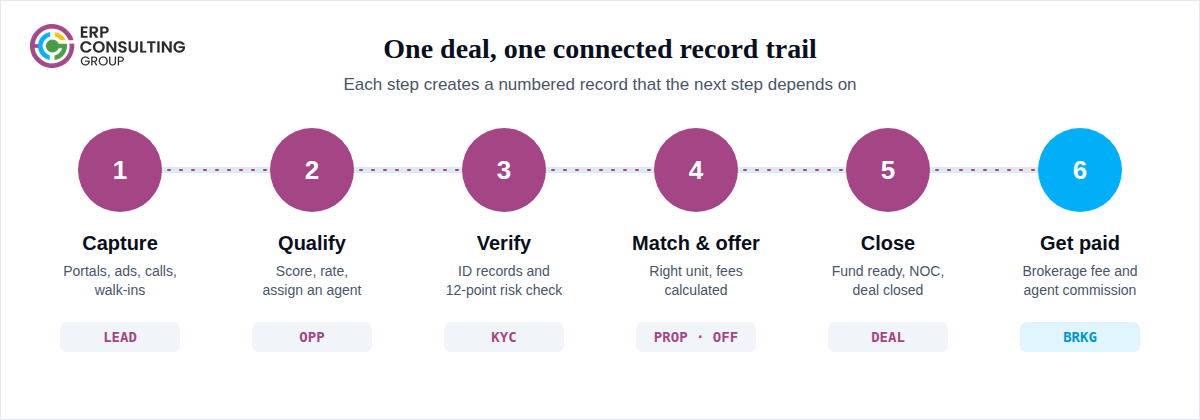
Every stage of the deal creates a numbered record that the next stage depends on.
Where the Leaks Actually Happen
- Leads scattered across channels. Enquiries arrive from Property Finder, Bayut, Dubizzle, digital ads, call centers, WhatsApp and walk-ins. Some are never logged, and nobody can say which channel actually produces deals.
- Slow and duplicated follow-up. The same buyer enquires through three portals, two agents call them, and the hottest leads still wait hours for a response. A structured approach to real estate lead and sales management can help brokerages improve lead ownership, follow-up consistency, and visibility across the sales pipeline.
- Property details retyped at every step. Size, rooms, address and permit numbers are entered again on each lead, each offer and each deal sheet, with a new chance for a mistake every time.
- Compliance done on paper. Passport and Emirates ID copies sit in email inboxes. Risk assessments are done from memory, if they are done at all.
- Offers and fees worked out by hand. Sellers do not know their net figure, buyers are surprised by the DLD fee, and counter-offers are lost in chat threads.
- Commissions rebuilt at month end. Finance reconstructs splits from messages, and agents get paid on fees that have not been collected yet.
The Business Impact
Each leak has a direct cost. Slow responses hand the buyer to a competitor who answered first. Duplicate effort means two agents spend time on one client while other leads go cold. Missing KYC or an expired ID can hold up a transfer at the last stage, after weeks of work. And commission disputes are a frequent source of friction that can push good agents to leave, taking their client relationships with them.
There is also a management cost. Without one system, an owner cannot answer basic questions quickly: which lead source brings the most deals, which agent converts best, and how much the brokerage fee is due next month.
For a broader look at this challenge, explore how real estate firms can reduce operational costs and close deals faster with Odoo ERP by connecting their business workflows.
A Worked Example: One AED 2.4M Secondary Sale
Take a single apartment sale with a final price of AED 2,400,000, a 2% brokerage fee shared equally between the listing and enquiry sides, a 4% DLD transfer fee, and agents on a 50% split of their side's fee. The figures are illustrative.
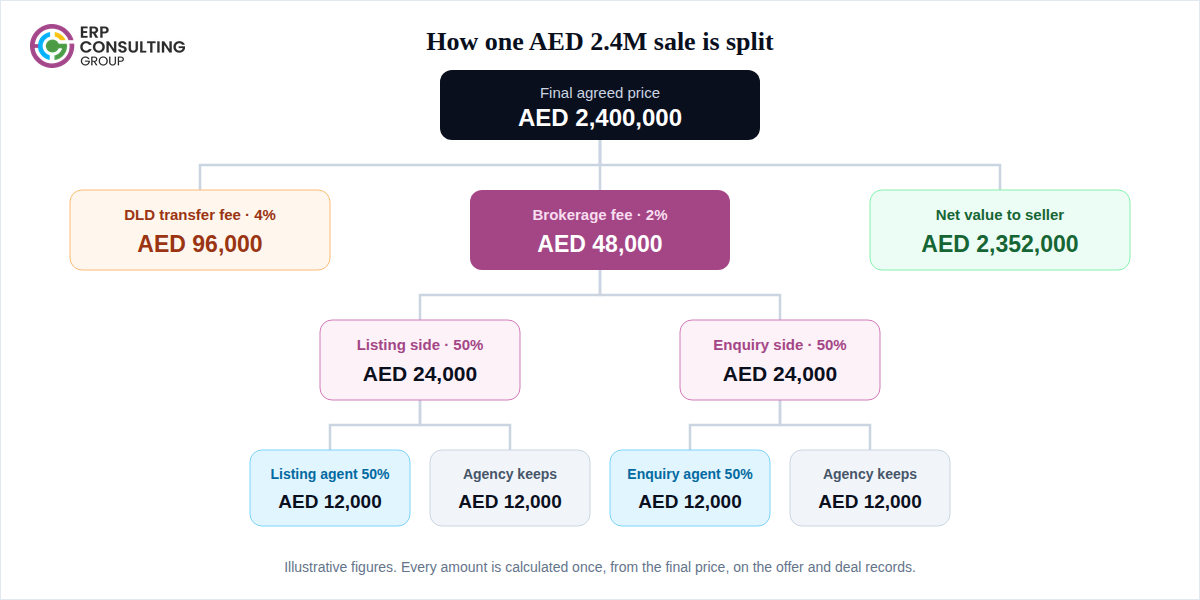
How the fee on a single sale is split between the agency and the agents on each side.
Item | How it's calculated | Amount (AED) |
Final offer | Agreed price | 2,400,000 |
Brokerage fee | 2% of final price | 48,000 |
Net value to seller | Offer minus brokerage | 2,352,000 |
DLD transfer fee | 4% of final price | 96,000 |
Listing side's share of fee | 50% of brokerage | 24,000 |
Listing agent's commission | 50% of listing side | 12,000 |
Enquiry agent's commission | 50% of enquiry side | 12,000 |
None of these numbers is hard to work out. The problem is that they are worked out several times: once when the offer is drafted, again when the price changes in negotiation, again on the deal sheet, and again by finance at month end. If the final price drops by AED 50,000 after a counter-offer and one spreadsheet is not updated, every downstream figure is wrong, including both agents' commissions.
Connecting sales and finance processes through Odoo accounting features can help businesses maintain consistent financial records and reduce repeated manual calculations.
Common Mistakes That Make This Worse
- Calculating fees on the asking price instead of the final agreed price.
- Recording the brokerage as one figure, without separating the listing and enquiry sides.
- Paying agent commission when the deal closes rather than when the brokerage fee is actually received.
- Keeping instalment payments of the fee in a separate sheet from the deal they belong to.
Why Compliance Breaks Down Under Deal Pressure
Real estate is treated as a high-risk sector for money laundering, and regulators expect a documented identity check and risk assessment for every client. The difficulty is timing. KYC is most likely to be skipped exactly when a deal is moving fast, which is also the case an auditor is most likely to look at.
A risk assessment done properly covers far more than a passport copy. The Broker Solution scores 12 indicators, including:
- Politically exposed persons (PEPs) and sanctions risk
- Clients from, or transactions involving, high-risk countries
- Cash payments above AED 55,000
- Payments involving virtual assets or crypto
- Third-party payers or a power of attorney
- Clients onboarded without meeting face to face
Each assessment is classified automatically as Low, Medium or High risk, with the analyst's approval recorded. The important change is not the checklist itself. It is making the check a gate: a lead cannot become an opportunity until its KYC record and risk assessment are complete.
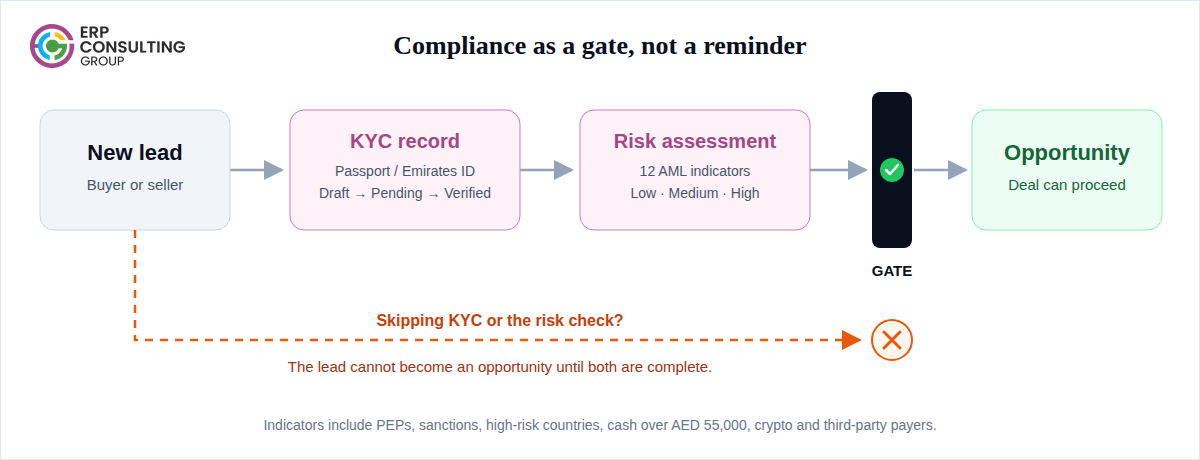
The lead only becomes an opportunity once the KYC record and the risk assessment are complete.
Reminders get ignored. Gates do not. A reminder that KYC is outstanding competes with every other notification an agent receives. A gate that blocks the next stage turns compliance into part of the sales process rather than a task after it.
Building a Connected Lead-to-Commission Workflow
The fix is a single system in which each step creates a numbered record that the next step depends on. Nothing moves forward with something missing, and nothing has to be typed twice.
1. One Lead Inbox with Source Tracking
Every lead is captured with its source and sub-source, so the brokerage can see which portals and campaigns actually pay. Leads are scored from critical to minimal, rated hot or cold, checked for duplicates and assigned to agents by team and workload. Lost leads are recorded with a reason, so managers can see where business is slipping. Read more: Why Portal Leads Go Cold.
2. A Property Master That Feeds Every Record
Each property has a single master record containing its specifications, photos, owner details, and RERA, Trakheesi, and title deed numbers. Properties move through a defined lifecycle: New, Published, Reserved, and Sold. When an agent selects a property on a lead, its details are populated automatically. Each portal listing has a tracked status, such as Draft, Live, Sold, or Failed. Automated XML feed synchronisation with property portals is available as an add-on.
3. Compliance Gates, Not Compliance Reminders
Identity documents such as passports and Emirates IDs are stored against the client with issue and expiry dates and a Draft → Pending → Verified/Rejected workflow. The 12-point risk assessment sits on the same lead. Required documents are listed as a checklist, with contract dates recorded.
4. Offers and Deals That Calculate Themselves
An offer links the buyer, the seller and the property, and calculates the brokerage, the DLD fee and the seller's net value automatically from the final price. Approved offers become deals that move through Fund Ready, NOC Applied, NOC Issued and Deal Closed, so managers can see exactly where each transaction is waiting.
5. Commission Ledgers Tied to the Deal
Brokerage and agent percentages are set for the listing side and the enquiry side of each deal. The brokerage record tracks the total fee, due date and instalments received, and commission logs track each agent's payout by month with pending, paid or cancelled status. Invoicing through Odoo Accounting is available as an add-on.
6. One System for Every Branch and Currency
Many brokerages run more than one branch or brand. Each one keeps its own leads, listings, deals and fees separate, while management can still see the whole group in one place. Each company works in its own currency, so a group with offices in different markets reports every deal in the right currency. Agents work from any browser or from their phone, so the same record follows the deal from the office to the viewing.
See Your Own Deal Flow on One Platform
Book a free 30-minute walkthrough. We will run a sample deal from enquiry to commission and show how your leads, listings and payouts would work in the Broker Solution. Book a free demo or explore the features.
Disconnected Brokerage vs a Connected Workflow
Stage | Disconnected (inbox, Excel, WhatsApp) | Connected (Broker Solution) |
Lead capture | Spread across portal inboxes and phones | One inbox with source, score and owner |
Property data | Retyped on every lead and offer | Filled in from the property master |
KYC & AML | ID copies in email, risk judged by feel | Verified ID records, 12-point risk score, gate before opportunity |
Offers | Fees calculated by hand on each revision | Brokerage, DLD fee and seller net calculated automatically |
Deal progress | Status known only to the agent | Deal stages from Fund Ready to Deal Closed |
Commissions | Rebuilt from chat at month end | Per-side splits and monthly commission logs |
Management view | A week of spreadsheet work | Pipeline, source and commission reports |
Executive Summary
- Brokerages rarely lose money for lack of buyers or stock. They lose it in the handovers between disconnected tools.
- A property deal has two linked pipelines, mandatory compliance steps, price-based fees and split commissions, which a generic CRM does not model.
- The biggest leaks are scattered leads, retyped property data, paper KYC, hand calculated offers and month-end commission rebuilding.
- Compliance works best as a gate in the workflow, not as a reminder after it.
- When every step creates a numbered record that the next step depends on, fees and commissions are calculated once, from the final price, and everyone works from the same figures.
Deep-Dive FAQ
Is a generic CRM enough for a real estate brokerage?
A generic CRM handles contacts and a sales pipeline, but not property records, permit numbers, KYC and AML checks, offers with DLD and brokerage fees, or split commissions. Brokerages end up running those parts in spreadsheets, which is where most of the leaks happen.
Can compliance checks really be enforced without slowing agents down?
Yes. When KYC records and the risk assessment are captured on the lead itself, the check becomes one step in the agent's normal workflow. A compliance gate simply stops the lead from becoming an opportunity until those steps are complete.
How are agent commissions calculated?
Brokerage and agent commission percentages are set separately for the listing side and the enquiry side of each deal. The system calculates the amounts from the final deal price and logs them by month with pending, paid or cancelled status.
Does the platform work outside the UAE?
Yes. It ships with UAE rules built in (DLD, RERA, Emirates ID, AML), and stages, documents and fees can be configured for other markets.
Can we bring our existing leads and listings across?
Yes. Data from Excel, Google Sheets or an existing CRM is migrated as part of onboarding, so the team starts with a complete database.
Do agents need to be at a desk to use it?
No. It runs in any modern browser and in the Odoo mobile app, so agents can update leads and schedule viewings from the field.
Ready to Connect Your Real Estate Brokerage Workflows?
When leads, property records, compliance checks, deal fees, and agent commissions sit across separate tools, small gaps can turn into costly delays. ERP Consulting Group helps businesses connect their processes through Odoo ERP, improving visibility from the first enquiry to deal closure and commission tracking. Want to see how a connected workflow could work for your brokerage? Contact ERP Consulting Group to discuss your business requirements. Email: info@erpconsulting24.com |

 Recent Posts



 Free Consultation