
A solar module’s serial number identifies the product. But for a manufacturer, the real value of that number depends on what it can retrieve.
Can the quality team identify the module’s flash-test result? Can production trace it to the relevant manufacturing batch? Can dispatch confirm which customer order and pallet contained it? And, where domestic-content verification applies, can the manufacturer retrieve the relevant cell-to-module records?
These are not simply documentation questions. They test whether manufacturing, quality, inventory and dispatch records remain connected after a module leaves the production line.
For solar manufacturers supplying large orders, serial-level traceability means being able to reconstruct the history of an individual module, not merely locate a spreadsheet containing its serial number.
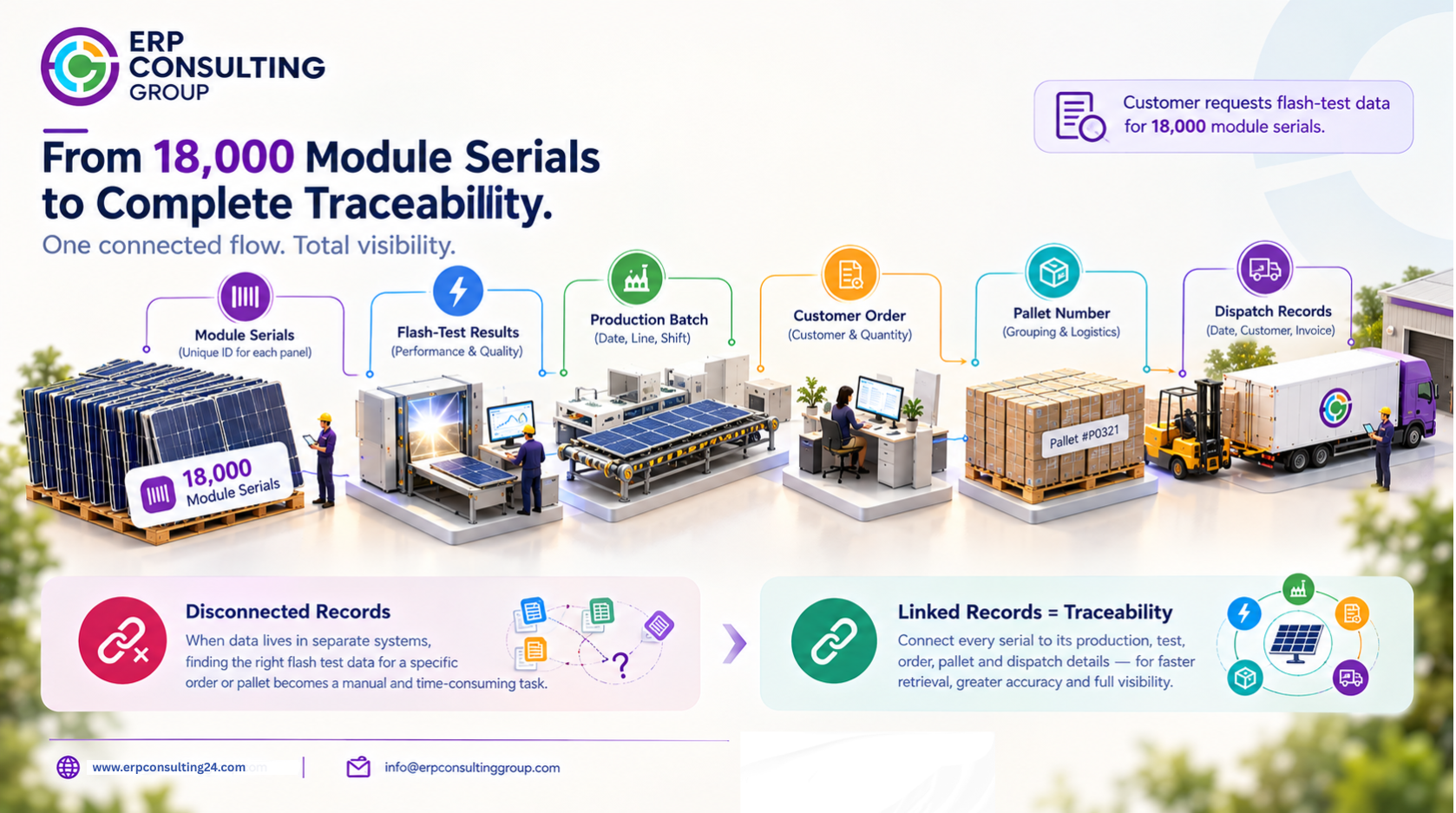
The 18,000-Serial Challenge
Illustrative scenario: connecting 18,000 solar module serials to their production, test, order and dispatch records.
ALMM and DCR: What Manufacturers Need to Distinguish
ALMM and Domestic Content Requirement (DCR) are related to solar module eligibility and domestic-content verification, but they address different questions.
ALMM List-I identifies eligible solar PV module models and manufacturers. List-II covers solar PV cell models and manufacturers. Which requirements apply depends on the relevant government orders, amendments and project circumstances.
DCR verification focuses on whether the applicable domestic-content requirements have been met. The Indian DCR verification process uses serial-number-based information and cell-to-module mapping to support verification of domestically manufactured products.
For manufacturers, the operational implication is important: a model appearing on a list, a product passing a quality test and a module having verifiable domestic-content records are not interchangeable forms of evidence.
A manufacturer should maintain the relevant model and certification records, production information, cell-origin records where applicable, serial-level data and transaction documents in a way that supports the specific verification required.
Do not assume that using an ERP automatically establishes ALMM eligibility or DCR compliance. Manufacturers must confirm the current applicable requirements and maintain the prescribed information and submissions.
Batch Tracking Is Not the Same as Serial-Level Traceability
Batch-level tracking groups products manufactured under a defined production run or set of conditions. It helps teams investigate common issues, monitor production and identify potentially affected output.
Serial-level tracking goes further. It identifies the individual module and links it to the records associated with that unit.
For example, knowing that 5,000 modules were produced during a particular shift does not establish which flash-test result belongs to module MOD-XXXX, which pallet contains it or which customer received it.
A robust system therefore needs both levels:
- Batch level: establishes shared production context, such as the production date, line, shift and relevant material lots.
- Serial level: connects an individual module to its test result, allocation, pallet and dispatch history.
- Relationship between the two: allows the team to move from an individual module to its wider production context and from a suspected batch issue to the specific modules that may be affected.
This distinction becomes particularly valuable when a defect investigation concerns only part of a production run or when a customer asks for records covering a specific set of serial numbers.
What Records Should Be Connected to Each Module?
A serial number is useful only when it serves as a reliable key across the manufacturing process. The exact data required depends on the manufacturer’s process, product and applicable obligations, but a practical traceability structure should consider the following.
Record category | Information to connect | Why it matters |
Product identity | Unique module serial, model and relevant product configuration | Establishes which product is being investigated |
Production history | Production date, line, shift and relevant batch or work order | Identifies the manufacturing context |
Materials and cells | Relevant supplier, material-lot and cell-source records, where maintained or required | Supports material investigation and applicable domestic-content verification |
Quality records | Flash-test values, applicable EL images or results, inspection status and disposition | Connects the module to recorded quality evidence |
Test exceptions | Retest history, failed tests, rework and final release status | Prevents an earlier or invalid result being treated as final |
Order allocation | Customer order, approved product specification and allocated serial range | Establishes which modules were assigned to the order |
Packing and dispatch | Pallet ID, container or shipment reference, invoice and dispatch date | Connects factory records to the physical delivery |
After-sales history | Complaint, warranty case, inspection findings and resolution | Supports later investigation without rebuilding the history |
The goal is not to collect every possible field in one enormous spreadsheet. It is to define the relationships that let an authorised employee retrieve the right records without manually reconciling several disconnected files.
Flash-Test Data: The Record Must Match the Correct Module
Flash testing provides electrical performance measurements for a module under the test conditions used by the manufacturer. Depending on the test system and reporting configuration, records may include maximum power (Pmax), open-circuit voltage (Voc), short-circuit current (Isc), voltage and current at maximum power point, and the applicable power bin.
For traceability, the critical question is not simply whether a report exists. It is whether the recorded result is correctly associated with the right serial number and the module’s final production status.
A manufacturer should establish controls for:
- Serial capture: the serial recorded by the test system must match the physical module being tested.
- Result association: the test result should be stored against the correct serial, rather than relying on a file name or manually maintained row position.
- Retests: an initial failed result and a later retest must remain distinguishable. The process should identify which result governs final release and why.
- Failed or rejected modules: a module that fails a required quality gate must not appear as an approved dispatch item simply because a serial number and test record exist.
- Report reconciliation: exported records should be checked for missing serials, duplicates and unmatched results before customer reporting or dispatch documentation is finalised.
The same principle applies to other quality evidence, including electroluminescence (EL) images where used. A file stored in a shared folder is not fully traceable if the team cannot reliably determine which module it belongs to.
The Control Points Where Traceability Can Break
Traceability failures often occur when records move between systems or departments not necessarily during the test itself.
A serial may be recorded by production but omitted from the packing list. A pallet may be rebuilt after quality inspection without the allocation being updated. A test report may be exported separately and later combined with the wrong order. A reworked module may retain a historical record that does not clearly show its final release status.
Manufacturers should therefore define exception controls at key handover points:
- Production to quality: confirm that each released module has the required identity and quality records.
- Quality to inventory: prevent rejected, quarantined or unreleased modules from being allocated as available stock.
- Inventory to order allocation: verify that the selected serials match the customer’s model and order requirements.
- Palletisation to dispatch: reconcile the serials physically packed against the pallet manifest and dispatch documents.
- Dispatch to after-sales: preserve the relationship between shipped serials, customer or project details and later warranty cases.
Where barcodes or QR codes are appropriate, scanning can reduce manual entry and help verify these handovers. It does not eliminate the need for validation: an incorrect label, duplicate serial or outdated allocation can still produce an incorrect record.
Connecting Traceability Through ERP
An ERP workflow can connect production, quality, inventory, sales and dispatch around shared product and transaction records. The exact design depends on the factory’s equipment, existing software and reporting obligations.
For example, a configured workflow could link a production order and material records to module serials, associate test-system results with those serials, record quality disposition, allocate released modules to customer orders, and preserve pallet and dispatch references.
Integration with test equipment may be required to transfer results reliably. Barcode or QR scanning may support identity checks at packing or dispatch. Validation rules can flag missing test results, duplicate serials, incomplete allocations or discrepancies between pallet contents and shipment records.
Manufacturers should also define who can correct records, how corrections are logged and how historical results are preserved. A traceability process should not silently overwrite a failed test or erase the original allocation after a pallet has been changed.
ERP Consulting Group works with businesses on ERP workflows that connect operational information across departments. For solar manufacturers, the starting point is to map how serial numbers, production data, quality evidence, inventory movements and dispatch records currently move through the factory, then identify the gaps that need to be addressed.
Software can help maintain these relationships, but it cannot compensate for inaccurate source data or an undefined production-control process.
A Practical Traceability Readiness Check
Before evaluating a new system, manufacturers can test their current process with a small sample of dispatched modules.
- Can the team retrieve a module’s flash-test result using its serial number?
- Can that serial be linked to the relevant production batch and recorded material or cell-source information?
- Can the team distinguish a failed test, retest, rework and final release status?
- Can the module be traced to its customer order, pallet and dispatch reference?
- Are duplicate serials, missing results and mismatched pallet records flagged for investigation?
- Where DCR requirements apply, can the relevant cell-to-module and supporting records be retrieved and reconciled with the required process?
- Can the team preserve a clear history of corrections and changes?
If answering these questions requires multiple employees to search personal files, email attachments and separate spreadsheets, the issue is not merely retrieval speed. The underlying relationships between the records may not be controlled.
Frequently Asked Questions
1. What is the difference between batch-level and serial-level solar panel tracking?
Batch-level tracking groups modules by a defined production run or shared manufacturing context. Serial-level tracking identifies an individual module and connects it to its own quality, allocation and dispatch records. Manufacturers need to relate the two to investigate both individual products and wider production issues.
2. Does ALMM require every manufacturer to use serial-level ERP tracking?
Manufacturers should not assume that ALMM mandates a particular ERP platform or that ERP use alone establishes compliance. ALMM eligibility, applicable DCR obligations and prescribed reporting processes should be checked against the current relevant orders and project requirements. Serial-level records can support traceability and verification, but they do not replace those obligations.
3. How should flash-test results be linked to module serial numbers?
The manufacturer should establish a reliable mapping between the serial captured during testing and the corresponding test record. Validation should identify missing, duplicate and unmatched entries, while retests and final quality disposition remain distinguishable. The precise method depends on the test equipment and the factory’s data integration.
4. How does serial-level tracking support warranty investigations?
It helps the service or quality team retrieve the module’s recorded production context, test results, order allocation and dispatch history. This supports a more focused investigation into the specific module and any wider batch-related concern, without assuming that traceability alone determines the cause of a failure.
Conclusion: Traceability Must Survive the Entire Manufacturing Journey
A serial number is only the starting point. Reliable traceability depends on preserving the connection between module identity, production history, quality evidence, customer allocation and dispatch and keeping those records usable when questions arise later. For solar manufacturers, this is both an operational-control issue and a practical way to prepare for quality investigations, customer documentation requests and applicable verification requirements. Explore the The Complete Guide To Solar Manufactures to understand how connected ERP workflows support wider manufacturing operations. To discuss your current process, contact ERP Consulting Group at info@erpconsulting24.com. |

 Recent Posts



 Free Consultation