Every enquiry from a property portal represents a marketing cost for a real estate brokerage. Whether it comes through a paid listing, a featured placement or a monthly portal package, the business has already invested in getting that potential buyer or seller to make contact.
Yet receiving an enquiry does not guarantee a conversation, a viewing or a deal.
A buyer may submit the same enquiry through multiple listings. Two agents may call the same person without knowing the other has already made contact. A serious buyer may wait hours for a response while an agent works through a long inbox. Meanwhile, an owner who wants to sell may be placed in the same queue as buyers looking for properties.
The lead has arrived. The problem is what happens next.
For a brokerage, the gap between receiving an enquiry and assigning it to the right agent can determine whether the marketing spend produces a genuine opportunity or another missed conversation.
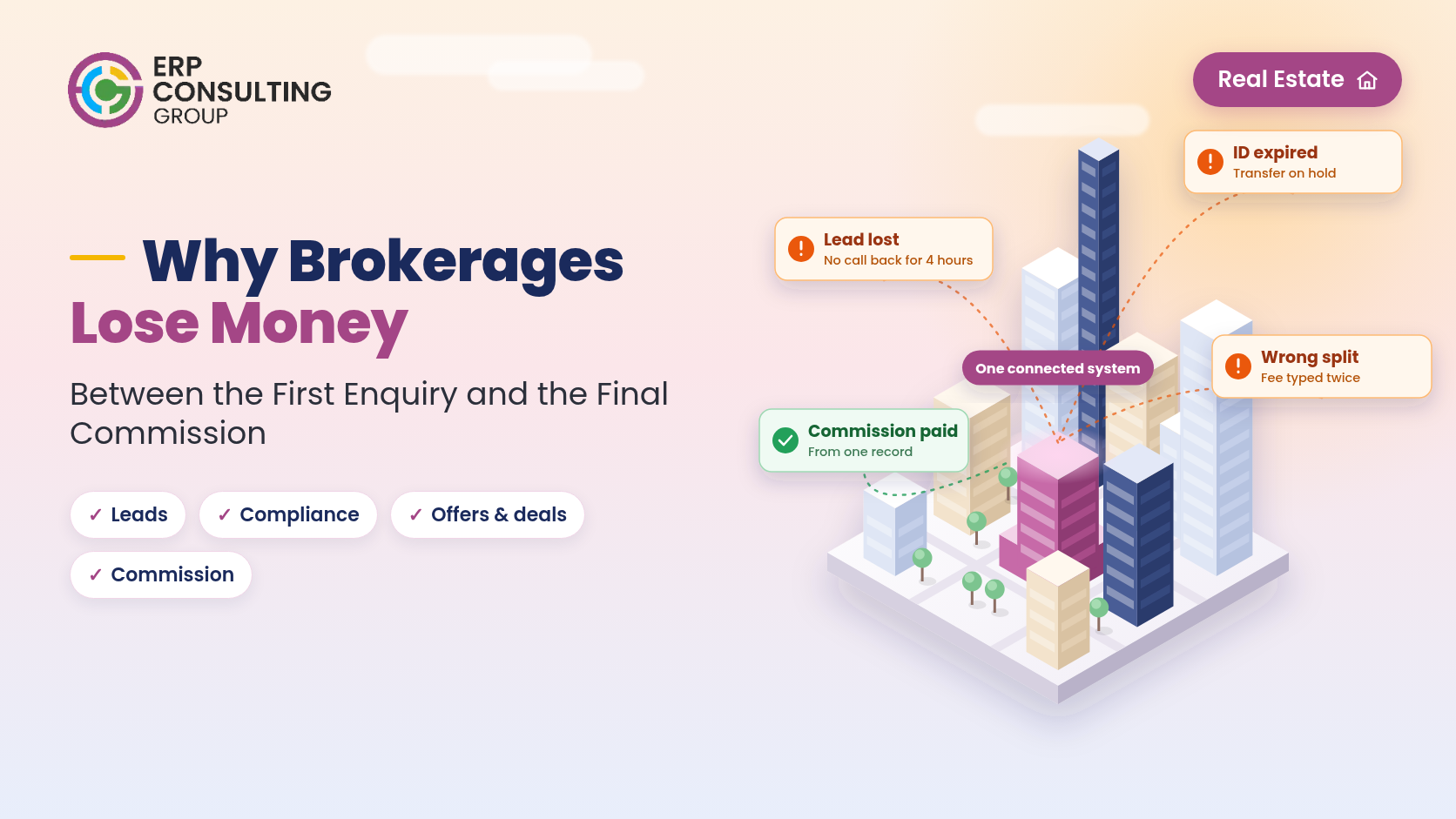
This is the first stage of the wider brokerage journey. In Why Real Estate Brokerages Lose Money Between the First Enquiry and the Final Commission, we explain how disconnected workflows create problems from initial contact through compliance, deal fees and commission payout. This article focuses on the first operational challenge: making sure every portal enquiry is captured, understood and acted on.
Why Property Portal Leads Need a Different Approach
A property portal enquiry behaves differently from a typical business-to-business sales lead. Buyers often contact several agencies at once, sometimes about similar properties on different portals.
Three factors make these enquiries particularly difficult to manage.
Speed matters. A buyer comparing properties may continue speaking to the first agent who responds with useful information and a suitable viewing option.
Volume does not equal intent. One listing can attract buyers who are ready to view, people who are still comparing prices and enquiries that may never progress. A shared inbox rarely makes those differences clear.
Not every enquiry is from a buyer. A brokerage also receives listing enquiries from owners who want to sell. These leads need a different qualification process, agent assignment and next action.
A spreadsheet or generic inbox may record that a message arrived, but it does not necessarily show whether the lead is a duplicate, how urgently it needs attention, which agent owns it or which marketing source generated it.
That information needs to be part of the lead record not something the team has to reconstruct later.
Where Property Portal Leads Go Cold
1. Enquiries arrive in disconnected places
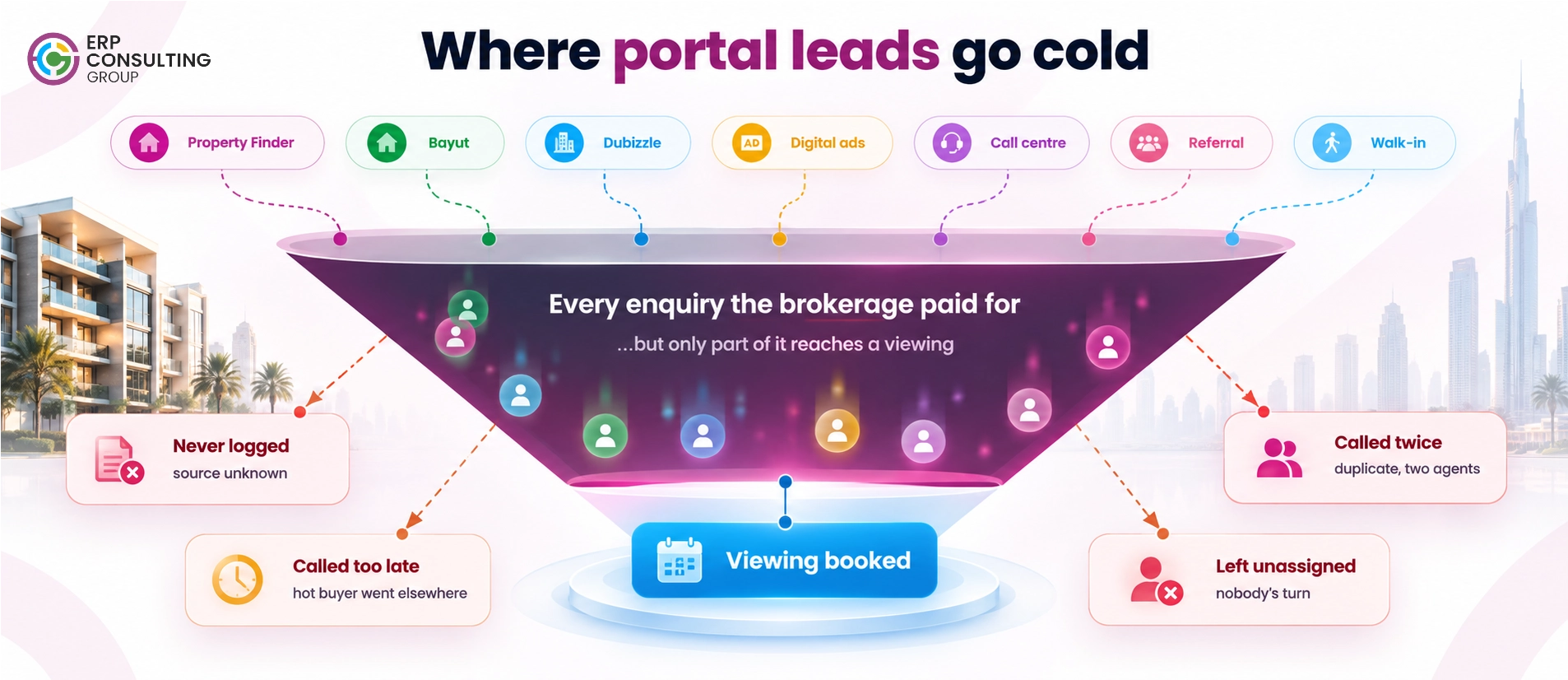
Leads may come from Property Finder, Bayut, Dubizzle, website forms, email notifications, paid campaigns, referrals and direct calls. When these channels are managed separately, agents may have to check several inboxes before they can see the complete picture.
Some enquiries are entered into the CRM late. Others remain in an individual agent's phone or spreadsheet.
What changes: Bring enquiries into a common lead-management process and record the source when each lead is created.
2. The brokerage cannot see which channel produces deals
Knowing which portal sends the most enquiries is not the same as knowing which portal generates the most qualified opportunities or completed transactions.
If the source is recorded only as “portal,” the brokerage loses the detail needed to compare individual platforms and campaigns. Marketing budgets may continue to be renewed without a clear view of what they produce.
What changes: Record both the main source and the specific sub-source, such as Property Finder, Bayut, Dubizzle, a website campaign or a referral. Track the lead through qualification, opportunity and deal stages so the team can evaluate performance beyond enquiry volume.
3. Serious buyers wait behind low-priority enquiries
When every enquiry appears the same, agents may work through the list in arrival order. A buyer who wants to view a property this week can end up waiting behind someone who is only browsing.
The issue is not that every enquiry must be treated as urgent. It is that the team needs a consistent way to identify which ones require attention first.
What changes: Use shared qualification criteria and lead-priority indicators. For example, readiness to view, intended purchase timeline, budget fit and whether the buyer is already speaking to other agencies can help determine the next action.
4. Duplicate leads create a poor first impression
The same person may enquire about several listings or use multiple portals. Without duplicate detection, two agents may call the same buyer, repeat the same questions and create confusion about who is responsible.
Duplicate records also distort reporting. A brokerage may mistake repeated enquiries from one person for separate potential customers.
What changes: Flag likely matching records using available contact details and review them before assigning ownership. Keep the relevant enquiry and property information visible without treating every repeated message as a new customer.
5. New leads remain unassigned
An enquiry can sit in a shared inbox while the team waits for a manager to distribute it. In other cases, agents select leads informally, creating an uneven workload and uncertainty over ownership.
Without a named owner, nobody may feel responsible for the first response or the next follow-up.
What changes: Define assignment rules based on factors such as sales team, buyer or seller enquiry, workload and relevant expertise. Every lead should have a visible owner and a clear next action.
6. Buyer and seller enquiries enter the same workflow
A buyer looking for an apartment needs property recommendations, viewing coordination and purchase qualification. An owner looking to sell needs a listing discussion, property information and a valuation or marketing conversation.
When both types enter the same queue, the enquiry may reach an agent who is not responsible for the required process.
What changes: Identify whether each record is a buyer enquiry or a seller listing lead, then route it into the appropriate workflow.
Most portal leads are not necessarily lost because the property or price is wrong. They can go cold because the process does not make the next action clear.
The Real Cost of a Cold Lead
The first cost is the marketing spend associated with enquiries that never receive proper attention. But the wider impact extends beyond the cost of acquiring the lead.
A buyer who receives a quicker, more relevant response from another agency may continue the conversation there. The brokerage may lose the immediate opportunity and any future relationship that could have developed from it.
There is also an operational cost. Duplicate calls consume agent time. Unclear ownership can create disputes. Missing source information makes it harder to assess marketing performance. When managers cannot see which leads are waiting, the team may discover the problem only after the opportunity has gone cold.
These issues are connected. Better lead capture alone will not solve slow follow-ups if ownership remains unclear. Lead scoring will not help if the team cannot identify duplicate records. Source tracking will not support marketing decisions if leads are never updated as they progress.
A reliable process needs to connect capture, qualification, assignment and follow-up.
A Day in the Inbox: An Illustrative Example
Imagine a mid-sized brokerage on a busy Saturday. Forty new enquiries arrive across three property portals, a digital advertising campaign and several referrals.
Among them are repeated enquiries from the same buyers, several people who want to view properties soon, owners who want to sell and buyers already speaking to other agencies.
With manual handling, agents may work through the inbox from the top. Duplicate enquiries get called twice, seller leads wait for the right listing agent, and serious buyers may not receive a useful response until the next working day.
With a structured lead-management process, the team can:
- Capture the enquiries in a common workflow.
- Flag likely duplicates for review.
- Separate buyer enquiries from seller listing leads.
- Prioritize leads using agreed qualification criteria.
- Assign each lead to a responsible agent.
- Record follow-up activity and the next action.
The difference is not simply having a shorter inbox. It is making the next decision clearer before the opportunity loses momentum.
Which Property Portal Actually Pays?
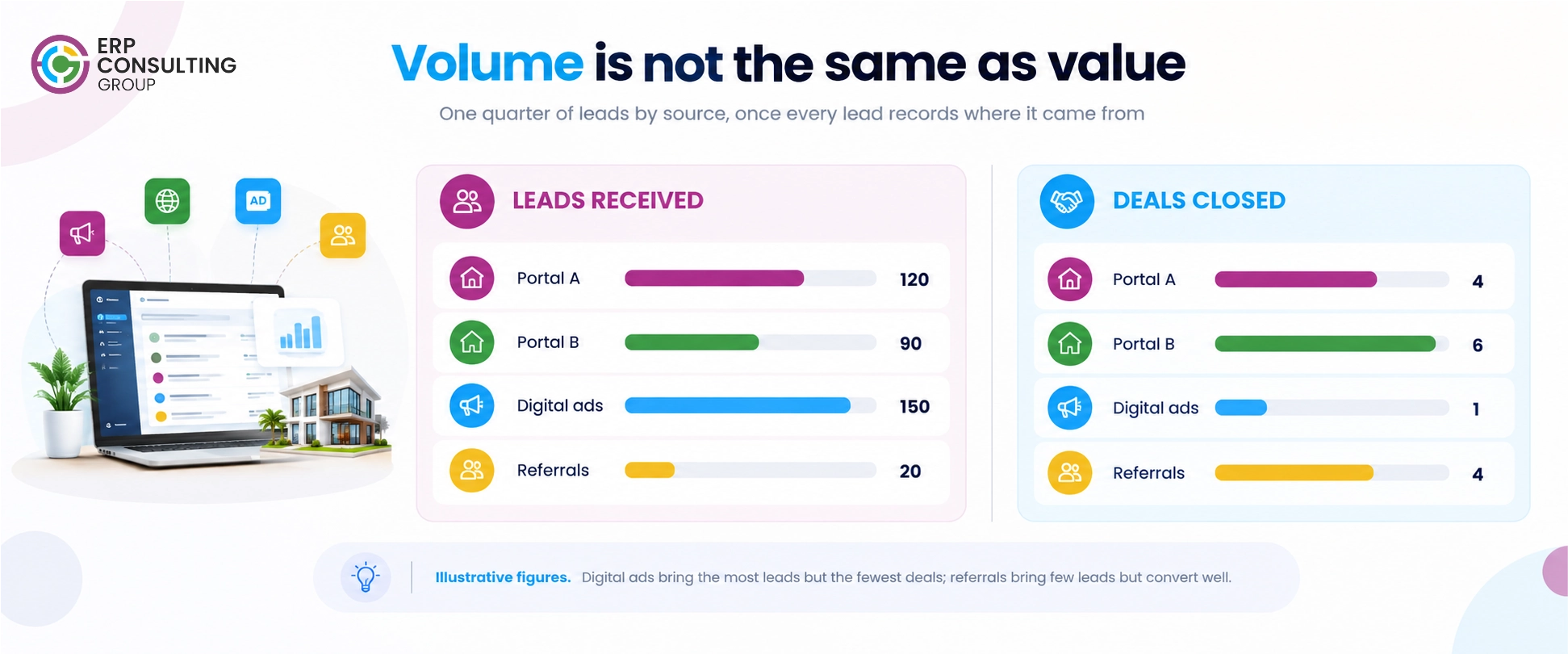
Portal packages can represent a significant marketing expense for a brokerage. However, the channel generating the highest number of enquiries may not be the channel generating the most deals.
To compare performance meaningfully, the brokerage needs to record the source and follow each lead through the sales process.
Source identifies the broad channel, such as a property portal, digital advertising, referral, website or direct enquiry.
Sub-source identifies the specific platform or campaign, such as Property Finder, Bayut, Dubizzle or an individual advertising campaign.
Once these details are consistently recorded, the brokerage can compare more than enquiry volume. It can assess how many enquiries become qualified opportunities, how many progress to viewings and deals, and which channels contribute to actual business outcomes.
The goal is not to discontinue a channel based on one week's results. It is to make marketing decisions using consistent records and a suitable evaluation period rather than relying only on the number of leads received.
What Makes a Lead High Priority?
Lead scoring works best when it reflects the brokerage's actual sales process. A score should help agents decide what to do next, not create another complicated field that nobody updates.
A brokerage might assess:
- Readiness: Is the buyer ready to arrange a viewing, or still researching?
- Timeline: Does the buyer intend to move or purchase soon?
- Property fit: Does the enquiry match the available property, budget and stated requirements?
- Engagement: Has the person responded to previous contact or requested specific information?
- Competing agencies: Has the buyer said they are already speaking to other brokers?
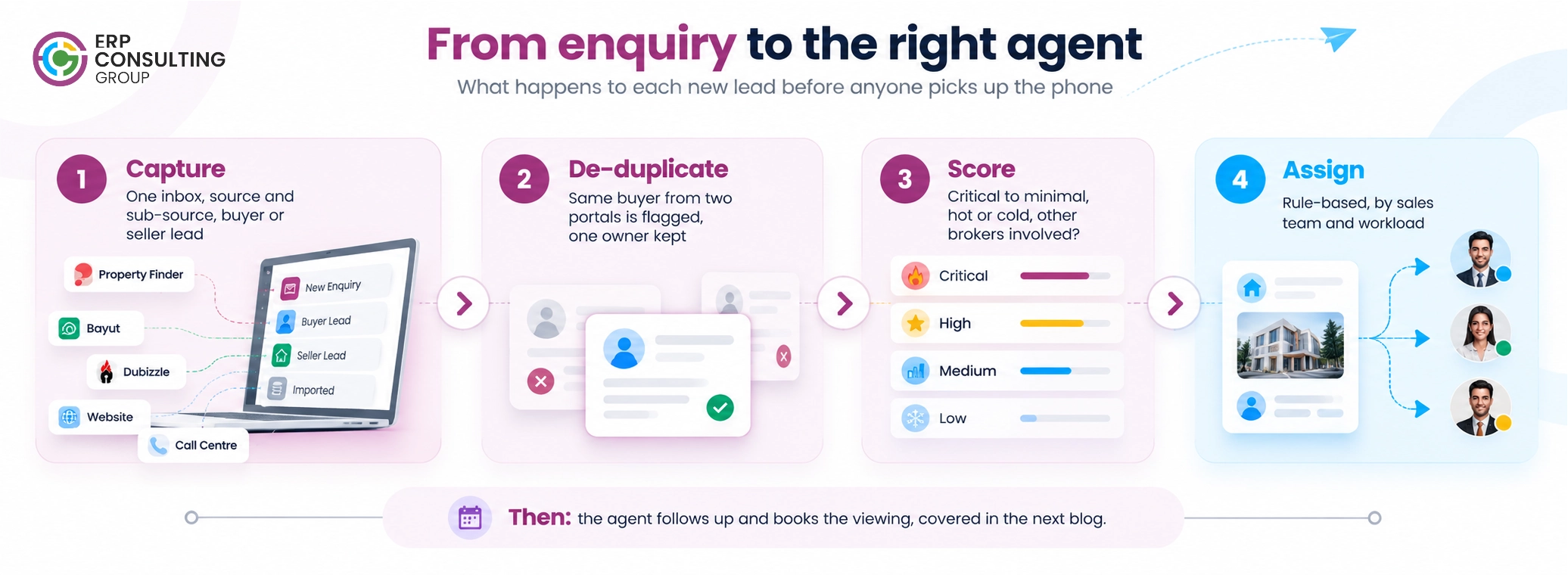
The team can use these factors to assign a priority such as Critical, High, Medium, Low or Minimal. A separate hot-or-cold indicator may provide a quick view of readiness, provided the criteria are defined consistently.
For example, a qualified buyer who wants to view a suitable property this week may require prompt action. Someone researching a move next year may need a different follow-up plan.
The important point is consistency. Agents should be working from shared criteria rather than making completely different decisions about similar enquiries.
Building a Lead Process That Keeps Enquiries Moving
A structured real estate lead-management workflow should make six things clear: where the enquiry came from, who the customer is, what they need, how urgent the lead is, who owns it and what happens next.
1. One lead inbox with source tracking
Capture enquiries from available channels in a common process. Record the source and sub-source at the point of entry so reporting does not depend on agents remembering where a lead originated.
This gives the brokerage a more reliable view of lead volume and marketing performance.
2. Separate buyer and seller workflows
Classify each record as a buyer enquiry or seller listing lead. Use the appropriate qualification fields and stages so the lead reaches an agent who can handle the relevant next step.
3. A clear lead reference
Give every lead a unique reference number. Where a lead is linked to a specific property, show that relationship clearly so agents can distinguish enquiries about different units and find the right record when a customer calls back.
4. Shared priority indicators
Apply agreed scoring and qualification criteria. Make it easy for agents to see which leads require prompt attention and which need longer-term follow-up.
5. Duplicate detection and clear ownership
Flag potential duplicates for review and make the responsible agent visible. Keep activity history and follow-up records attached to the lead so the team can see whether contact has already taken place.
6. Rule-based lead assignment
Assign leads using defined business rules, such as team responsibility, workload and enquiry type. Where automatic assignment is configured, it can reduce the time spent distributing enquiries manually.
Every assignment should leave the team knowing who is responsible and what action is expected next.
Manual Lead Handling vs a Connected Lead Process
Area | Manual handling | Connected lead process |
Lead capture | Portal dashboards, emails and phones are checked separately | Enquiries enter a common workflow |
Source tracking | Broad or missing source information | Source and sub-source recorded consistently |
Buyer and seller leads | Mixed queue | Separate classifications and workflows |
Lead identification | Searching across multiple records | Unique reference linked to relevant property |
Priority | Depends on agent judgement alone | Shared qualification and priority criteria |
Duplicates | Same buyer may be called twice | Potential matches flagged for review |
Ownership | Unclear or informally assigned | Named owner and visible activity history |
Assignment | Manual distribution | Defined assignment rules, where configured |
Marketing decisions | Based mainly on enquiry volume | Lead progression can be compared by source |
Executive Summary
- Property portal enquiries can go cold when capture, prioritization, duplicate handling and assignment are disconnected.
- Recording source and sub-source helps brokerages evaluate which portals and campaigns contribute to qualified opportunities and deals.
- Shared lead-priority criteria, buyer and seller workflows, duplicate checks and clear ownership make it easier to act on every enquiry.
- A connected process should show not only where a lead stands, but who owns it and what happens next.
- Better lead management creates a more reliable starting point for the wider brokerage workflow, from the first enquiry through compliance, deal execution and commission tracking.
Deep-Dive FAQ
Can Property Finder, Bayut and Dubizzle enquiries be tracked separately?
They can be tracked separately when each portal is configured as a source or sub-source and the enquiry records preserve that information. This makes it easier to compare lead volume and progression by platform.
How can a brokerage reduce duplicate calls to the same buyer?
Use duplicate detection to flag records with matching contact information or other relevant identifiers. Review matching records, clarify ownership and keep the activity history visible so agents can see whether the customer has already been contacted.
How should new leads be distributed between agents?
Define assignment rules based on the brokerage's operating model, such as team, enquiry type, workload or agent responsibility. Automatic distribution can help when configured appropriately, but ownership and reassignment rules should remain clear.
Should buyer and seller enquiries follow the same process?
Not necessarily. Buyers and sellers have different requirements and next steps. Separate classifications and workflows help route each enquiry to the appropriate team and keep the follow-up relevant.
How can agents decide which leads to contact first?
Use shared criteria such as readiness, timeline, property fit, engagement and competing agency involvement. A priority score can help agents focus on the enquiries that need attention first, provided the scoring rules are understood and applied consistently.
Can a brokerage track portals from other markets?
Yes, provided the lead-management setup supports the relevant sources and the business configures them during implementation. The exact integrations and data available will depend on the portal, market and solution configuration.
Turn More Portal Enquiries into Conversations
When enquiries arrive from several portals and campaigns, the challenge is not simply receiving more leads. It is ensuring that each enquiry is captured, prioritized, assigned and followed up consistently. ERP Consulting Group can help brokerages assess their current lead-management process and explore how a connected Odoo-based workflow could support clearer ownership, source tracking and follow-up. Want to see how your brokerage could manage portal enquiries in one connected workflow? Contact ERP Consulting Group to discuss your requirements. Email: info@erpconsulting24.com |

 Recent Posts


 Free Consultation