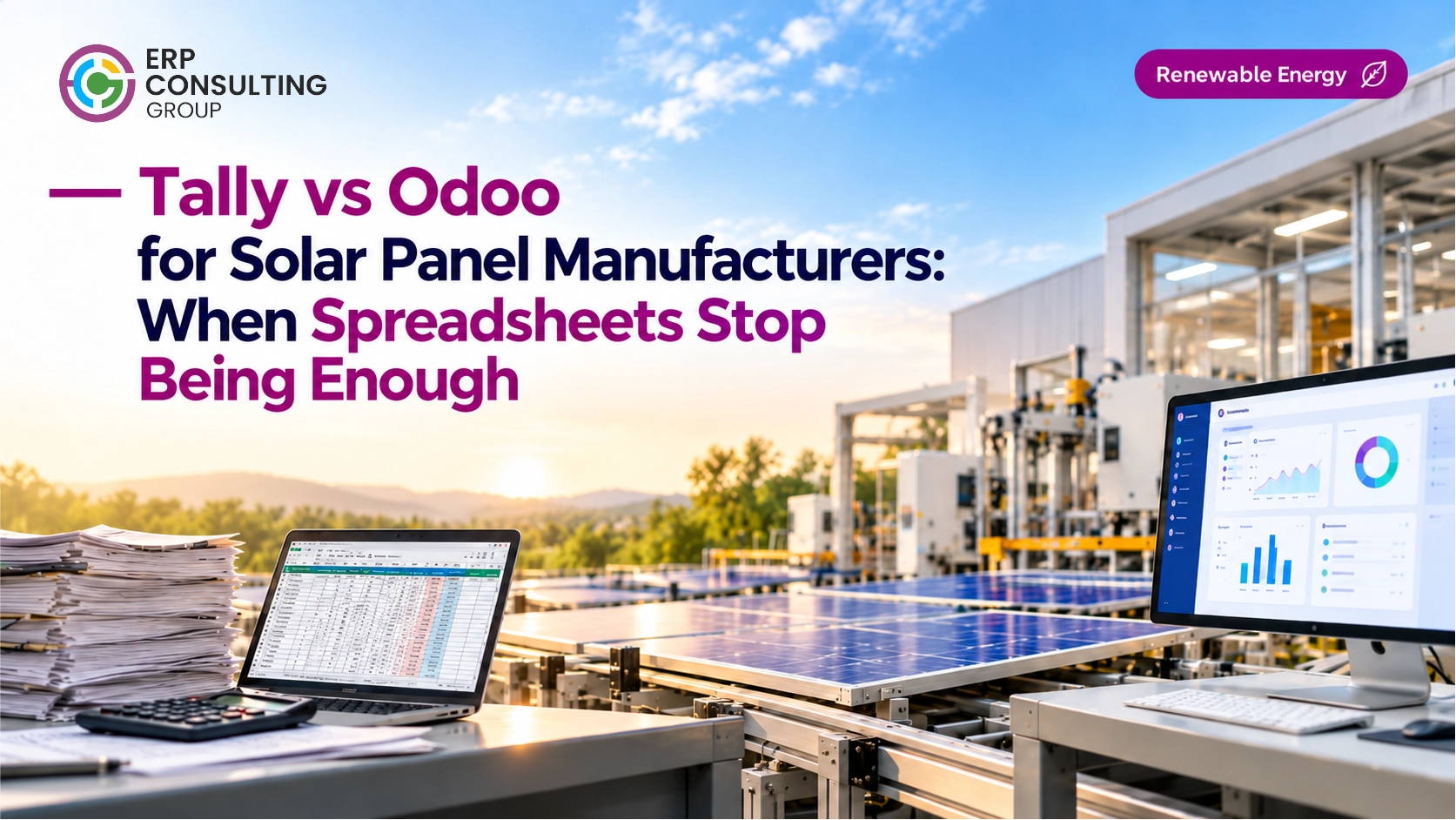
A solar panel manufacturer may use Tally for accounting, spreadsheets for production planning, and separate files for inventory, quality checks, and dispatch records. This setup can work well while production remains manageable and teams can maintain consistent records.
The challenge begins when production grows and management needs to connect raw material consumption, manufacturing costs, finished panels, serial numbers, and customer orders. When these records sit in different systems, teams may spend more time reconciling information than understanding what is happening on the production floor.
For growing manufacturers, the question is not simply whether Odoo is better than Tally. It is whether the current setup provides the operational visibility and coordination the business needs.
ERP Consulting Group helps businesses assess their processes and evaluate ERP solutions around their operational requirements. In this guide, we compare Odoo vs Tally for solar panel manufacturers, explain when Tally and spreadsheets remain practical, and identify the signs that a more connected manufacturing workflow may be worth considering.
When Tally and Spreadsheets Are Enough
TallyPrime is not limited to basic bookkeeping. Its manufacturing-related capabilities include bills of materials (BoMs), manufacturing journals, inventory records, and stock movements. These features can support businesses that need to record manufacturing transactions and maintain inventory information.
A Tally-based setup may remain practical when:
- Production processes are relatively straightforward.
- The number of products and product variants is manageable.
- Inventory movements and manufacturing transactions are recorded consistently.
- Production planning does not require extensive coordination across multiple work centres.
- Management can prepare reliable reports without spending excessive time combining files.
Spreadsheets can also be useful for temporary calculations, production planning scenarios, and analysis. The problem is not the spreadsheet itself. The problem begins when a spreadsheet becomes the only place where a critical operational record exists.
For example, the production team may update a workbook while the inventory team continues using an older version. The reported stock position may then differ from the quantity actually available. Similarly, if production quantities, material consumption, and dispatch details are recorded separately, employees may need to reconcile multiple records before answering basic operational questions.
A growing manufacturer does not automatically need to replace Tally. It needs to identify where its current process is becoming difficult to manage reliably.
1. Production Planning Depends on Manual Updates
A production plan may specify how many panels need to be manufactured, but the team also needs to know whether the required materials are available, which customer orders have priority, and whether production is progressing as planned.
If these details sit in separate files, planners may need to confirm information manually before making decisions. A change in an order quantity or delivery date can also require updates across several records.
A connected manufacturing workflow can bring production orders, bills of materials, material availability, work orders, and production status into a more consistent process. The exact functionality depends on the software edition, configuration, and production requirements.
2. Material Consumption and Finished Stock Are Difficult to Reconcile
Solar panel manufacturing involves multiple inputs and production stages. Management may need to know what materials were issued to production, what was consumed, what remains available, and how many finished panels were recorded.
A bill of materials defines the components and quantities required to manufacture a product. Recording production against that structure helps connect material requirements with manufacturing transactions.
The warning sign is having to reconcile several records to answer a straightforward question: how much material did a production run consume, and how many finished panels did it produce?
If material consumption, production output, and finished-stock entries are not recorded consistently, it becomes harder to investigate differences and plan the next production run.
3. Product and Serial-Number Traceability Is Becoming More Important
A manufacturer may need to connect a finished panel to its production batch, serial number, relevant inspection records, and dispatch information. As order volumes increase, finding these details across separate files can become more difficult.
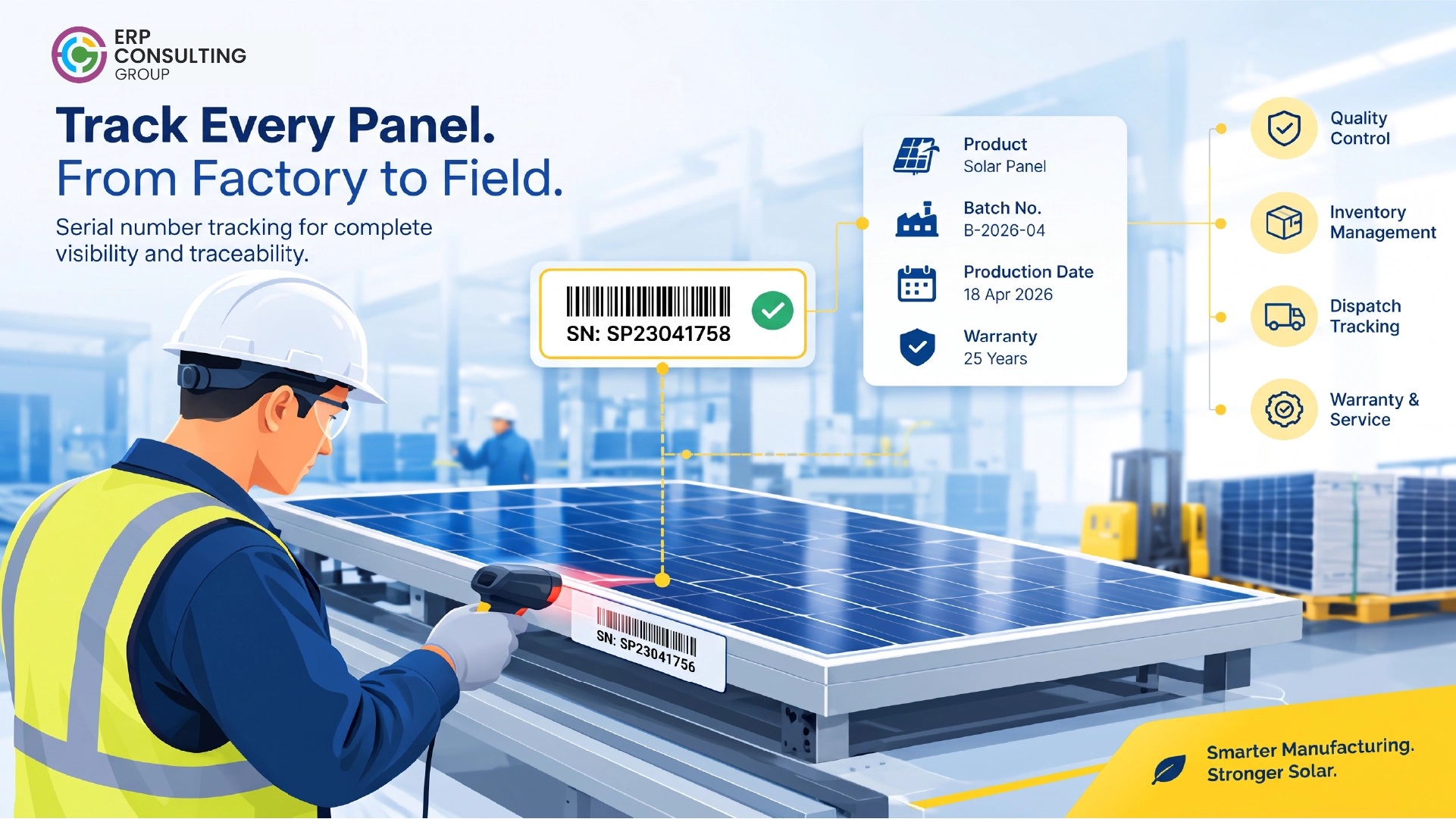
Odoo supports lot and serial-number tracking when the relevant functionality is configured. Serial numbers can identify individual products, while lot numbers can identify a group of products.
For solar manufacturers, the practical question is whether the business can reliably retrieve the required production and dispatch history without depending on one employee or a collection of manually maintained files.
For more detail on this subject, read Solar Panel Traceability: Why Serial-Level Tracking Matters for ALMM Compliance.
Software can help organize traceability records, but the manufacturer must define the required data, configure the workflow, and ensure employees record information accurately.
4. Actual Manufacturing Costs Are Hard to Explain
Knowing the value of purchases and sales is not always enough to understand manufacturing performance.
Management may also need to examine material consumption, production quantities, scrap, work in progress, and other relevant production costs. The level of detail required depends on the company's accounting policies and manufacturing processes.
If cost analysis involves exporting data from different systems and matching it manually, it can become difficult to identify where the numbers diverge.
An integrated setup can help connect manufacturing transactions with inventory and financial records. However, useful costing still depends on correct configuration, consistent data entry, and a clearly defined costing method. Software alone does not guarantee accurate product costs.
5. Compliance and Dispatch Records Are Becoming Harder to Maintain
Solar manufacturers may need to manage product specifications, production records, serial-number information, and customer-specific dispatch documentation.
For projects covered by applicable requirements, India's Ministry of New and Renewable Energy maintains the Approved List of Models and Manufacturers (ALMM). The applicable list and requirements depend on the project category and current government provisions.
An ERP does not automatically ensure regulatory compliance. Manufacturers must verify which requirements apply to their products and projects and maintain accurate records.
A connected system can help organize product, production, and dispatch information when the necessary workflows are configured. It should support the compliance process rather than be treated as a substitute for checking official requirements.
Odoo vs Tally: What Should Solar Manufacturers Compare?
The practical difference is not that one system can handle accounting and the other cannot. TallyPrime provides accounting and manufacturing-related functionality, while Odoo offers a modular environment that includes manufacturing, inventory, accounting, and other business applications.
The more useful comparison is how each setup fits the manufacturer's complete workflow.
Business requirement | Tally with spreadsheets | Odoo-based manufacturing ERP |
Accounting and financial records | Suitable when the configured setup meets accounting and reporting needs | Accounting can be connected with other configured business workflows |
Bills of materials and production records | Supports BoMs and manufacturing transactions | Supports BoMs, manufacturing orders, and work orders |
Inventory visibility | Depends on the accuracy of stock records and any supporting spreadsheets | Manufacturing and inventory workflows can be connected |
Serial-number traceability | Depends on the configured tools and recording process | Lot and serial-number tracking is available when configured |
Production and operational reporting | May require manual consolidation when information is spread across files | Can provide connected reporting based on configured workflows and data |
Fit for the business | Often practical when processes are straightforward and records remain reliable | Worth evaluating when multiple operational processes need to work together |
This is a workflow-level comparison, not a claim that every Odoo implementation will outperform every Tally setup. Actual capabilities depend on the edition, configuration, integrations, customizations, and how consistently the system is used.
Is Odoo Good for Accounting?
Odoo includes accounting functionality that can operate alongside its other business applications. For a manufacturer, the potential advantage is the ability to connect financial records with sales, purchasing, inventory, and manufacturing transactions.
However, whether Odoo is suitable for a particular business depends on its accounting requirements, applicable tax and reporting needs, configuration, and existing processes. Businesses should evaluate the required functionality and local compliance needs before making a decision.
Tally may continue to meet a manufacturer's accounting requirements. If the main difficulty is production coordination rather than accounting, the decision should focus on the operational gaps that need to be addressed.
When Should a Solar Manufacturer Consider Odoo?
Odoo becomes worth evaluating when the main problem is no longer accounting alone, but the connections between production, inventory, sales, purchasing, and finance.
Consider a manufacturer that receives an order for a particular panel model. The business needs to check the required materials, plan production, record manufacturing progress, update finished stock, maintain relevant product traceability, and prepare dispatch information. Finance also needs accurate purchase, inventory, and sales records.
If each department manages these steps independently, employees may have to re-enter information or reconcile conflicting records.
A properly configured manufacturing ERP can connect the workflow:
Sales Order → Material Planning → Manufacturing Order → Production Recording → Finished Goods → Dispatch → Financial Records
The exact workflow depends on the manufacturer's production model and requirements. Some businesses may need additional quality checks, work-centre planning, serial-number controls, or integrations with existing equipment and systems.
Before selecting software, map the current process and identify which handoffs create the most rework or uncertainty. Then evaluate whether standard functionality can address the gaps or whether configuration, integration, or customization will be needed.
There is no single best system for every manufacturer. The right decision depends on production complexity, traceability needs, reporting requirements, implementation effort, and the team's ability to maintain accurate data.
For a wider view of connected renewable-energy operations, read our Complete Guide to Solar Business Management Software.
For the solar manufacturing-specific overview, see The Complete Guide to ERP for Solar Panel Manufacturers.
For the inventory side of the workflow, read Raw Material to Finished Module: Inventory Management for Solar Panel Plants.
What Is the Monthly Cost of Odoo?
Odoo's subscription pricing depends on the selected plan, billing arrangement, number and type of users, and hosting requirements. Its official pricing information also distinguishes the software subscription from implementation services and certain additional costs.
Note on pricing: Do not assess Odoo only by its advertised monthly subscription. The total cost of ownership may also include implementation, process analysis, data migration, customization, integrations, training, hosting where applicable, and ongoing maintenance. The actual cost depends on the business's requirements and chosen setup. Check the official Odoo pricing page and obtain a tailored estimate before budgeting.
For a solar manufacturer, the relevant question is not only how much the software costs each month. It is whether the proposed system addresses the operational gaps that matter, what effort is required to implement it, and what ongoing resources will be needed to maintain it.
Executive Summary
- Tally may remain sufficient when accounting, inventory, and manufacturing records meet the business's needs and can be maintained reliably.
- Spreadsheets become a concern when critical information is duplicated, updated inconsistently, or difficult to reconcile across production, inventory, dispatch, and finance.
- Odoo is worth evaluating when a manufacturer needs connected workflows, provided the proposed configuration meets its actual requirements and the overall cost is understood.
Frequently Asked Questions
1. Is Tally suitable for solar panel manufacturers?
TallyPrime can be suitable for manufacturers whose accounting, inventory, and manufacturing-record requirements are met by their configured setup. The decision should depend on operational complexity, reporting needs, and record accuracy not company size alone.
2. Is Odoo better than Tally for solar panel manufacturing?
Neither system is automatically better for every manufacturer. Tally may be sufficient for businesses with straightforward processes and reliable records. Odoo may be worth evaluating when production, inventory, traceability, purchasing, and finance need to work through connected workflows.
3. Do manufacturers need to stop using spreadsheets after implementing an ERP?
No. Spreadsheets can remain useful for analysis, planning scenarios, and temporary calculations. The priority is to maintain critical operational records in a reliable system and avoid unnecessary duplicate data entry.
4. How can a manufacturer decide whether to migrate from Tally to Odoo?
Start by reviewing production planning, inventory accuracy, material consumption, traceability, costing, reporting, and the time spent reconciling records. Compare these gaps with the proposed ERP workflow, migration effort, training needs, implementation cost, and ongoing support requirements before making a decision.
Ready to Connect Your Manufacturing Workflow?
The right ERP decision starts with understanding how your business works, not choosing software based on a feature list. ERP Consulting Group can help your team review its current processes, identify information gaps, and evaluate an Odoo-based approach for connecting manufacturing, inventory, and finance. Start with your process, then decide what needs to change. Visit ERP Consulting Group or contact info@erpconsulting24.com to discuss your requirements. |
 Recent Posts

 Free Consultation