Solar businesses in India are scaling faster than their operations can keep up with. Daily rooftop installations have climbed from just over 5,000 a day in October 2025 to more than 16,000 a day by July 2026 - a more-than-threefold jump in under a year. Government subsidy schemes are bringing in more customers every month.
Yet many solar companies still manage their operations using a mix of Excel sheets, WhatsApp groups, and accounting software that doesn't connect with the rest of the business.
This guide explains what solar business management software should actually do - from lead capture and site surveys to project costing, inventory, subsidy tracking, invoicing, and after-sales service. It also explains the difference between a solar CRM and a full ERP, so you can evaluate software based on your actual operational needs rather than a vendor's feature list.
● Site Survey, BOQ & Proposals ● Project & Milestone Execution ● Multi-Site Inventory & Material Tracking ● Subsidy Application Tracking ● DISCOM & Net-Metering Approval Tracking |
What Is Solar Business Management Software?
Solar business management software is a system that manages the operational side of a solar company - from the first customer inquiry through installation, commissioning, and after-sales service - in one connected platform instead of across multiple disconnected tools.
The confusing part is that solar CRM, solar ERP, and solar project management software are often used as if they mean the same thing. They don't, and the difference matters when choosing a system.
● CRM: Manages leads, deals, customer communication, and sales activities. Its focus is primarily on winning and managing customers.
● Project management software: Tracks tasks, timelines, teams, and milestones for active installations.
● ERP: Connects sales and projects with inventory, procurement, finance, accounting, and service. A completed milestone can feed directly into invoicing, while material used on a project can update inventory and project costs.
Many tools marketed as "solar management systems" are essentially CRMs with a project-tracking layer, while accounting continues in a separate system.
That distinction is important because a system that manages the customer relationship isn't automatically managing the business behind the customer.
Why This Matters More in 2026 Than It Did a Year Ago
A few changes are making disconnected operations a bigger liability for solar businesses:
● Subsidy volume has increased: Government rooftop solar schemes are bringing more projects into the pipeline, creating more applications, documents, approvals, and disbursement stages to track.
● More projects are moving through the pipeline: As rooftop solar adoption grows, teams need to manage more customers and installations without increasing manual follow-ups at the same rate.
● Compliance is critical: ALMM listings, BIS certification, DISCOM approvals, and project documentation can all affect whether an installation moves forward.
● Multi-site material control is becoming harder: Panels, inverters, cables, and mounting structures can move between warehouses and sites, making manual inventory tracking increasingly difficult.
None of these challenges are isolated. They are the predictable result of a growing solar business relying on tools that weren't designed to keep operational data connected as project volume increases.
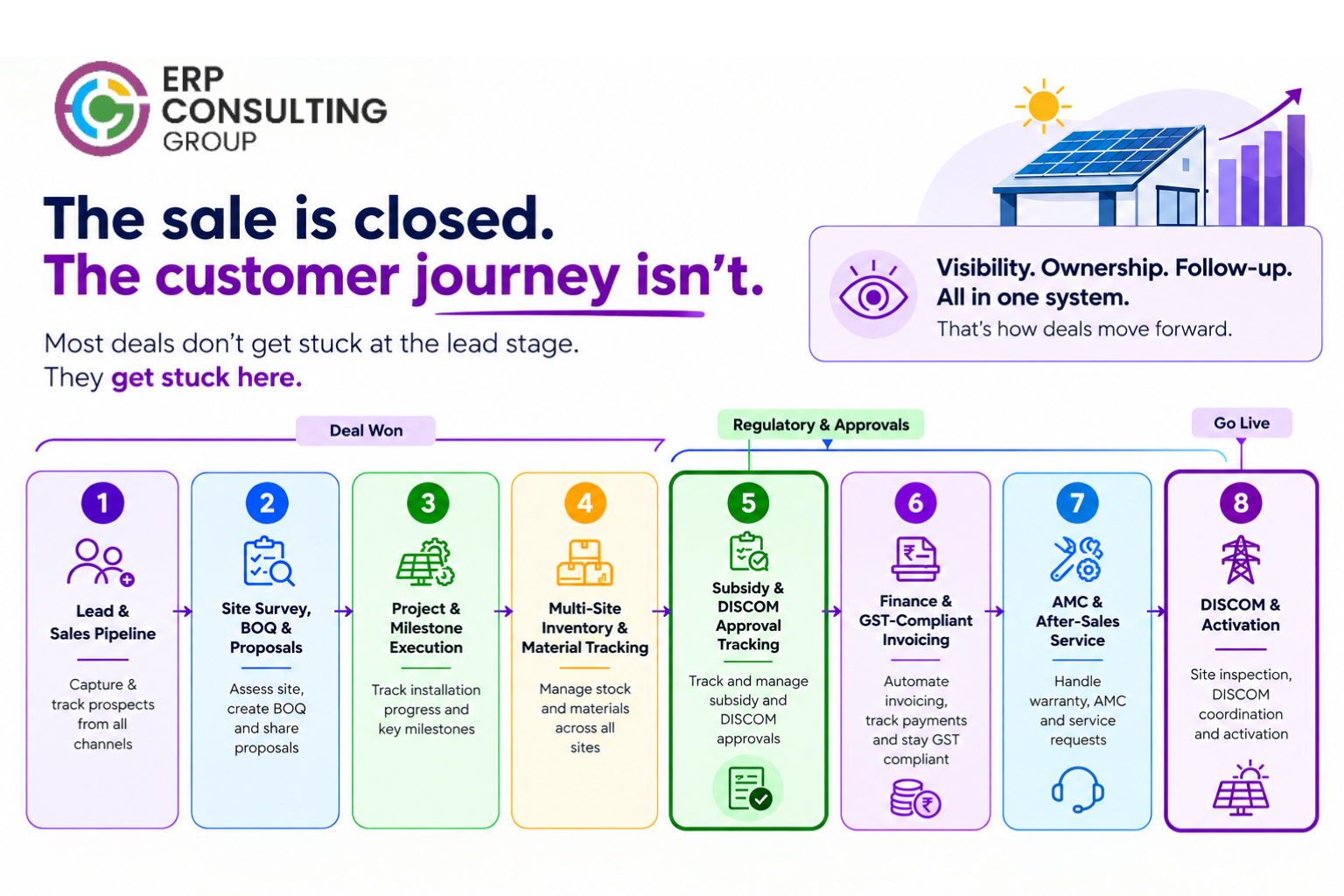
The sale closing is rarely where a solar project gets stuck. In practice, registration, approval, DISCOM, activation, and payment stages can create significant visibility gaps without a connected system.
The Core Modules of a Solar Business Management System
A complete system generally covers seven areas. Here's what each should actually do - and the specific operational problem it solves.
1. Lead & Sales Pipeline
A solar management system should capture inquiries from websites, referrals, walk-ins, and social channels into one pipeline instead of scattered WhatsApp conversations.
A good system moves a lead through defined stages such as inquiry, site survey scheduled, quotation sent, negotiation, and won - while showing who is responsible for the next action.
Without this visibility, leads can go cold simply because nobody followed up at the right time.
Read the deep dive: Why Solar Leads Go Cold Before You Even Know They Existed
2. Site Survey, BOQ & Proposals
Solar site surveys involve roof measurements, shading information, site photographs, electrical requirements, and other project-specific details.
Field teams should be able to capture this information digitally and use it to prepare the Bill of Quantities (BOQ) and client proposal.
This reduces the risk of manual errors such as incorrect panel quantities, missing balance-of-system components, or inconsistent pricing between proposals.
Read the deep dive: From Site Survey to Proposal: How Solar EPCs Can Automate BOQ and Estimation
3. Project & Milestone Execution
Once a deal is won, the project should be created without requiring the team to re-enter the same information manually.
The project can then be divided into milestones such as:
Civil Work → Mounting → Wiring → Installation → Commissioning
The important part isn't simply tracking whether a task is complete. It's knowing how much the project has actually cost compared with the planned budget.
Most solar EPC companies don't lose money because a project completely fails. Costs often increase gradually at the site or milestone level, and the problem isn't noticed until the project is already close to completion.
Read the deep dive: Why Solar EPC Projects Lose Money at the Milestone Level
4. Multi-Site Inventory & Material Tracking
Panels, inverters, cables, mounting structures, and other materials may move between warehouses and multiple active sites.
Without proper tracking, two problems appear quickly:
- Materials can go missing between locations with limited accountability.
- One warehouse can be overstocked while another site is waiting for the same material.
A connected system can reserve material against a project's Bill of Materials, track stock across locations, and flag shortages before they become installation delays.
Read the deep dive: Where Did Those Panels Go? The Hidden Cost of Multi-Site Solar Inventory
5. Subsidy & DISCOM Approval Tracking
This is one of the most important India-specific requirements - and one that generic software guides often overlook.
A system designed for Indian solar businesses should help teams track subsidy applications through stages such as:
Registration → Document Submission → Approval → Installation → Disbursement
It should also provide visibility into net-metering and DISCOM inspection processes.
The objective isn't to replace the government or DISCOM portals. It is to give the internal team a clear view of which projects are waiting, what documentation is pending, and where follow-up is required.
This becomes particularly important as project volumes increase and individual manual follow-ups become harder to manage.
Read the deep dives:
Tracking PM Surya Ghar & State Subsidy Applications: A Practical Guide
The Bottleneck Between 'Installed' and 'Paid'
6. Finance & GST-Compliant Invoicing
Project progress and finance should not operate as two separate processes.
When a project milestone is completed, the relevant information should flow into the billing process without requiring someone to manually copy project data into another accounting system.
This is where the CRM-vs-ERP distinction becomes particularly important.
A CRM can tell you that a milestone has been completed.
A connected ERP can connect that milestone to project costing, invoicing, accounting, and financial reporting.
For a growing solar EPC company, this can significantly reduce duplicate data entry and reconciliation between systems.
Read the deep dive: Why Milestone Billing Breaks Standard Invoicing
7. AMC & After-Sales Service
A solar installation doesn't end when commissioning is complete.
Systems may require maintenance, performance checks, inverter support, panel cleaning, warranty management, and other after-sales services.
AMC contracts should trigger renewal reminders, while service tickets should remain connected to the original project and customer record.
We've seen the importance of this connected approach directly. In a recent Odoo deployment for a solar module and battery manufacturer - not an EPC company - connecting warranty records to the original sale reduced warranty turnaround time by 87%.
Read the full Solar energy manufacturer success story.
Read the deep dive: Turning 25-Year Warranties Into Recurring Revenue
Solar CRM vs. Solar ERP: The Real Difference
This distinction is worth understanding before evaluating any software.
A solar CRM can be an excellent tool for managing leads and customer relationships. But it doesn't automatically connect those activities with inventory, procurement, project costing, and finance.
Feature | Solar CRM (point solution) | Full ERP |
Lead & site tracking | Yes | Yes |
Multi-warehouse inventory | Often limited or an add-on | Native |
GST-compliant accounting | Rarely - usually needs a separate tool like Tally | Native, connected directly to project data |
Multi-entity / multi-branch finance | No | Yes |
Customisation | Limited to what the vendor's roadmap allows | Fully extensible |
What happens at milestone completion | Someone manually creates an invoice elsewhere | Invoice can be generated from the same connected system |
The practical cost of a CRM-only approach often appears quietly.
Someone spends time re-entering data from one system into another. Finance teams reconcile figures between CRM and accounting software. Project teams maintain separate spreadsheets. Managers discover mismatches only after the work has already happened.
For a company managing 20 projects a month, this may be manageable.
For a company managing 200, it can become a structural operational problem.
That doesn't mean every solar business needs a full ERP from day one. A small residential installer with simple operations may be perfectly well served by a CRM and separate accounting system.
The important thing is knowing what your software actually covers before you buy it.
Choosing the Right System for Your Solar Business
The right system depends heavily on the type of solar business you operate.
Residential Installers
High-volume residential installers need:
● Fast quotation and proposal generation
● Strong subsidy and document tracking
● Bulk project visibility
● Simple site-to-installation workflows
● Customer and payment tracking
Commercial & Industrial (C&I) Contractors
C&I businesses running multiple concurrent projects typically need:
● Milestone-level cost control
● Material planning
● Subcontractor coordination
● Project profitability visibility
● PPA and ROI-related proposal capabilities
Utility-Scale Developers
Large-scale solar developers have different requirements, including:
● Large-site and zone-based tracking
● Multi-party coordination
● Procurement planning
● Project milestone management
Government and contract-based billing workflows
A system that works well for a residential company managing 20 installs a month may not be appropriate for a utility-scale developer managing a 50MW project.
Start with the operational problem you need to solve, not the number of features a vendor puts on its website.
1. Treating subsidy tracking as manual follow-up
When subsidy applications are tracked through spreadsheets and messages, stalled applications can easily be overlooked.
2. Using one spreadsheet for multi-site inventory
As locations and material movements increase, spreadsheet-based inventory becomes difficult to keep accurate.
3. Finding project cost overruns too late
If budget-vs-actual costs are visible only after project completion, the business has very little opportunity to correct the problem.
4. Keeping sales and finance completely separate
Moving information manually between a CRM and accounting system creates an ongoing reconciliation burden.
5. Buying software that is too complex
More features don't automatically mean a better system.
If a company spends months configuring features it doesn't need while its core operational problem remains unresolved, the software has not solved the right problem.
How ERP Consulting Group Can Help
RENEWvate, built on Odoo, follows the full-ERP approach described above rather than treating sales, projects, inventory, and finance as disconnected systems.
It is designed to help renewable-energy businesses connect areas such as:
Lead Management → Project Execution → Inventory → Finance → After-Sales
For solar businesses operating in India, the ability to adapt the system around specific workflows is particularly important because residential, C&I, and larger projects can have very different operational requirements.
Explore RENEWvate for Renewable Energy Businesses to see how ERP Consulting Group approaches renewable-energy operations.
If you're evaluating whether your current setup has outgrown a point-solution CRM, explore how ERP Consulting Group helps businesses build and scale connected ERP systems with Odoo.
The goal isn't to add another piece of software to your business.
It's to connect the systems you're already relying on so your team can see what is happening across sales, projects, inventory, finance, and service without constantly moving information between tools.
Frequently Asked Questions
Is a solar CRM enough, or do I need a full ERP?
If your business is small, your books are simple, and you're comfortable connecting CRM data with accounting manually, a CRM can work.
Once reconciliation between systems becomes a recurring operational task, it may be time to consider a more connected ERP approach.
Does this kind of software actually help with PM Surya Ghar and other subsidy schemes?
Yes, when the software is designed around the workflow.
It won't replace government portals or submit every application automatically, but it can help your team track applications, documents, approvals, and stalled cases in one place.
Can one system handle both residential and C&I projects?
Yes, provided the system is flexible enough to support different sales pipelines, project structures, milestone workflows, and reporting requirements.
Residential and C&I projects operate differently, so they shouldn't necessarily be forced into the same workflow.
How long does implementation typically take?
Implementation time varies depending on the software, project size, integrations, data migration, and level of customisation required.
Ask vendors for a specific implementation plan based on your business rather than relying on a generic timeline.
What does solar business management software typically cost?
Pricing can range from relatively simple software subscriptions to highly customised ERP implementations.
The right comparison isn't simply the monthly licence price. Consider the number of users, projects, integrations, customisation, implementation, support, and the operational costs the system is expected to reduce.
Ready to Evaluate Your Current Setup?
Not sure which category your business falls into?
Book a free 20-minute consultation and we'll help you map your current setup against what you actually need.
Contact Us: info@erpconsulting24.com.
 Recent Posts
 Free Consultation