
This is Part 3 of our series breaking down the 7 operational modules from The Complete Guide to Solar Business Management Software (2026) - this piece goes deeper on the third: Project & Milestone Execution.
Most Solar EPC companies don't lose money because a project fails.
They lose it somewhere in the middle.
A project can be progressing normally, the site team can be reporting good progress, and the customer can be satisfied - while the project's margin is quietly getting smaller. Labour takes longer than estimated. Material consumption is higher than planned. Additional civil work is required. A subcontractor's cost increases. A site delay creates additional expenses.
None of these costs necessarily looks serious on its own. The problem is that they are often tracked separately from project progress. By the time management compares the original budget with the actual project cost, the milestone is already complete and the opportunity to correct the variance has passed.
For a C&I or utility-scale Solar EPC, project execution should therefore answer more than "How much of the work is complete?" It should also answer "How much have we spent to reach this point, and are we still within the cost we planned?"
A connected project workflow makes that comparison visible while the project is still moving.
Catching this kind of drift means the budget and the actuals need to live in the same place while the project is still running, not get reconciled after the fact. ERP Consulting Group builds this kind of milestone-level budget-vs-actual tracking into RENEWvate, our Odoo-based system for Solar EPC companies, so variances surface while there's still time to act on them.
The Real Cost of Finding Project Overruns Too Late
A project's final margin is rarely lost through one dramatic mistake. More often, it disappears through small cost overruns that accumulate across individual activities and milestones.
Consider a simple illustrative example.
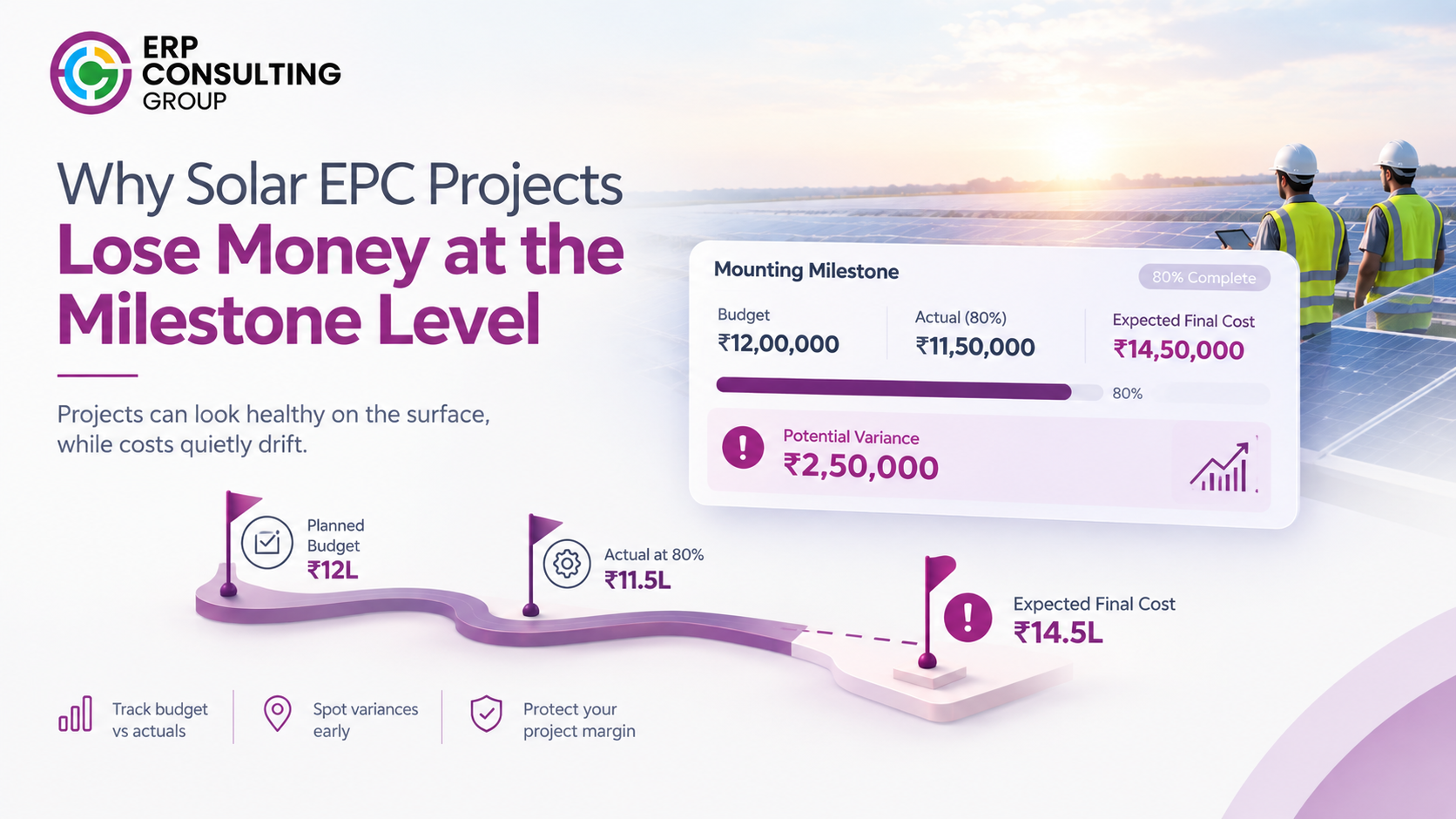
A Solar EPC has allocated ₹12 lakh for a mounting milestone. When the milestone is 80% complete, actual costs have already reached ₹11.5 lakh.
At first glance, the project may still appear to be progressing normally. But suppose the remaining work is expected to require another ₹3 lakh. The expected final cost of the milestone is now ₹14.5 lakh against an original budget of ₹12 lakh.
That creates a potential ₹2.5 lakh variance.
The important point is not the ₹2.5 lakh itself. It is when the EPC becomes aware of it.
If the variance is identified while the milestone is still active, the project team can investigate the cause, control remaining costs, review the scope, negotiate an approved variation where appropriate, or adjust the execution plan.
If it is discovered after the milestone is complete, the cost has already been absorbed.
This is why budget-vs-actual tracking matters at the milestone level.
The first reason is that project progress and project costs often live in different places.
The site team may report progress through daily updates or WhatsApp. Procurement records material purchases separately. Finance records invoices and payments. The project manager may maintain an Excel tracker for milestones. Each team has useful information, but that information is not necessarily connected.
This creates a delay between what is happening at the site and what management can see financially.
The second problem is that the original project budget is often created during estimation but is not actively used as the baseline during execution. Once the project starts, actual costs begin accumulating through purchases, material consumption, labor, subcontractors, transportation, and other site expenses.
If these costs are only consolidated periodically, the project team may know what has already been spent without knowing whether that spending is ahead of or behind the original plan.
There is also a difference between physical progress and financial progress.
A project that is 70% complete does not necessarily mean that it should have consumed 70% of its budget. Some activities may have cost more than expected. Others may have been completed below budget.
Without this comparison, a progress report can tell management that the project is moving - but not whether it is moving profitably.
Imagine two projects, both reporting 70% completion.
The first project has consumed ₹65 lakh against a planned cost of ₹70 lakh at that stage.
The second has consumed ₹82 lakh against the same ₹70 lakh planned cost.
Both may show "70% complete" on a basic project tracker.
Operationally, however, they are in very different positions.
The first project is currently below its planned cost. The second has already consumed ₹12 lakh more than expected.
If management only reviews project progress, this difference can remain hidden.
Budget-vs-actual discipline changes the conversation. Instead of looking only at whether a milestone is complete, the project team can see whether the cost of reaching that milestone is consistent with the original plan.
The useful comparison becomes:
Planned Cost → Actual Cost → Remaining Cost → Expected Final Cost
This gives project managers an opportunity to investigate the variance before it becomes a final project loss.
Building a Connected Solar Project Execution Workflow
The objective is not to turn project managers or site engineers into accountants. It is to make the financial impact of project execution visible through the same workflow that teams already use to manage the work.
Once a deal is won, the project should be created from the approved opportunity instead of requiring the project team to enter the same customer, scope, and commercial information again. The approved quotation can become the starting point for project execution, reducing the gap between what sales sold and what the project team is expected to deliver.
The project can then be divided into meaningful milestones such as civil work, mounting, wiring, testing, commissioning, and handover. Each milestone can have its own planned dates, responsible owner, expected cost, and actual cost.
Project Creation from the Won Opportunity
A won opportunity should not mark the end of the sales workflow and the beginning of a completely separate project process.
The customer information, approved scope, commercial assumptions, and relevant quotation information should move forward with the project. This reduces duplicate data entry and gives the execution team a clearer understanding of what was originally committed.
The transition becomes:
Won Opportunity → Project → Approved Scope → Budget → Milestones
This creates continuity between sales and execution.
Budget vs. Actual at Milestone Level
The approved project budget should become the baseline against which execution is measured.
As materials are consumed, labour is recorded, subcontractors complete work, and other project expenses are incurred, actual costs can be associated with the relevant project or milestone.
This means a project manager does not have to wait until the end of the month or the end of the project to discover that a particular activity is exceeding its planned cost.
If mounting was budgeted at ₹12 lakh and the expected final cost has moved toward ₹14.5 lakh, the variance becomes visible while the work is still underway.
That gives the team time to ask the more important question: why?
From Variance to Action
A variance by itself does not solve anything.
The project team needs to understand whether the additional cost came from unexpected site conditions, increased material consumption, additional customer requirements, rework, subcontractor changes, labour overruns, or an estimation error.
Once the reason is understood, the appropriate action can be assigned.
Sometimes the answer may be cost control. Sometimes it may be a procurement review. Sometimes an approved change in customer scope needs to become a commercial variation. In other cases, the original estimate may need to be reviewed for future projects.
The important thing is that the variance becomes visible while the project can still respond to it.
Manual Project Tracking vs. Connected Project Control
Project Process | Manual Spreadsheet Model | Connected Workflow |
|---|---|---|
Project creation | Re-entered after sales | Created from approved opportunity |
Project scope | Separate quotation and project files | Connected to project |
Budget | Stored in estimate sheet | Used as project baseline |
Milestones | Manually maintained | Defined with owners and dates |
Site progress | Daily reports and messages | Linked to project milestone |
Material cost | Tracked separately | Connected to project |
Labour cost | Recorded manually | Associated with project |
Subcontractor cost | Separate records | Linked to project |
Actual cost | Consolidated later | Updated during execution |
Budget variance | Found periodically | Visible at milestone level |
Variance reason | Reconstructed later | Recorded during execution |
Corrective action | Informal follow-up | Assigned and tracked |
Project margin | Known at closure | Monitored throughout execution |
Executive Summary
See margin erosion early: compare planned and actual costs while milestones are still in progress.
Connect progress with cost: link civil work, mounting, wiring, commissioning, materials, labour, and subcontractor activity to the project.
Act before project closure: identify the reason behind a variance while there is still time to control its impact.
The real value of project cost control is not simply knowing what a project costs after it is finished.
It is knowing where the project is moving away from budget while there is still something you can do about it.
A Solar EPC does not necessarily need another progress tracker. It needs a way to connect what is happening at the site with what is happening to the project margin.
If your team only discovers that a project missed its expected margin after commissioning, the problem may not be the final costing.
The problem may be that nobody could see the variance early enough.
Deep-Dive FAQ
How do we know when a milestone is becoming unprofitable?
A milestone needs both a planned cost and an actual cost.
Completion percentage alone does not tell you whether the milestone is financially healthy. The project team needs to compare what has already been spent with what should have been spent at that stage, and then consider the expected cost of the remaining work.
For example, if a milestone is 80% complete but has already consumed 96% of its budget, that should trigger a closer review even if the physical work appears to be progressing normally.
The purpose is not to predict the exact final cost perfectly. It is to identify when the project is moving away from its original assumptions early enough to investigate.
What costs should be included in milestone-level tracking?
The exact categories depend on how the EPC prepares its project budgets, but they can include materials, labour, subcontractors, transportation, equipment, site expenses, and other project-specific costs.
The important part is consistency between estimation and execution.
If mounting costs are estimated using one structure during the quotation stage but actual mounting costs are recorded differently during execution, the comparison becomes difficult.
A connected cost structure helps maintain the relationship between:
Budgeted Cost → Actual Cost → Variance → Project Margin
What happens when the actual cost exceeds the approved budget?
The system should not simply show that the budget has been exceeded.
The project team needs to understand what caused the difference and whether it can still be controlled.
If the additional cost is caused by an approved customer requirement, it may need to be treated as a commercial variation. If it is caused by unexpected site conditions, the project team may need to revise the remaining execution plan. If it is caused by excessive material consumption or rework, management may need to investigate the operational reason.
The useful workflow is:
Budget → Actual → Variance → Reason → Action
Can the project budget change after execution begins?
Yes, but the original approved budget should remain visible.
Projects can change because of customer scope, site conditions, technical revisions, or other approved requirements. Updating the budget without preserving the original baseline can make it difficult to understand what actually changed.
A better approach is to maintain the relationship between the original budget, approved changes, revised budget, and actual cost.
This allows management to distinguish between a genuine project overrun and a legitimate change in project scope.
Ready to Connect Your Site Survey to Project Execution?
ERP Consulting Group can help map your existing site survey → BOQ → proposal → procurement → project workflow, using RENEWvate, our Odoo-based tool for renewable energy operations, to identify where manual handoffs are costing you accuracy and margin. Start with your process, not a generic software demo - Book a Free Strategy Session or email info@erpconsulting24.com |
This article is part of our Complete Guide to Solar Business Management Software (2026) - read the full guide for the other 6 modules, including lead pipeline management, subsidy tracking, and GST-compliant invoicing.

 Recent Posts



 Free Consultation