This is Part 4 of our series breaking down the 7 operational modules fromThe Complete Guide to Solar Business Management Software (2026) - this piece goes deeper on the fourth: Multi-Site Inventory & Material Tracking.
A Solar EPC can have the right material in stock and still have a project waiting for it.
Panels are at one warehouse. Inverters are at another location. Cables have already been dispatched to a project site. Mounting structures are being transferred between sites. Some materials are reserved for projects that have not yet started installation.
When several projects are running simultaneously, simply knowing the total quantity in the business is no longer enough.
The bigger question is: Where is the material, which project does it belong to, and who is accountable for it?
Without that visibility, two problems start appearing together. Material can disappear between warehouses and project sites without a clear trail, while another site may be waiting for the same material because nobody knows that it is sitting unused somewhere else.
For a growing C&I or utility-scale Solar EPC, inventory control therefore needs to go beyond stock quantities. It needs to provide traceability from purchase to warehouse, warehouse to site, and site to installation.
Solving this isn't really about tighter paperwork - it's about giving every unit of material a traceable home from the moment it leaves the supplier.ERP Consulting Group builds this kind of serial-level, multi-site traceability into RENEWvate, our Odoo-based platform for Solar EPC companies, so a panel or inverter's location and project allocation stay visible instead of being reconstructed after something goes missing.
The Real Cost of Losing Visibility Between Sites
Material rarely disappears in one obvious event.
A panel may be dispatched from the central warehouse with several other components. The delivery reaches the site, but the receiving quantity is not updated immediately. A few damaged panels are moved aside. Some material is shifted to another project because that site needs it urgently.
Later, the warehouse records may still show the original quantity.
The project team assumes the material has been delivered. The warehouse assumes it is already at the site. Management sees the material as part of company inventory.
Nobody necessarily knows exactly where the gap occurred.
The same problem can happen with inverters and other high-value equipment. An inverter may be moved from one project to another to prevent a site delay, but if that movement is only communicated through a phone call or WhatsApp message, the original project allocation may never be updated.
The result is not always theft.
Sometimes it is misallocation, unrecorded transfer, damage, incorrect receiving, or simple data-entry delay.
But from a management perspective, the result is similar: the business cannot confidently account for its material.
Why Stock Quantity Alone Is Not Enough
Imagine an EPC has 1,000 solar panels across its warehouses and project sites.
The inventory report says 1,000.
But 400 are reserved for Project A, 250 are already at Project B, 150 are in transit, 100 are at the central warehouse, and the remaining 100 are allocated to another upcoming project.
The business technically has 1,000 panels.
But only a fraction may actually be available for a new requirement.
This distinction becomes critical when multiple projects are being executed at the same time.
A warehouse report that says "100 panels available" does not answer whether those panels are actually free to use. They may already be committed to another project.
A connected inventory workflow therefore needs to distinguish between physical stock, reserved stock, available stock, in-transit stock, and project-allocated stock.
That is what allows procurement teams to identify a genuine shortage before a project reaches the installation stage.
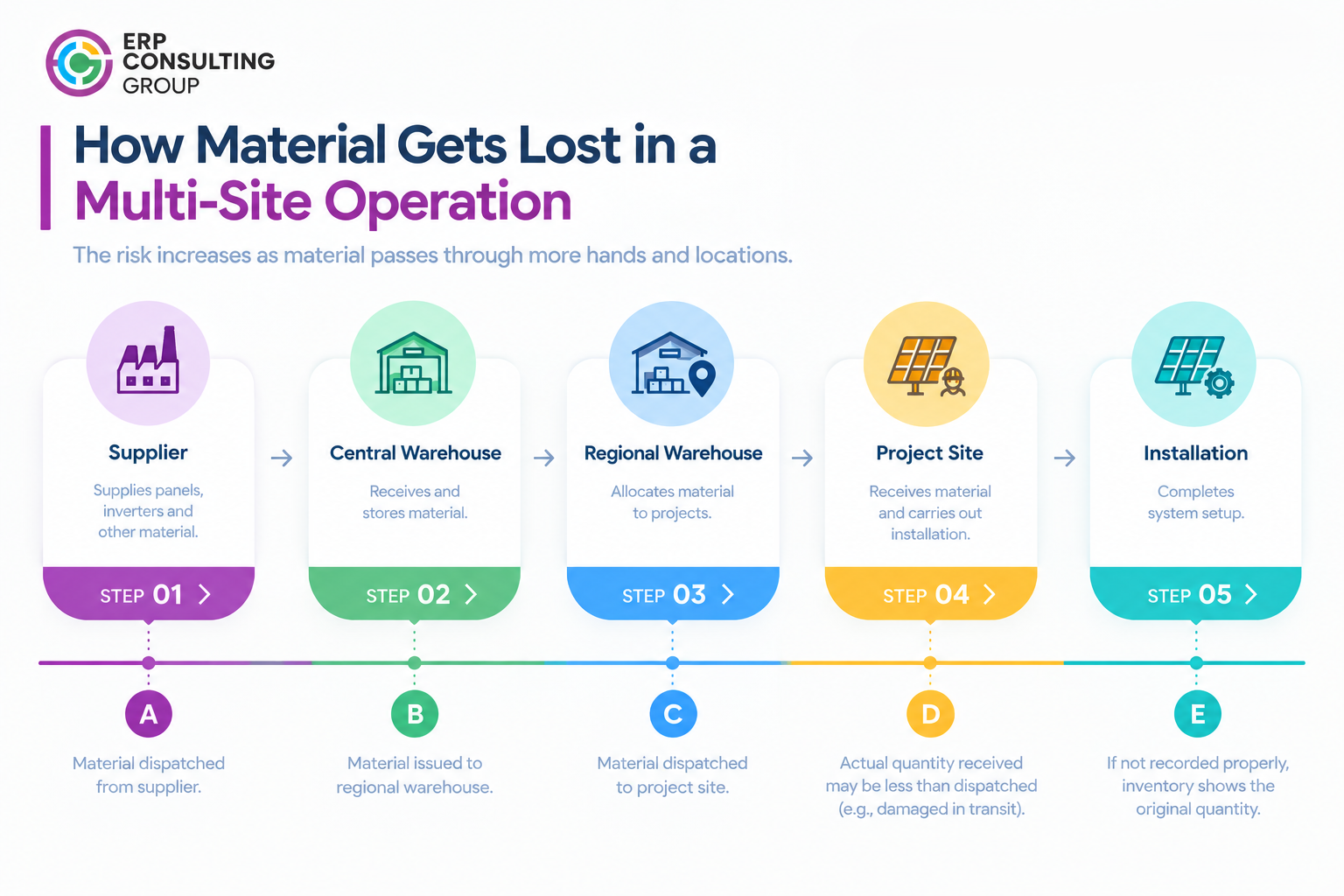
How Material Gets Lost in a Multi-Site Operation
The risk increases as material passes through more hands and locations.
A typical Solar EPC movement may look like:
Supplier → Central Warehouse → Regional Warehouse → Project Site → Installation
At each stage, there is an opportunity for quantity differences, incorrect allocation, delayed updates, damage, or unrecorded movement.
For example, a project may request 500 panels. The warehouse dispatches 500. The site received 492 because eight panels were damaged during transportation. If the receiving quantity is not recorded properly, the system may continue showing 500 at the project.
Those eight panels then become difficult to account for.
The same issue can occur when material is transferred between projects. Project A may have excess cables while Project B has an immediate shortage. The team moves the cables to Project B to keep the site running, but the inventory record still shows them against Project A.
The business has not necessarily lost the material.
It has lost the traceability.
And once traceability is lost, accountability becomes difficult.
Building a Connected Multi-Site Inventory Workflow
The objective is not simply to create a larger warehouse spreadsheet. It is to maintain one traceable record of material movement across warehouses, projects, and sites.
When the project BOQ is confirmed, the required materials can be associated with that specific project. Available stock can then be checked against those requirements before procurement begins.
As material is purchased, received, reserved, transferred, dispatched, and consumed, each movement remains connected to the relevant location and project.
This creates a continuous material history rather than a collection of disconnected stock updates.
Reserve Material Against the Project
A project should not have to compete with every other project for the same stock.
Once the BOQ is approved, required materials can be reserved against the relevant project. This gives procurement and project teams visibility into what is already available and what still needs to be purchased.
For example, if Project A requires 500 panels and 300 are already available and reserved, the system can show the remaining requirement instead of treating all warehouse stock as freely available.
This creates an important distinction:
Stock Available ≠ Stock Available for This Project.
That difference can prevent last-minute shortages and unnecessary purchasing.
Track Every Material Movement
Once material leaves the warehouse, the inventory record should continue with it.
A transfer from the central warehouse to a project site should identify what was moved, how much was moved, where it came from, where it is going, and which project it is associated with.
If material is later transferred from one project to another, that movement should also remain visible.
This creates a chain of accountability:
Purchase → Receipt → Warehouse → Transfer → Site → Project → Consumption
Instead of asking someone where the material went, the business can follow its movement through the record.
Serial-Level Tracking for High-Value Equipment
For high-value equipment such as inverters and other serialized components, quantity tracking alone is not enough.
A serial number provides an individual identity for the equipment.
An inverter received into the warehouse can be associated with its serial number, supplier, purchase record, warehouse location, and allocated project. Once dispatched, the same serial can be connected to the project site and eventually the installation record.
If that inverter later appears at another project, the movement can be traced.
This makes unexplained movement much harder to hide and makes legitimate transfers easier to document.
The objective is not simply to "stop theft."
It is to create enough traceability that missing, damaged, misallocated, or transferred material can be identified and investigated quickly.
Manual Multi-Site Tracking vs. Connected Inventory Control
Inventory Process | Manual Spreadsheet Model | Connected Workflow |
|---|---|---|
Stock quantity | Updated separately | Centralized inventory visibility |
Project requirement | Separate BOQ | Linked to project |
Stock reservation | Manual tracking | Reserved against project |
Warehouse location | Separate records | Location-based visibility |
Material transfer | WhatsApp/manual update | Recorded stock movement |
Project dispatch | Delivery document | Project-linked dispatch |
Site receipt | Manually confirmed | Recorded against project |
In-transit material | Limited visibility | Transfer status visible |
Serial numbers | Separate spreadsheets | Connected to equipment |
Project allocation | Manually maintained | Material linked to project |
Cross-site transfer | Difficult to trace | Transfer history maintained |
Material shortage | Found during execution | Flagged against requirements |
Missing material | Investigation starts later | Movement history available |
Accountability | Depends on individuals | Traceable responsibility |
Executive Summary
Know where material is: maintain visibility across warehouses, transit locations, and active project sites.
Create accountability: use project allocation and serial-level tracking to make high-value material movements traceable.
Catch shortages early: compare project BOQs with available, reserved, and incoming stock before material becomes an installation delay.
The real value of multi-site inventory management is not simply knowing how many panels or inverters the company owns.
It is knowing where they are, which project they belong to, whether they are actually available, and what happened to them between purchase and installation.
When material moves across several warehouses and project sites, spreadsheets can show quantities. They often struggle to show accountability.
If your team is still asking "Where did those panels go?", "Was this inverter already allocated?", or "Why are we buying more when we have stock?" - the problem may not be the amount of inventory you hold.
It may be the visibility around it.
Deep-Dive FAQ
Does serial tracking actually prevent theft?
Serial tracking cannot physically prevent someone from taking equipment.
What it does is create accountability and traceability.
If an inverter has a recorded serial number, warehouse location, project allocation, dispatch record, and installation record, an unexplained movement becomes much easier to identify.
Without that history, the business may only know that "one inverter is missing."
With serial-level tracking, it can potentially determine which inverter, from which project allocation, was last recorded at which location, and what movement happened afterward.
That changes inventory control from quantity-based tracking to asset-level accountability.
Do we need serial tracking for every solar component?
Not necessarily.
The level of tracking should reflect the value, risk, and operational importance of the material.
High-value or serialized equipment such as inverters may justify individual serial-level tracking. Other components may be more efficiently managed through quantity, batch, lot, or project-level tracking.
The objective is not to create unnecessary data entry.
It is to apply the appropriate level of traceability to the materials where losing visibility creates the greatest operational or financial risk.
How can the system identify a shortage before the project is delayed?
The starting point is the project BOQ.
Once the required quantities are associated with the project, the system can compare those requirements against available, reserved, received, and in-transit material.
For example, if a project requires 500 panels and only 350 are available or allocated, the remaining requirement becomes visible before installation begins.
Procurement can then evaluate supplier lead times and place the required purchase earlier instead of discovering the shortage when the site team is ready to install.
The workflow becomes:
Project Requirement → Available Stock → Reserved Stock → Shortage → Procurement
What happens when one project has excess material and another has a shortage?
A connected inventory system can make the imbalance visible.
If Project A has unused material while Project B is approaching a shortage, management can evaluate whether a controlled transfer makes sense instead of automatically purchasing additional stock.
The transfer should remain recorded so that Project A's allocation is reduced, Project B's allocation is increased, and the movement remains part of the inventory history.
This provides better control over both inventory levels and project costs.
Ready to Connect Your Site Survey to Project Execution?
ERP Consulting Group can help map your existing project → BOQ → procurement → warehouse → transfer → site → installation workflow using RENEWvate, our Odoo-based tool for renewable energy operations. We can identify where material movements become difficult to trace, where project allocations break down, and where inventory visibility can prevent both shortages and unnecessary purchases. Start with your process, not a generic software demo -Book a Free Strategy Session or email info@erpconsulting24.com |
This article is part of our Complete Guide to Solar Business Management Software (2026) - read the full guide for the other 6 modules, including lead pipeline management, subsidy tracking, and GST-compliant invoicing.
 Recent Posts



 Free Consultation