Getting an enquiry (or inquiry) is only the start. A buyer who calls once, asks a few questions and then hears nothing for three days is as good as lost.
In many brokerages, the first call goes reasonably well. The trouble starts afterwards. The agent promises to send options and forgets. The viewing (or site visit, as it is usually called in India) is agreed in a chat and never reaches the calendar. The flat the buyer asked about is reserved, and the lead is closed instead of being offered something similar.
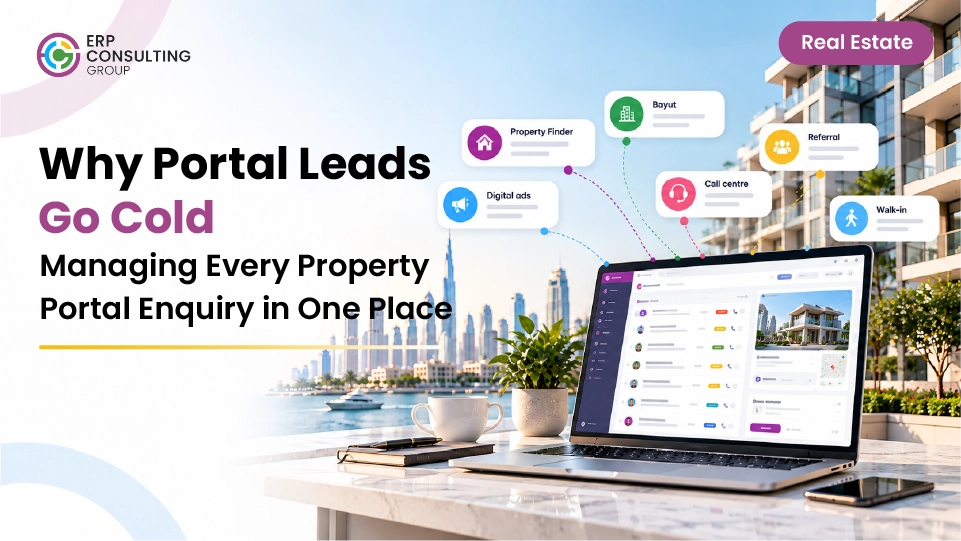
This guide covers real estate lead follow-up in the stretch between the first call and the first viewing. It follows Why Portal Leads Go Cold: Managing Every Property Portal Enquiry in One Place, which covers how enquiries are captured and assigned, and is part of our series that starts with Why Brokerages Lose Money Between the First Enquiry and the Final Commission. These topics explore how better enquiry management and follow-up processes can help brokerages prevent leads from being lost.
The Gap Between "Interested" and "Booked a Viewing"
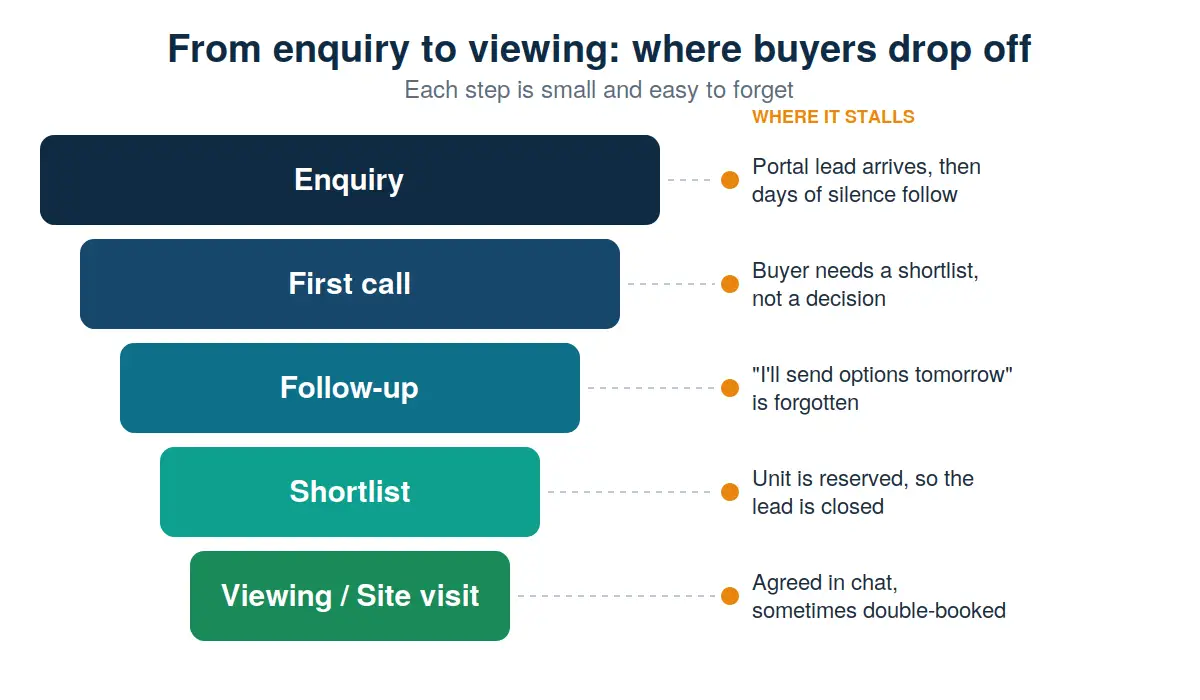
An enquiry and a viewing are separated by a few days and several small steps. Each one is easy on its own, and each one is easy to forget:
- The first call is rarely a decision. Many buyers want a shortlist, a follow-up call and some reassurance before they give up a weekend for a viewing or site visit.
- The unit they asked about is often not the one they buy. The enquired property may be reserved, out of budget or in the wrong building. What matters is what they actually need.
- Buyers have their own way of talking. Some want a phone call, some only reply on WhatsApp, and many are more comfortable in their own language, whether Arabic, Hindi, Urdu, Marathi, Gujarati or Tamil.
- Money decides the timeline. A cash buyer and a buyer who needs a mortgage or home loan move at very different speeds, and the agent needs to know which one they are dealing with.
When all of this lives in an agent's head and phone, the gap between "interested" and "booked a viewing" is where many buyers quietly disappear.
Where Enquiries Stall After the First Call
Whether the lead came from Bayut, Property Finder or Dubizzle in the UAE, or from 99acres, MagicBricks or Housing.com in India, the same problems tend to appear:
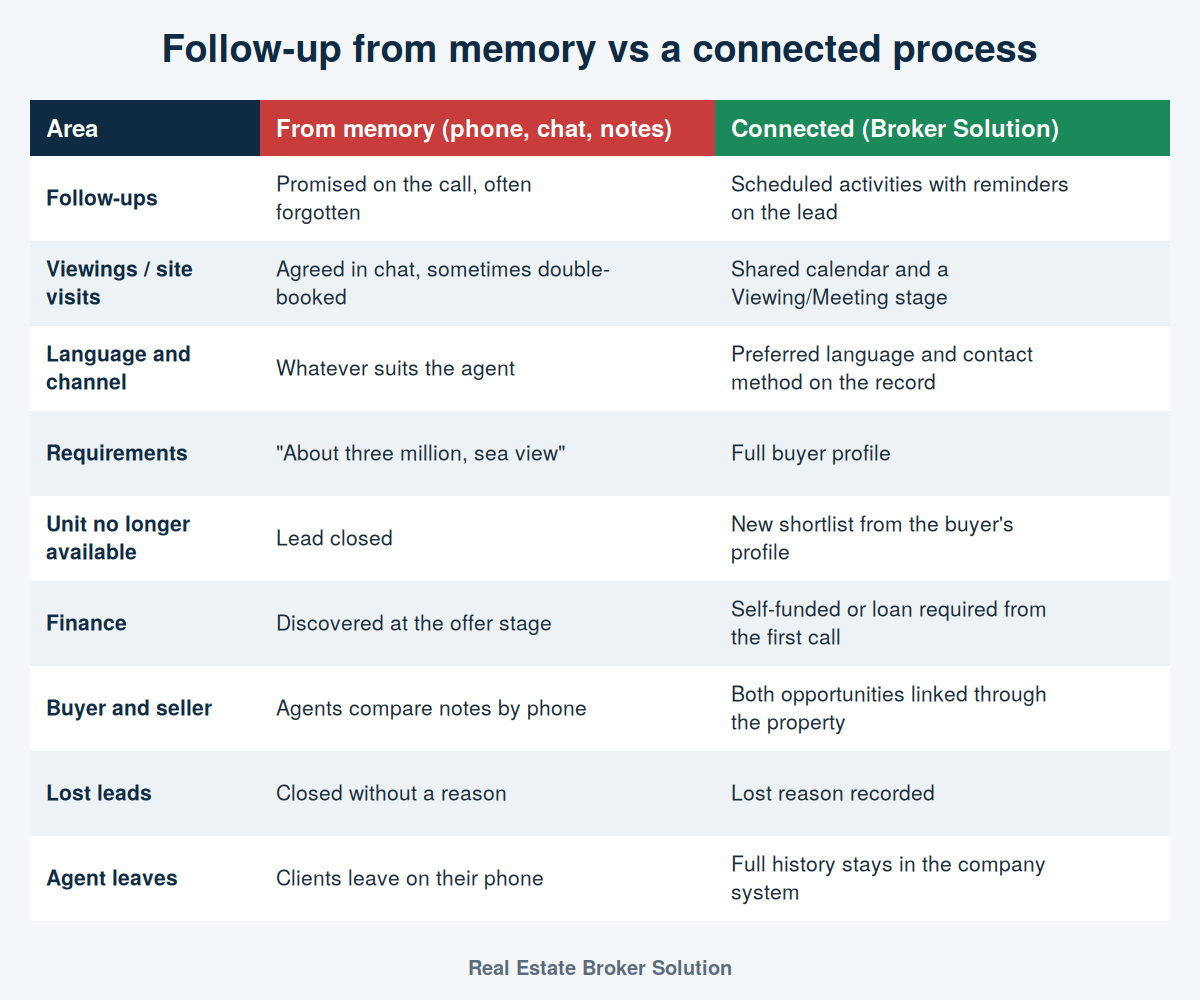
- Follow-ups live in memory. "I'll send you some options tomorrow" is one of the most common promises in real estate, and one of the most commonly broken.
- Viewings are arranged in chat. Times are agreed in messages, two agents can book the same unit for the same slot, and nobody else can see what was agreed.
- The wrong language or channel. A buyer who prefers Arabic or Hindi on WhatsApp gets an English email and never replies.
- Requirements are never written down. The agent remembers "about three million, sea view" but not the communities, the move-in date, whether the buyer wants off-plan or ready, or the school the family needs nearby.
- The enquired unit is gone, so the lead is closed. Instead of offering three similar options, the agent says "sorry, it's reserved" and moves on.
- Nobody knows how the buyer is paying. A mortgage or home loan buyer is treated like a cash buyer, and the deal stalls weeks later when the bank is not ready.
- Lost leads leave no lesson. Leads are closed without a reason, so the brokerage never learns whether it lost on price, speed or stock.
- The client leaves with the agent. When an agent resigns, their buyers, notes and conversations can leave on their phone.
A good first week is a series of small, scheduled steps. Missing one of them is often enough to lose the buyer.
The Cost of a Stalled Enquiry
By the time an enquiry stalls, the brokerage has already paid for it twice: once in portal or advertising spend, and again in the agent's time on the first call. Every stalled enquiry throws both away.
A simple way to see the impact is to run your own numbers:
- Monthly portal and advertising spend: [AED X / ₹ X]
- Enquiries received per month: [N]
- Cost per enquiry: spend ÷ enquiries
- Share of enquiries that never reach a viewing: [Y%]
- Money spent on enquiries that go nowhere each month: cost per enquiry × enquiries × Y%
Even a modest improvement in the share that reach a viewing can change the return on the same marketing budget.
Wrong viewings cost even more. An agent who drives a family to a two-bedroom flat when they need three bedrooms near a school loses an afternoon and the buyer's trust. And when an agent leaves, the brokerage can lose not just one deal but every half-finished conversation that agent was holding.
One Buyer's Week: Two Illustrative Examples
These examples are illustrative, not real client cases.
Example 1: UAE
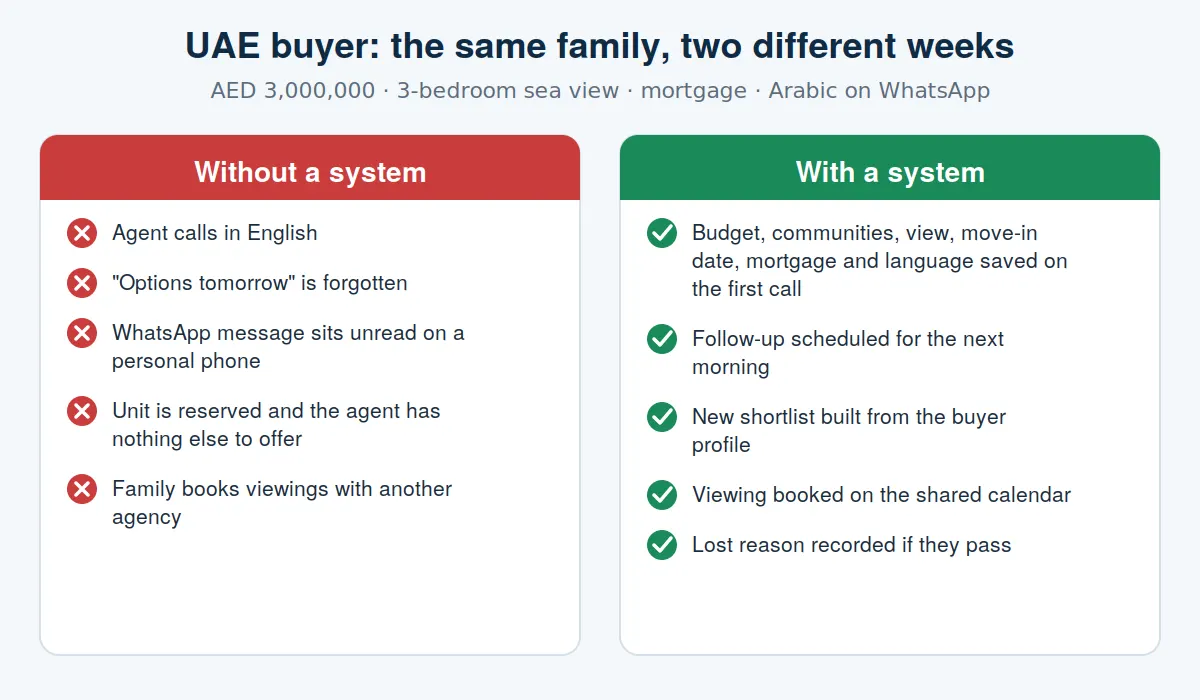
A family enquires about a three-bedroom flat with a sea view, listed at AED 3,000,000. They are moving to the city in three months, they need a mortgage, and they prefer to talk in Arabic on WhatsApp.
Without a system: the agent calls in English, promises options "tomorrow" and gets busy. Two days later the family asks again on WhatsApp, but the message sits unread on the agent's personal phone. Meanwhile the flat they asked about is reserved. When the agent finally calls back, all they can say is that it is gone. The family books viewings with another agency that weekend.
With a system: on the first call the agent records the family's budget range, the communities they like, the sea view, three bedrooms, the move-in date, the mortgage and their preferred language and channel. A follow-up is scheduled for the next morning. When the unit is reserved, the agent builds a new shortlist from the profile, not from memory. The viewing is booked on the shared calendar for Saturday, so the team can see it and nobody double-books the unit. If the family still decides not to go ahead, the lead is closed with a reason, so the manager can see why.
Example 2: India
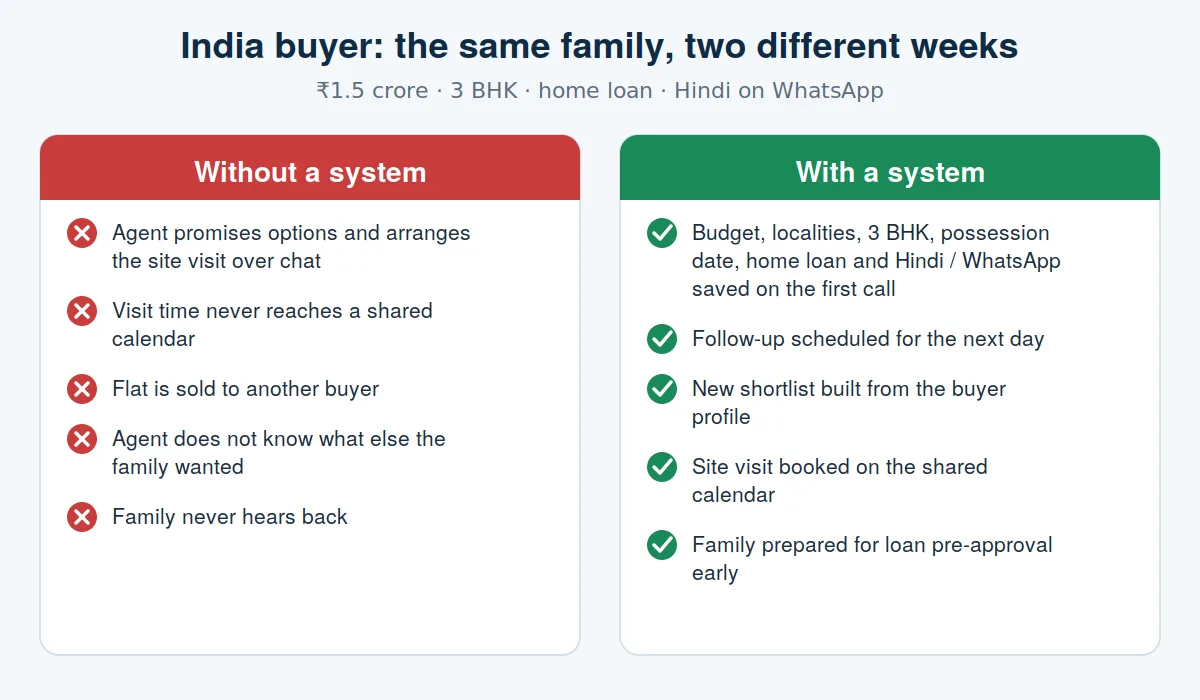
A family enquires about a 3 BHK flat listed at ₹1.5 crore. They plan to move in within six months, they need a home loan, and they prefer to talk in Hindi on WhatsApp.
Without a system: the agent calls, promises to share a few options and arranges a site visit over chat. The time never goes on a shared calendar. The flat is sold to another buyer, the agent does not know what else the family wanted, and the family never hears back.
With a system: the agent records budget, preferred localities, 3 BHK, possession timeline, home loan requirement and Hindi on WhatsApp as the preferred channel. A follow-up is scheduled for the next day. When the flat is gone, a new shortlist is built from the profile, and a site visit is booked on the shared calendar so the team can see it. Because the home loan need is known from day one, the agent can prepare the family for loan pre-approval early.
And When the Agent Resigns
Imagine the same agent hands in their notice a month later. Without a system, the family's details, their requirements and the history of every call can go with the agent's phone. With a system, every requirement, activity, message and note is on the lead record. A new agent can open it, see exactly where things stand and carry on without asking the family to start again.
What a Good Buyer Profile Captures
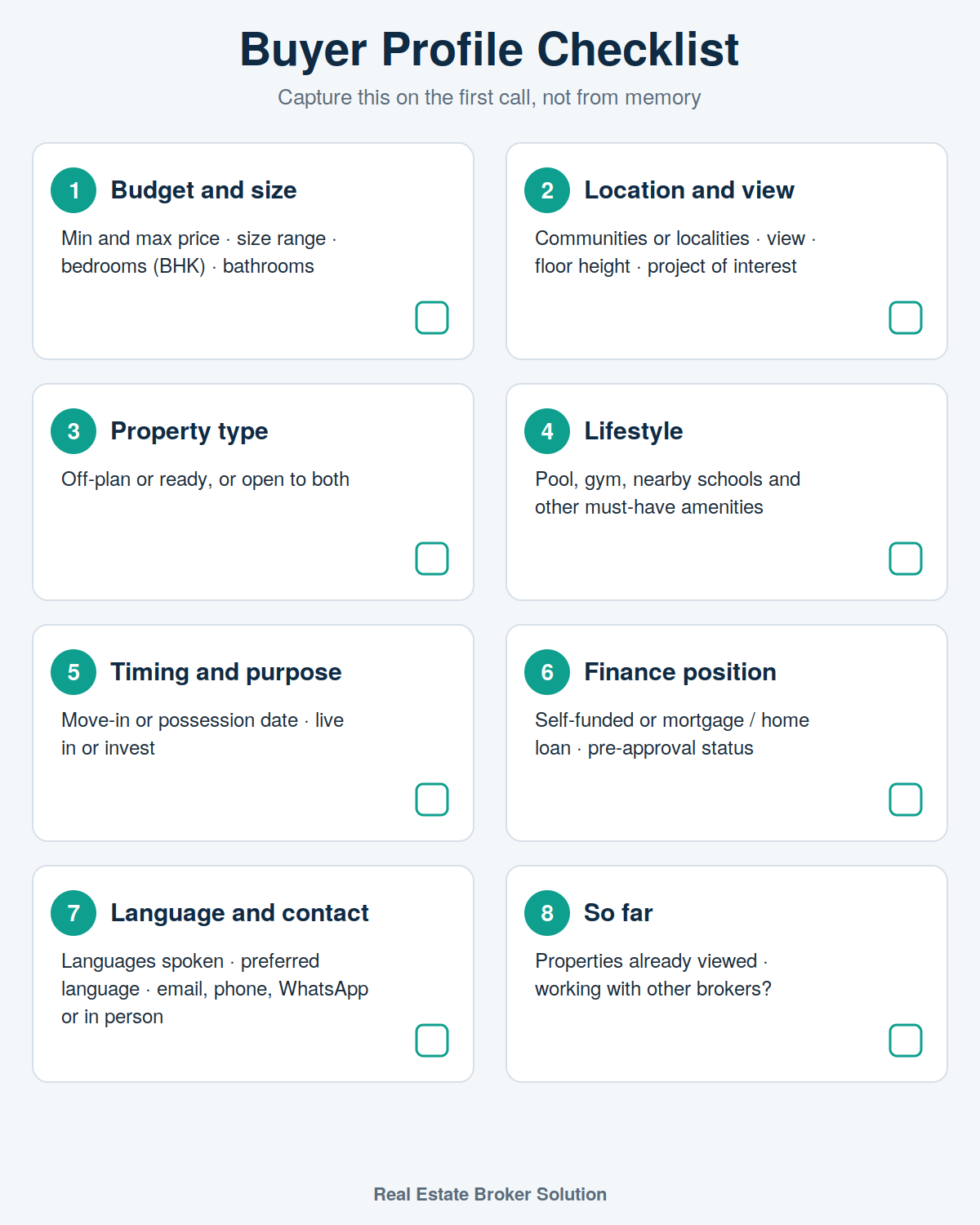
The single most useful thing an agent can do on the first call is to turn "about three million, sea view" into a proper profile. It is what lets them suggest the right alternatives when the first unit is gone, and it is what a colleague needs if they ever take the lead over.
- Budget and size: minimum and maximum price, size range, bedrooms (or BHK) and bathrooms.
- Location and view: preferred communities or localities, view, preferred floor height and the project they are interested in.
- Property type: off-plan or ready, and whether they are open to both.
- Lifestyle: lifestyle preferences and the amenities that matter, such as a pool, a gym or nearby schools.
- Timing and purpose: the move-in or possession date and why they are buying, for example to live in or as an investment.
- Finance position: self-funded, or mortgage / home loan required, and whether pre-approval is in place.
- Language and contact: the languages they speak, their preferred language and how they like to be contacted: email, phone, WhatsApp or in person.
- So far: whether they have already viewed properties and whether they are working with other brokers.
Building a Follow-Up Process That Gets Buyers to Viewings
The fix is to move everything the agent is holding in their head onto the lead itself, so every next step is scheduled, visible and shared. The Real Estate Broker Solution supports this process through eight capabilities.
1. Every Follow-Up Scheduled, Not Remembered
Calls, messages and tasks are scheduled as activities on the lead, with due dates and reminders. Each agent sees what is due today and what is overdue, and managers can see the same list for the whole team.
2. Viewings and Site Visits on a Shared Calendar
Viewings, site visits and meetings are scheduled against the opportunity on a shared calendar, with reminders, and the pipeline has its own Viewing/Meeting stage. The team can see who is
showing which unit and when, which helps reduce double bookings and forgotten viewings.
3. The Right Language and the Right Channel
Each client record stores the languages the client speaks, their preferred language and their preferred contact method. The agent knows before the first follow-up whether to call, email or send a WhatsApp message, and in which language.
4. A Buyer Profile Instead of a Single Unit
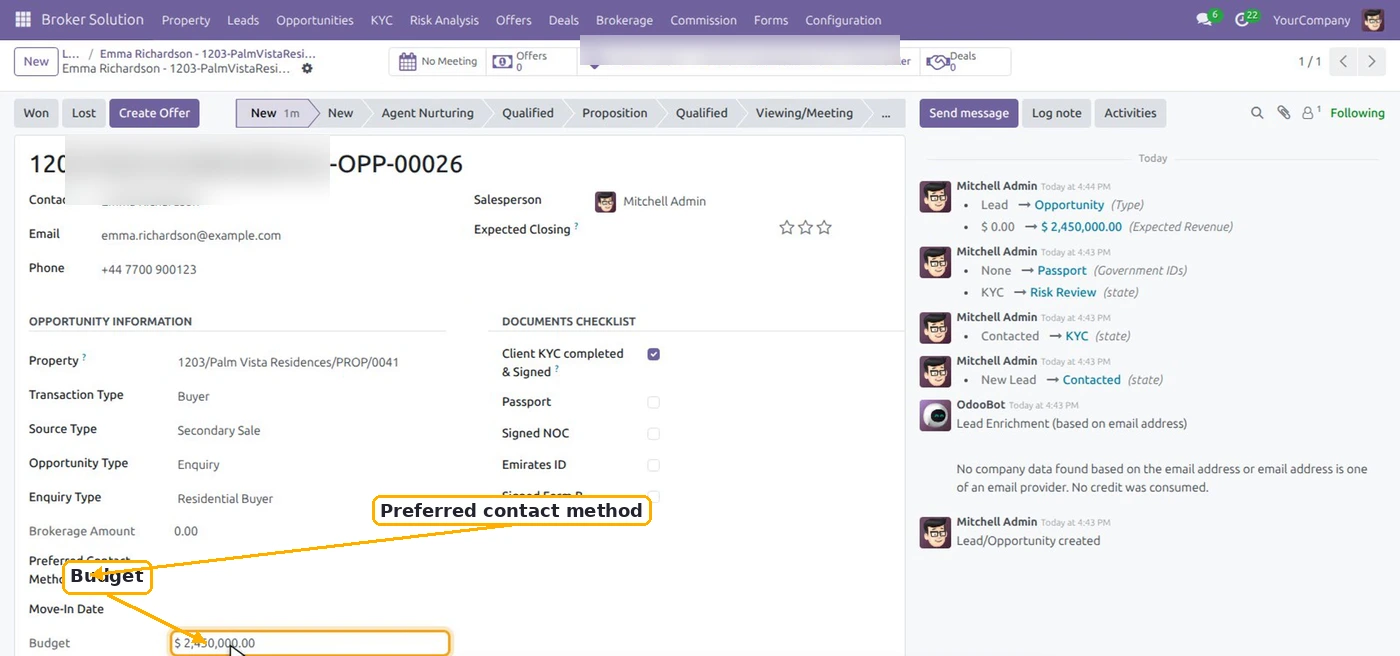
Every buyer enquiry carries the full profile above. When the enquired property is no longer available, the agent shortlists alternatives from the buyer's own requirements instead of closing the lead.
5. Finance Position from the First Conversation
Each buyer is recorded as self-funded or loan required from the first call. Agents plan viewings and timelines around it, and a buyer who needs a mortgage or home loan is prepared for pre-approval early instead of discovering it at the offer stage.
6. Buyer and Seller Linked on the Same Property
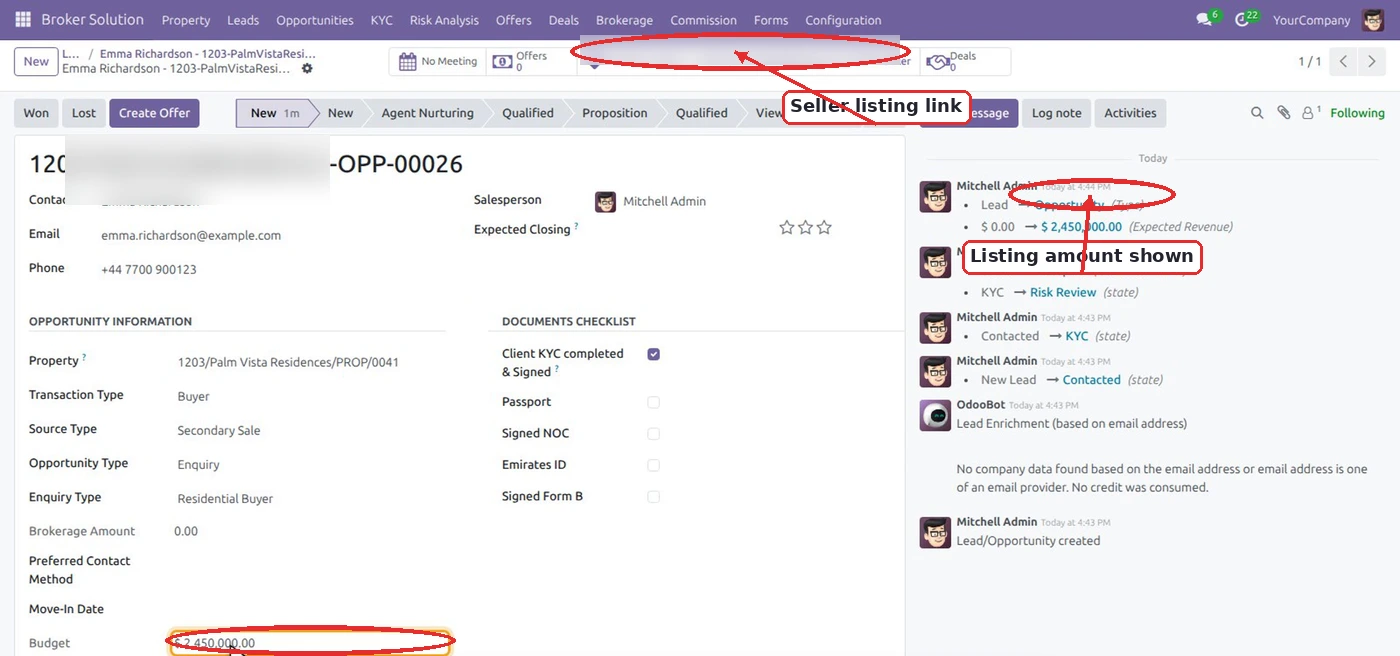
When a buyer's opportunity is linked to a property, the platform finds the seller's listing opportunity for the same unit automatically. The listing price is shown on the buyer's side, and each agent can open the other side from a smart button. Both sides of the deal meet on the same property record.
7. A Reason for Every Lost Lead
When a lead does not go ahead, it can be closed with a written reason. Over time, managers can see whether the brokerage is losing buyers on price, on speed or on stock, and fix the right problem.
8. Client History That Stays with the Company
All leads, clients, owners, activities and conversations are stored in the company system, not on personal phones. When an agent leaves, their leads are reassigned and the new agent picks up where the last one stopped.
Add-ons for Follow-Up and Matching
Two capabilities make this stage even stronger for brokerages with high lead volumes. Both are available on request and tailored to your brokerage.
- WhatsApp integration (add-on): WhatsApp conversations and viewing reminders are linked to the lead record, so the chat history stays with the agency, not on the agent's phone.
- Automatic property matching (add-on): every active listing is compared with each buyer's profile, and agents are alerted when a new listing fits a buyer's requirements.
Follow-Up from Memory vs a Connected Process
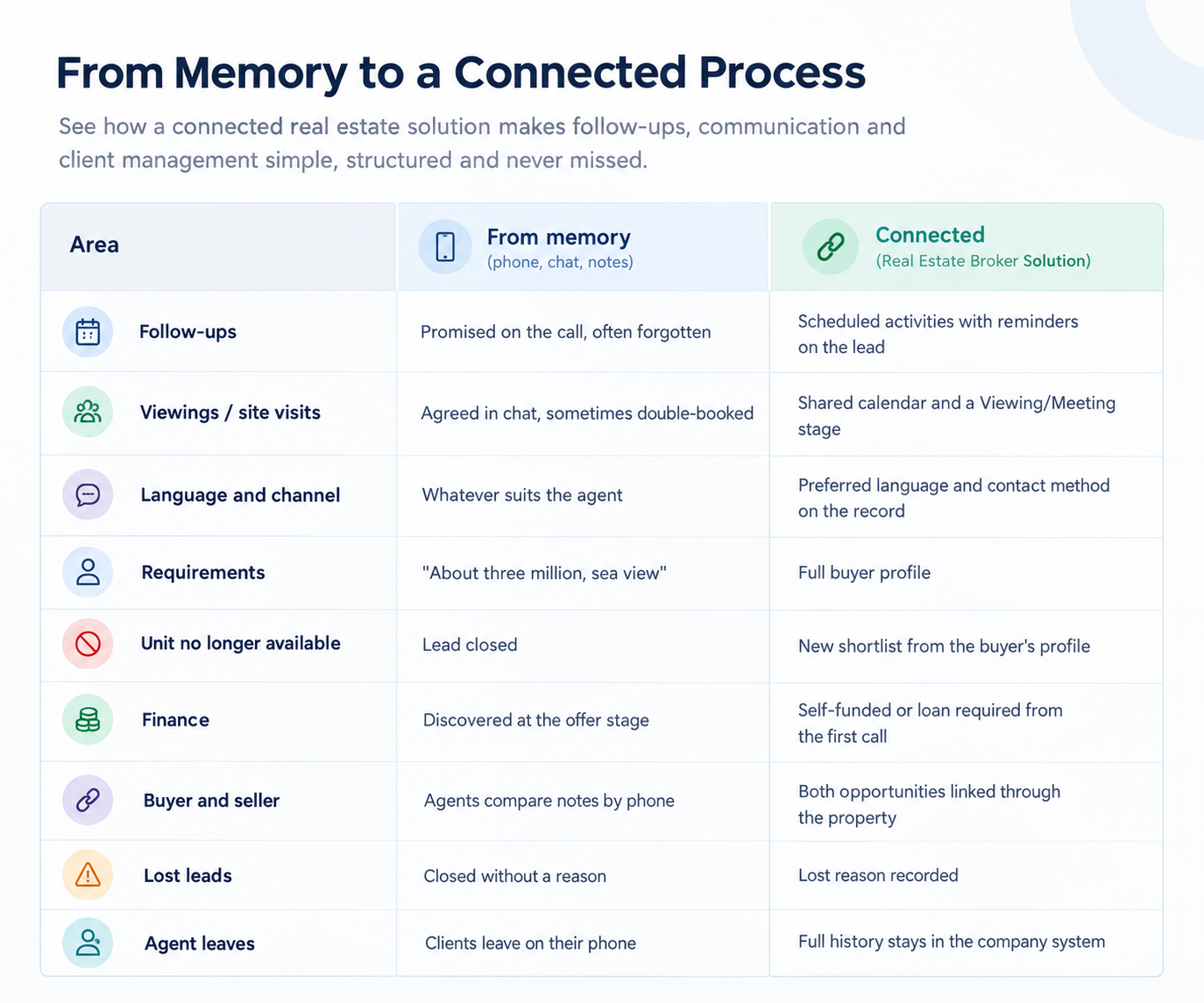
Executive Summary
- Many enquiries are lost not on the first call but in the days after it, between "interested" and "booked a viewing".
- Scheduled follow-ups and a shared viewing calendar stop the small, forgettable steps from being forgotten.
- A full buyer profile, including finance position, language and channel, lets agents suggest the right alternatives and talk to buyers the way they prefer.
- Linking the buyer's and seller's opportunities through the property keeps both agents working from the same facts.
- Lost reasons and a company-owned client history turn every lost lead into a lesson and protect the pipeline when agents change.
Deep-Dive FAQ
Can agents see which follow-ups are due today?
Yes. Follow-ups are scheduled as activities on each lead, so every agent has a list of what is due today and what is overdue, and managers can see the same for the whole team.
Can the whole team see who is showing which property?
Yes. Viewings and site visits are booked on a shared calendar against the opportunity, so the team can see every appointment and avoid booking the same unit twice.
Can we record that a client prefers WhatsApp or a particular language?
Yes. Each record stores the languages the client speaks, their preferred language and their preferred contact method: email, phone, WhatsApp or in person. Linking the WhatsApp conversations themselves to the lead is available as an add-on.
What happens when the property a buyer asked about is no longer available?
The buyer's profile holds their budget, size, communities or localities, view, lifestyle, timing and finance position, so the agent can shortlist similar properties straight away instead of closing the lead.
Can we record whether a buyer needs a mortgage or home loan?
Yes. Each buyer is recorded as self-funded or loan required from the first conversation, so agents can plan viewings and timelines around it.
What happens to a client's history when an agent leaves?
It stays. Leads, activities, messages and notes are stored in the company system. The leads are reassigned to another agent, who sees the full history from the first call.
Can we see why leads are lost?
Yes. Leads that do not go ahead can be closed with a written reason, so managers can see patterns and act on them.
Connect Your Real Estate Workflows with Odoo
From lead management and property listings to sales, accounting, and reporting, Odoo can bring essential real estate operations into one connected system. Read more about how real estate firms are cutting costs and closing deals faster with Odoo ERP. ERP Consulting Group helps businesses configure Odoo around their specific processes and operational needs. Let's discuss how Odoo can fit your real estate business. Email: info@erpconsulting24.com |

 Recent Posts


 Free Consultation