
A solar panel manufacturing line can meet its planned output and still miss a delivery commitment. Production may be completed, but the order cannot leave the plant because quality clearance is pending, the finished modules have not been allocated correctly, packaging is incomplete or transport has not been coordinated.
For solar panel manufacturers, the challenge is not only how many modules the factory produces. It is how reliably production, quality, warehouse and dispatch teams work toward the same order deadline.
ERP Consulting Group works with manufacturing workflows where production, inventory and delivery information needs to remain connected. In solar manufacturing, that connection matters because a delay at one stage can affect every activity that follows it.
Understanding where these bottlenecks occur is the first step towards reducing avoidable waiting, improving production visibility and making delivery commitments more reliable.
Why Production Scheduling and Dispatch Become Disconnected
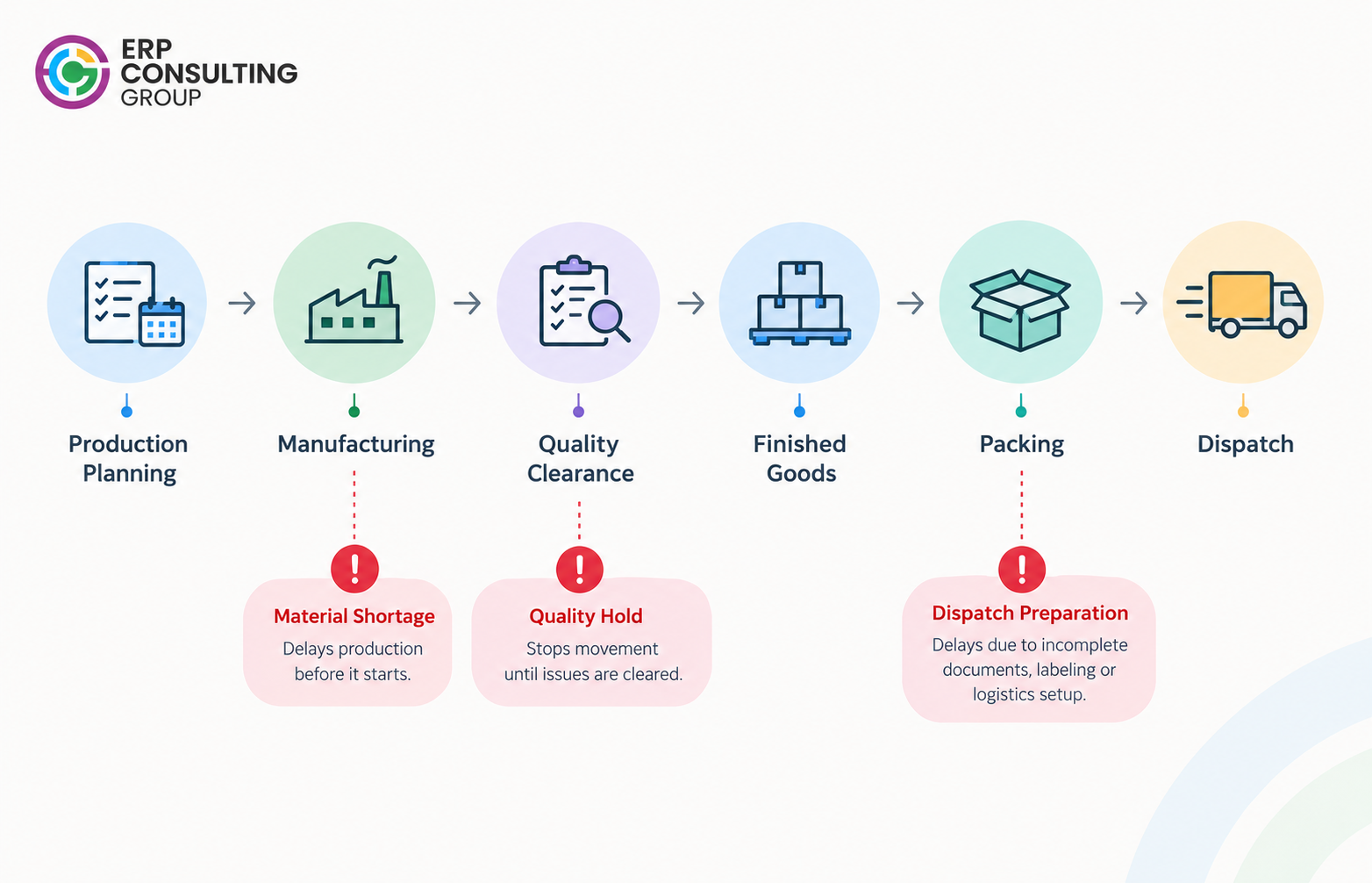
A production schedule translates demand into planned manufacturing activity. It considers which products need to be manufactured, when production should begin, what materials are required and how available capacity will be used.
Dispatch has a different immediate responsibility: ensuring the correct finished products are ready, documented, packed and available to leave the facility on time.
Both activities depend on each other, but they are often managed through different spreadsheets, departmental updates or standalone records. Production may report that an order is complete while the warehouse is still checking quantities. Dispatch may plan a shipment based on an expected completion date that has already changed.
The result is a gap between what the factory planned to produce and what it can actually deliver.
This gap can become more difficult to manage when a plant handles multiple module specifications, production orders, customer deadlines and shipment quantities simultaneously.
1. Production Schedules Do Not Always Reflect Actual Material Availability
A production plan is only as reliable as the information behind it.
Solar module manufacturing depends on the availability of the components specified for each product. Depending on the module design, these may include solar cells, glass, encapsulant materials, backsheets where applicable, frames, junction boxes and other electrical components.
A schedule may allocate a production run for a particular date, but one required component might still be in transit, awaiting inspection or reserved for another order.
The production team then faces a choice: wait for the missing material, rearrange the schedule or prioritise another production run. Each option can affect labour allocation, machine utilisation and downstream commitments.
What manufacturers should address
- Check material requirements against available, reserved and incoming stock before confirming production dates.
- Distinguish physically received materials from those that have been released for use.
- Identify which production orders depend on delayed or restricted components.
- Coordinate procurement updates with production planning rather than relying on separate status reports.
A more realistic schedule accounts for material readiness instead of assuming that the inventory quantity shown in a report is automatically usable.
2. Changes on the Production Line Do Not Reach Dispatch in Time
Manufacturing schedules are plans, not guarantees. Equipment interruptions, process adjustments, rework, staffing constraints or changes in production priorities can affect the expected completion of an order.
The problem becomes more serious when the updated production status does not reach the teams responsible for packing and delivery.
Consider an illustrative scenario: a plant plans to complete a customer order by Thursday, with dispatch arranged for Friday. A production run takes longer than expected, but the original completion date remains in the dispatch team's spreadsheet.
The warehouse prepares for a shipment that is no longer ready. Transport coordination may need to be revised, and the customer may receive a later delivery estimate.
The issue is not simply that production was delayed. It is that the delay did not trigger a timely update to the next stage.
What manufacturers should address
Production orders should have clear statuses, planned and actual completion dates, and a defined process for communicating changes. When a schedule changes, the people responsible for quality, finished goods and dispatch need to know whether their commitments are still achievable.
A shared view of order progress helps teams respond to changes earlier rather than discovering them when a shipment is due.
3. Quality Clearance Creates a Gap Between Production Completion and Dispatch
A completed production order does not necessarily mean that every finished module is ready to ship.
Modules may require inspection, testing, grading, documentation or a quality release according to the manufacturer's process and applicable requirements. Some output may be held for investigation or rework.
If production completion and quality clearance are recorded separately, the dispatch team may see an order as finished without having a clear view of how much output has actually been released.
This can create confusion when only part of an order is ready. The factory may have completed the planned run, but the quantity available for shipment may be lower than expected.
What manufacturers should address
- Record production completion separately from quality release.
- Make the quantity awaiting inspection or rework visible.
- Confirm the released quantity before allocating modules to a shipment.
- Ensure quality holds are communicated to the relevant production and dispatch teams.
Quality checks should not be bypassed to protect a delivery date. Instead, the schedule should account for the time and decisions required to release finished products.
4. Finished Goods Are Not Allocated to Customer Orders Clearly
Once modules are released, manufacturers still need to identify which finished goods are intended for each customer order.
A plant may hold output from multiple production runs, product configurations or batches. Some quantities may already be reserved for confirmed orders, while others remain unallocated. Without clear allocation records, teams may need to reconcile warehouse reports, production sheets and sales updates before preparing a shipment.
For example, a manufacturer may have completed 5,000 modules, but those modules are not necessarily all available for a single customer. Some may be committed to another order, awaiting a final check or stored in a different location.
The total finished-goods quantity alone does not answer whether a specific customer order can be fulfilled.
What manufacturers should address
Maintain a clear relationship between finished-goods availability, customer orders, product specifications and relevant batch or serial records. Before dispatch planning begins, teams should confirm the quantity that is both released and allocated to the intended order.
This reduces the risk of making shipment plans from an overall stock figure that hides existing commitments.
5. Packing and Dispatch Preparation Begin Too Late
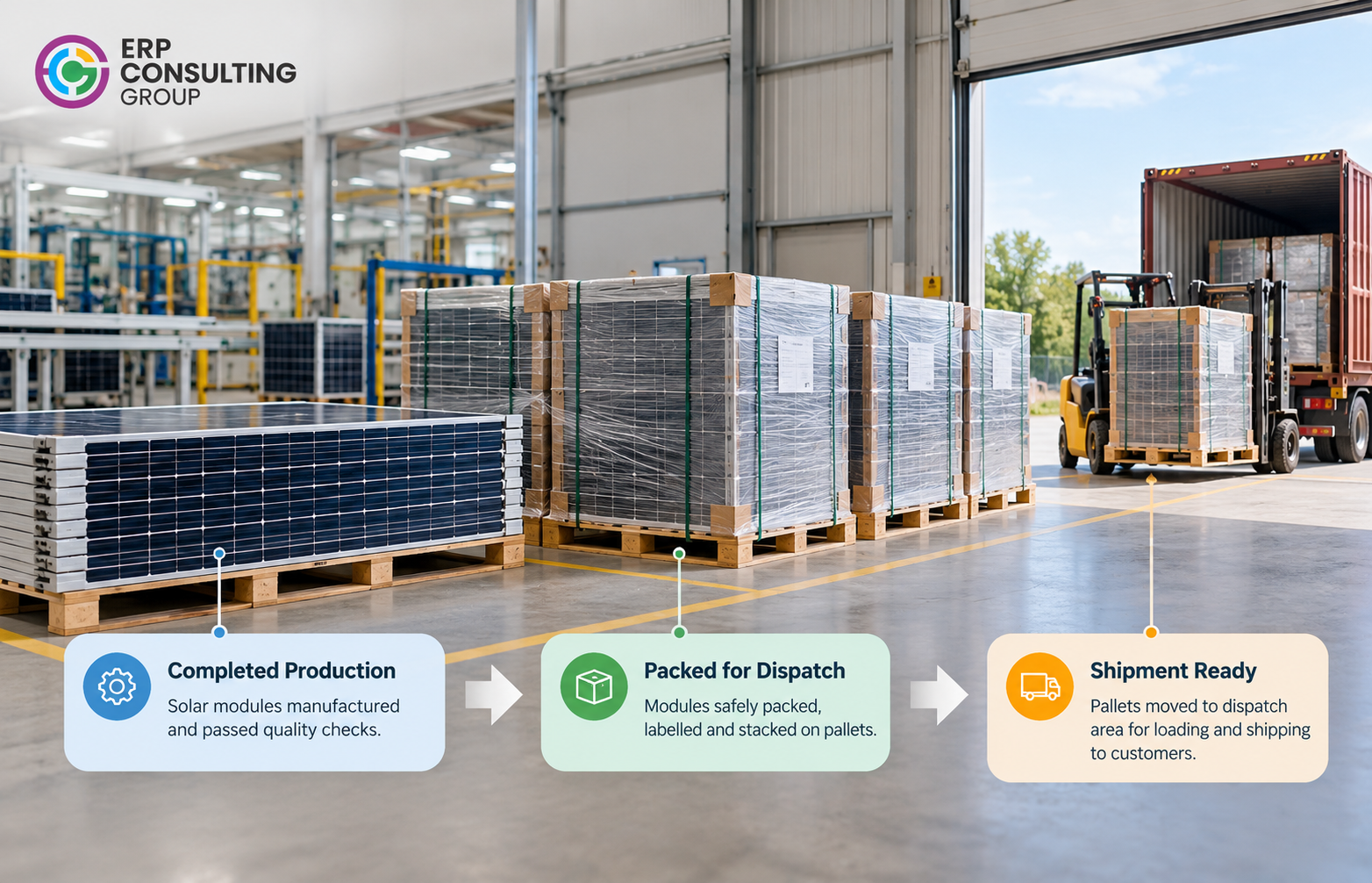
Dispatch involves more than arranging a vehicle. The required modules need to be identified, picked, checked, packed and matched with the relevant shipment and customer documentation.
If these activities begin only after production is reported complete, the dispatch team may have insufficient time to prepare the order. This is particularly challenging when multiple shipments compete for warehouse space, packing resources or loading capacity.
A finished order can therefore remain inside the plant even when the manufacturing work itself is complete.
What manufacturers should address
Plan packing and dispatch preparation around realistic production completion and quality-release estimates. Where practical, prepare order details and documentation in advance, while keeping final quantities subject to confirmed production and release status.
A clear dispatch checklist should identify the order, released quantity, required packing, shipment documentation, loading arrangements and any remaining approval.
The objective is to remove avoidable waiting without treating unfinished or unreleased modules as ready to ship.
6. Production, Warehouse and Transport Teams Work From Different Updates
One of the most persistent bottlenecks is not a machine or a shortage. It is inconsistent information.
Production may maintain the latest completion status in one file. The warehouse may track finished goods in another. Sales may communicate the delivery promise, while dispatch maintains a separate shipment schedule.
When these records are not updated together, different teams can make reasonable decisions based on different versions of the same order.
This makes routine questions harder to answer:
- Has the production order actually been completed?
- How much output has passed the required checks?
- Which quantity is allocated to this customer?
- Is the shipment packed and documented?
- Does the current dispatch plan still meet the promised date?
What manufacturers should address
Create a common order-level view that connects production progress, quality status, finished-goods allocation and dispatch readiness. Define who updates each status and when other teams need to be notified.
A shared workflow will not eliminate every delay, but it can help teams identify the next constraint earlier and avoid acting on outdated information.
Bottleneck | What goes wrong | What needs to improve |
Material availability | A scheduled run lacks a required component | Check usable stock and incoming supply before scheduling |
Production changes | Revised completion dates do not reach dispatch | Share updated order status across teams |
Quality clearance | Completed output is mistaken for released stock | Track production completion and quality release separately |
Order allocation | Total inventory is mistaken for available stock | Connect released quantities to customer orders |
Dispatch preparation | Packing and paperwork start too late | Prepare shipment activities around realistic readiness dates |
How to Improve Scheduling and Dispatch Coordination
Manufacturers do not need to start by adding more reports. They need to identify the points where a change in one department affects the next department.
A practical improvement process includes five steps.
1. Map the order from production planning to delivery
Document the steps an order passes through: material readiness, production scheduling, manufacturing, quality clearance, finished-goods allocation, packing and dispatch. Identify which team owns each step and what information is needed before the next activity can begin.
2. Separate planned dates from actual status
Track planned production completion alongside actual progress. Make delays, quality holds and changes in expected readiness visible. This helps dispatch teams plan around the current situation instead of relying on the original schedule.
3. Define clear readiness criteria
Agree on what “production complete,” “quality released,” “ready for packing” and “ready for dispatch” mean in the plant. These statuses should represent distinct operational conditions rather than interchangeable descriptions.
4. Coordinate production priorities with customer commitments
When a production order changes, assess which customer orders and shipments may be affected. Prioritisation should consider material availability, production capacity, release requirements and delivery commitments not just which job is easiest to run next.
5. Review recurring causes of delay
Record why orders miss their planned production or dispatch dates. Group the causes into categories such as material shortages, schedule changes, rework, quality holds, allocation issues, packing delays and transport coordination.
Reviewing these patterns helps management distinguish isolated incidents from recurring bottlenecks that require process changes.
Where a Connected Manufacturing ERP Can Help
When production, inventory, quality, sales and dispatch are managed through disconnected tools, teams may spend considerable time reconciling information before making decisions.
A suitably configured manufacturing ERP can connect these activities through shared records and defined workflows. Depending on the implementation, it can help teams:
- Compare production requirements with available and incoming materials.
- Track production orders and planned versus actual progress.
- Record material consumption and completed output against production orders.
- Distinguish finished products awaiting quality clearance from released stock.
- Connect finished-goods allocation to customer orders.
- Record relevant batch or serial details and link products to dispatch transactions.
- Give teams a clearer view of order status before confirming or revising delivery commitments.
An ERP does not automatically solve poor scheduling, supplier unreliability, equipment downtime or unclear responsibilities. The value depends on accurate data, suitable configuration and consistent use by the people responsible for each workflow.
For a broader overview, read our Guide to ERP for solar panel manufacturers. For the material side of the process, see Solar Manufacturing Inventory Management: Raw Material to Module.
From Production Completion to Reliable Dispatch
Production performance should not be judged only by the number of modules completed on the line. Manufacturers also need to understand how much output has been released, allocated, packed and dispatched against the original order plan.
A production schedule that ignores material readiness can create avoidable changes. A finished-goods report that ignores quality holds can overstate availability. A dispatch plan that does not reflect actual production progress can put delivery commitments at risk.
Connecting these stages gives teams a more accurate view of what can be delivered and what still needs attention.
Executive Summary
- Plan around real readiness: Production schedules should account for material availability, production capacity and the time required for quality clearance.
- Connect production with dispatch: Keep production status, released quantities, customer-order allocation, packing and shipment preparation aligned.
- Investigate recurring bottlenecks: Track the reasons for schedule and dispatch delays so that process improvements address their actual causes.
Frequently Asked Questions
1. What causes production scheduling delays in solar panel manufacturing?
Delays can result from unavailable materials, changes in production priorities, equipment interruptions, rework, capacity constraints or inaccurate planning information. The impact often increases when schedule changes are not communicated to downstream teams.
2. Why can solar panel dispatch be delayed after production is complete?
Finished modules may still require quality clearance, allocation to a customer order, packing, documentation or loading arrangements. Production completion and dispatch readiness should therefore be tracked as separate stages.
3. How can solar manufacturers improve production and dispatch coordination?
They can map the order workflow, establish clear status definitions, update planned and actual completion dates, connect quality-release information with finished-goods availability and review recurring reasons for missed dispatch dates.
4. Can ERP software help reduce manufacturing and dispatch bottlenecks?
A suitably configured ERP can improve visibility across material planning, production orders, inventory, quality, customer orders and dispatch. Results depend on process design, data accuracy, implementation and how consistently teams use the system.
Improve Visibility Across Your Solar Manufacturing Workflow
When production, inventory, quality and dispatch operate from disconnected records, it becomes harder to know whether an order is genuinely ready to ship. ERP Consulting Group helps businesses assess and connect operational workflows using Odoo-based ERP solutions. The right starting point is understanding where information stops moving between teams and which delays repeatedly affect delivery commitments. To discuss your solar manufacturing workflow, contact info@erpconsulting24.com. |
 Recent Posts





 Free Consultation