
This is Part 1 of our series breaking down the 7 operational modules fromThe Complete Guide to Solar Business Management Software (2026)- this piece goes deeper on the first: Lead & Sales Pipeline.
A high-value solar lead rarely disappears with a clear "lost" status.
A customer sends an enquiry on WhatsApp. Sales shares it with the field team. The engineer sends photographs and measurements back through another chat. The estimator prepares the BOM in Excel. A quotation is emailed to the customer, and the next follow-up depends on someone remembering to make it.
Nobody intentionally loses the lead. The lead simply gets stuck.
For a C&I or utility-scale Solar EPC, this becomes expensive. When customer information, site surveys, single-line diagrams, BOMs, quotations, and follow-ups are scattered across different tools, nobody has a complete view of what is happening. The result is lead leakage.
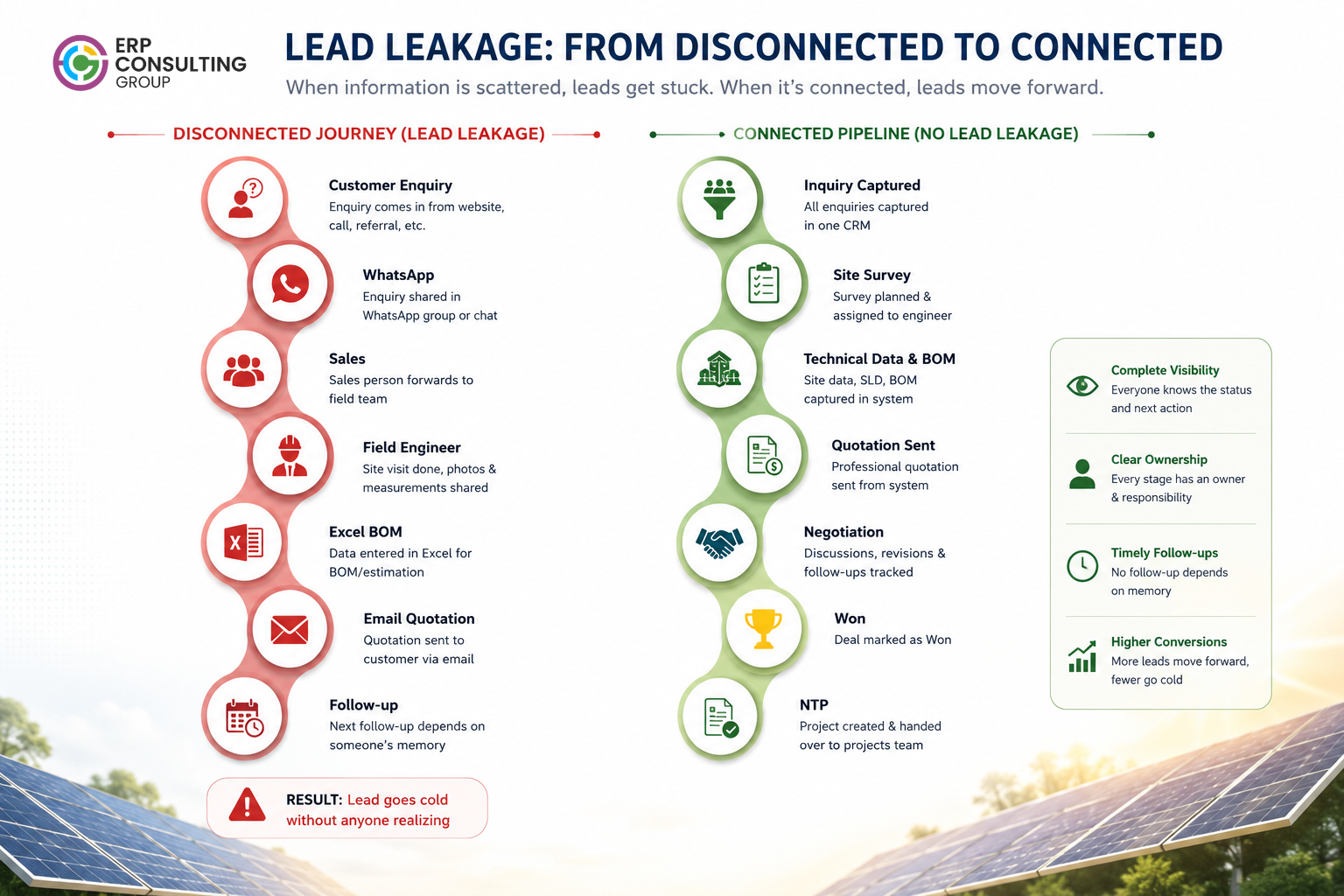
This kind of leakage is rarely a sales-skill problem - it's a structural one, and it tends to show up the moment a company scales past what one person can track from memory. ERP Consulting Group works with growing Solar EPC teams on exactly this gap, connecting the pipeline to site surveys, quotations, and procurement inside a single Odoo-based system instead of a patchwork of chats and spreadsheets.
A structured pipeline changes this by connecting the opportunity from:
Inquiry → Site Survey → Quotation → Negotiation → Won → NTP, while making ownership and the next action visible at every stage.
The Real Cost of Scattered Sales Tracking
WhatsApp and Excel are useful tools. The problem begins when they become the system used to manage the entire sales process.
The first problem is accountability. A message saying "follow up tomorrow" does not tell management whether the action happened, who owns it, or what is preventing the opportunity from moving forward.
The second is lost context. Solar opportunities generate technical and commercial information at every stage - site photographs, measurements, single-line diagrams, BOM changes, quotations, customer objections, and negotiation history. When this information sits across different platforms, employees spend time reconstructing what has already happened instead of moving the opportunity forward.
The risk becomes greater when a salesperson leaves. If the relationship has been managed mainly through personal chats and private spreadsheets, the company may retain the customer's contact details but lose the history behind the opportunity.
There is also a forecasting problem. Management may know the total value of open opportunities, but not necessarily which ones are genuinely progressing, which quotations are waiting for a response, or which leads have had no activity for weeks.
A structured pipeline makes ownership, stage, activity, and next action visible in one place.
Your Sales Pipeline Can Also Forecast Procurement Demand
A Solar EPC's sales pipeline is usually viewed as a revenue forecast. It can also become an early signal for procurement.
Consider a C&I opportunity that has completed its site survey, has a preliminary BOM, and has moved into quotation or negotiation. The project is not confirmed yet, but the business already has useful information about its likely capacity, configuration, location, and material requirements.
That information can help procurement prepare. If several high-value opportunities are approaching closure around the same period, procurement can evaluate potential requirements for modules, inverters, structures, cables, and other BOM components. This does not mean purchasing for every open lead - it means giving the supply chain earlier visibility into probable demand.
An enquiry has low certainty. A surveyed project with an accepted technical proposal and active negotiation provides a stronger signal. As the opportunity moves closer to contract and NTP, the forecast becomes more useful.
The connection becomes:
Sales Pipeline → Expected Projects → Indicative BOM → Procurement Visibility → Execution Planning.
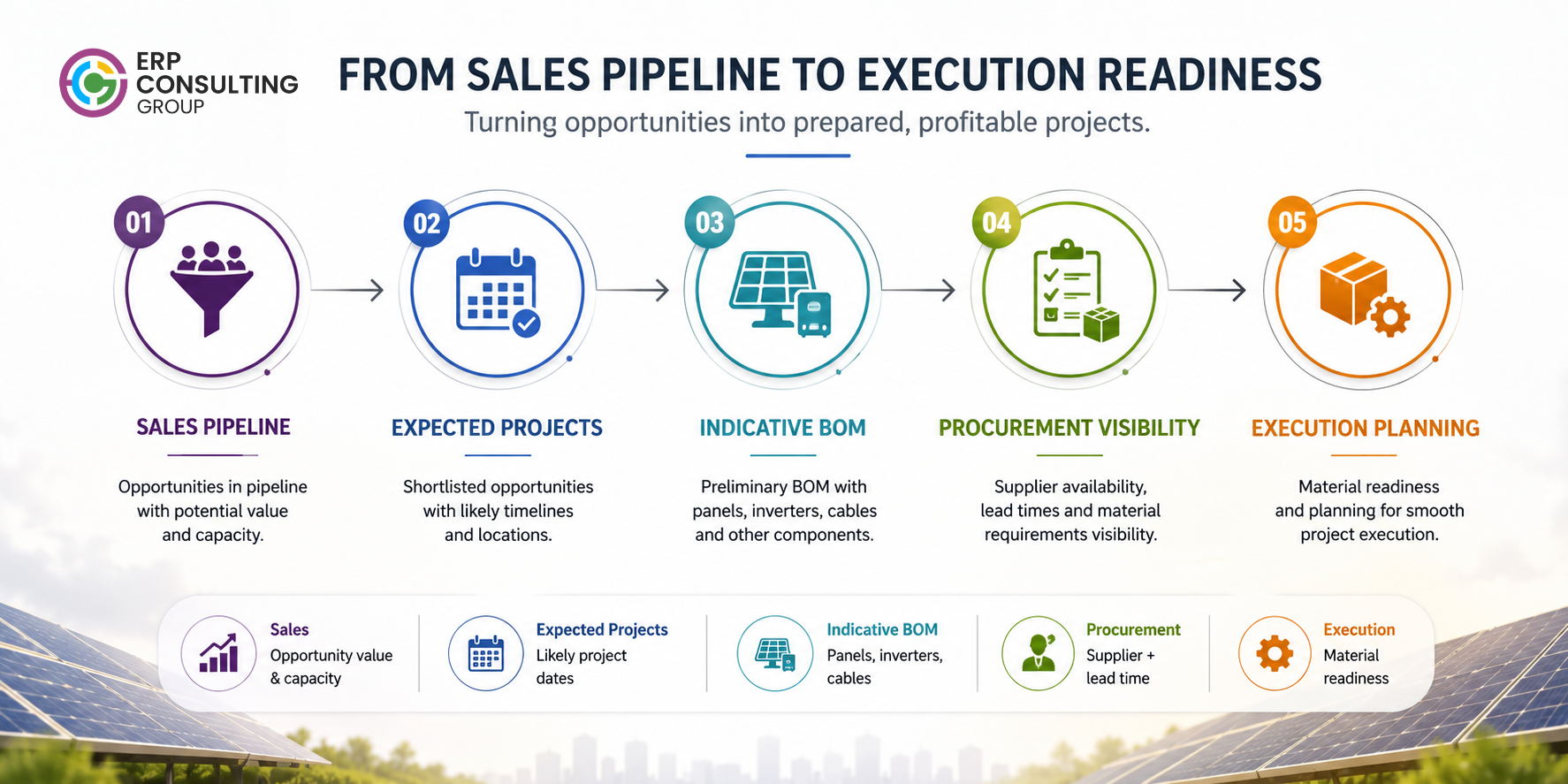
This allows procurement to consider supplier availability, lead times, and potential material constraints before the project becomes an urgent requirement.
Building a Connected Solar Sales Pipeline
The objective is not to replace every WhatsApp conversation with another data-entry task. It is to create one operational record around the opportunity and make important information available to the people who need it. Below is what that looks like in practice, regardless of which system runs it.
Omni-Channel Capture
Solar enquiries can arrive through websites, referrals, social media, campaigns, channel partners, or direct conversations. The source can differ, but the opportunity should enter one common pipeline.
A structured CRM record can bring together the customer, project location, requirement, lead source, responsible salesperson, activities, documents, and opportunity status. This prevents the same lead from becoming a WhatsApp conversation for sales, an Excel row for management, and a separate file for engineering.
Milestones to NTP
A useful Solar EPC pipeline should represent actual business progress:
Inquiry → Qualification → Site Survey → Technical Evaluation → Quotation → Negotiation → Won → NTP.
At the survey stage, the field team can capture measurements, photographs, electrical information, and single-line diagrams. At the quotation stage, this technical information supports the BOM and commercial proposal. During negotiation, changes to capacity, equipment, scope, or pricing remain connected to the opportunity. Once the contract is won, the information can move into the project workflow instead of being recreated manually.
The objective is simple: the pipeline should show progress, not just activity.
Next-Action Visibility
The most important question in a pipeline is often not "What stage is this lead in?" It is "What happens next?"
If an estimator needs additional site information, that requirement should be visible. If a quotation needs revision, someone should own the action. If the customer is waiting for a response, the follow-up should not depend on memory.
This creates a controlled handoff between sales, field engineering, estimation, and management. A lead should always have a clear owner, status, and next action.
The Old Way vs. The Connected Way
Sales Process | Scattered WhatsApp + Excel | Connected Pipeline |
Lead capture | Enquiries remain across channels | Leads enter a common pipeline |
Ownership | Depends on individual tracking | Responsible owner is visible |
Follow-up | Personal reminders and memory | Defined activities and next actions |
Customer history | Chats, emails, and files separated | Information stays with the opportunity |
Site survey | Updates shared manually | Survey activity linked to opportunity |
Technical data | Photos and diagrams scattered | Documents connected to the record |
BOM | Separate spreadsheets and versions | Connected to quotation/project workflow |
Quotation | Status tracked manually | Quotation progress is visible |
Negotiation | History buried in conversations | Commercial activity remains with opportunity |
Forecasting | Manual updates and assumptions | Structured pipeline stages |
Procurement | Visibility arrives later | Earlier view of probable demand |
Handover | Information recreated manually | Won opportunity feeds the next workflow |
Management | Multiple trackers require consolidation | Centralized operational visibility |
Executive Summary
● Stop lead leakage: keep opportunities, customer history, technical information, quotations, and follow-ups in one connected pipeline.
● Improve supply visibility: use qualified sales opportunities to give procurement earlier signals about future BOM requirements.
● Connect the workflow: move from lead and site survey through quotation, NTP, and project execution without recreating information at each handoff.
A Solar EPC does not necessarily need more tools. It needs fewer information gaps between sales, engineering, procurement, projects, and management.
If your team is still asking "Who has the latest quotation?", "Did the engineer send the survey?", or "Who is following up with this customer?" - the problem may not be your people. It may be the process they are working inside.
Deep-Dive FAQ
How do we stop sales representatives from bypassing the system?
The answer is not simply to ban WhatsApp. Sales teams use messaging because customers expect quick communication. The important distinction is between where the conversation happens and where the business record lives.
Approved CRM messaging integrations can help bring relevant customer interactions into the opportunity record, so the system remains the source of truth for ownership, follow-ups, quotations, documents, and opportunity history - rather than critical commercial information staying inside one employee's personal account.
How does a pipeline help field engineering teams?
A pipeline gives field teams more than a list of customers - it can define what needs to be completed before an opportunity moves forward.
For a C&I site survey, the workflow can include required information such as measurements, photographs, electrical details, load information, and single-line diagrams. Using mobile-friendly workflows and cloud document storage, engineers can update the relevant opportunity and attach supporting files while the information is still fresh. The estimator can then see whether the inputs required for the BOM are complete - reducing the repeated calls and messages between field and office teams.
Can the pipeline track net metering and grid interconnection?
Yes, when these requirements are built into the project workflow. Instead of one spreadsheet field saying "Approval Pending," regulatory processes can be broken into meaningful sub-stages - for example:
Application → Documentation → Submission → Inspection → Approval.
Net metering, grid-interconnection, and CEIG-related activities can be tracked against the project, with responsible owners and pending actions. The exact workflow should reflect the project's location, authority requirements, and contract structure.
How long does spreadsheet migration take?
There is no responsible fixed timeline - it depends on the number of spreadsheets, data quality, duplicates, historical records, integrations, customizations, and workflow complexity.
A sound migration approach moves through discovery, process mapping, and solution design before any configuration begins, followed by data preparation, testing, and a controlled go-live - rather than shutting down the existing process and starting fresh. Ask any vendor you're evaluating to walk you through their specific version of this before committing to a timeline.
Ready to Connect Your Site Survey to Project Execution?
ERP Consulting Group's RENEWvate tool, built on Odoo, connects lead requirements and quotations, BOMs, site inspections, and project materials in one workflow. We can help map your current sales process, identify where leads are being lost, and show how a connected pipeline would fit alongside the teams that pick up after a deal is won.
Start with your process, not a generic software demo - Book a Free Strategy Session or email info@erpconsulting24.com.
Ready to Fix the Gaps in Your Solar Sales Pipeline? This article is part of our Complete Guide to Solar Business Management Software (2026) - read the full guide for the other 6 modules, including subsidy tracking, GST- compliant invoicing, and after-sales service.
 Recent Posts


 Free Consultation