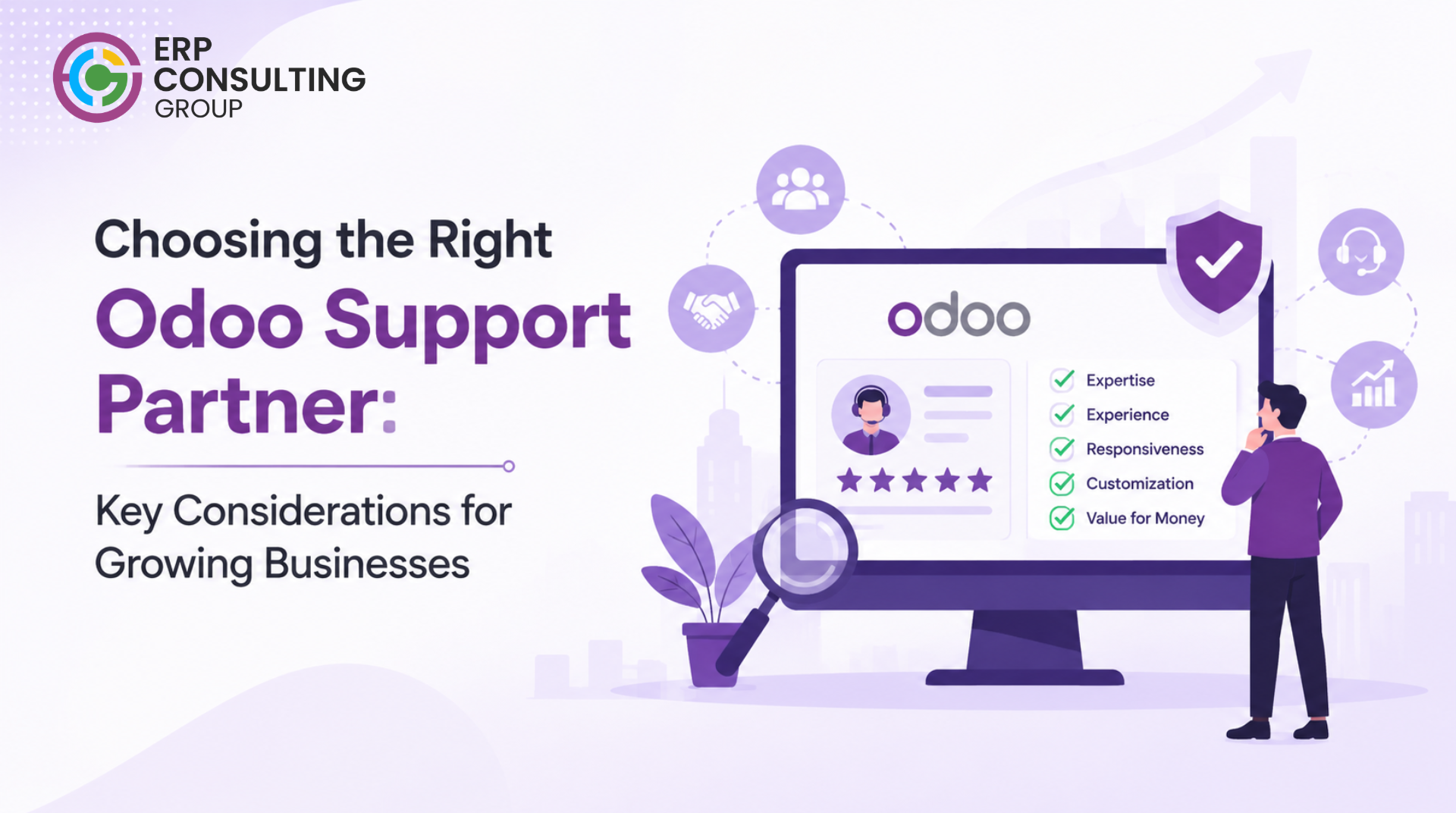
All Odoo Partners Say the Same Thing
Search for Odoo support partners, and you'll find dozens of providers all making similar claims. Certified developers. Proven process. Responsive support. Competitive pricing. The messaging is almost identical across the market.
So how do you choose? And more importantly, how do you avoid choosing the wrong partner and paying the price six months later?
We picked an Odoo partner based on a good sales call and a low price. Three months in, tickets took a week to get responses. Our 'dedicated developer' turned out to be a shared resource across twenty clients. We were rebuilding the relationship from scratch.
Choosing an Odoo support partner is not like buying software. It is a relationship that directly affects how reliably your business operations run. This guide gives you a practical, experience-based framework for evaluating Odoo support partners so you choose one that actually delivers.
Why the Wrong Partner Is Worse Than No Partner
Many businesses assume that any Odoo support partner is better than none. That is not always true.
The wrong partner creates specific problems:
The Risks of a Poorly Chosen Odoo Partner:
Slow ticket response disguised by SLA language full of exclusions.
Junior developers handling complex issues they are not qualified for.
Partners who 'support' Odoo but cannot develop or migrate custom modules.
Vendors who lock your documentation and code so switching is expensive.
Partners with no industry experience who misunderstand your business processes.
A bad support partner can introduce new problems while pretending to fix existing ones. Choosing carefully at the start is far less expensive than fixing a bad relationship mid-contract.
The Six Things That Actually Matter When Evaluating a Partner
2.1 Odoo Certification and Team Depth
Odoo certification matters, but what matters more is team depth. A single certified developer is a single point of failure. Ask how many certified Odoo developers the partner has on staff, and specifically whether they have specialists in the areas your business uses most: manufacturing, accounting, eCommerce, or custom development.
Questions to Ask:
How many certified Odoo developers do you have on staff?
Who specifically will be working on our account?
What happens if that developer is unavailable?
2.2 Industry Experience
Odoo behaves very differently across industries. A partner with deep manufacturing ERP experience understands work orders, BoM structures, and production flows. A partner who primarily does retail will struggle with manufacturing-specific configurations.
Ask specifically for case studies or references from businesses in your industry, not just general Odoo experience.
2.3 Written SLAs Not Verbal Promises
Every partner will tell you they respond quickly. What matters is what is written in the contract. Request their SLA schedule before any commercial discussion. If they don't have a standard SLA document, that is itself a signal.
Minimum SLA expectations for a credible Odoo support partner:
Priority Level | Expected Response SLA |
Critical system down | 2–4 hours |
High major module failure | 4–8 hours |
Medium partial impact | Within 24 hours |
Low minor or enhancement | Within 48–72 hours |
2.4 Transparency in Documentation and Knowledge Transfer
A trustworthy support partner documents what they build and configure, and that documentation belongs to you. Be wary of partners who maintain system knowledge internally without sharing it. This creates dependency and makes switching partners extremely difficult.
What to Request:
All custom module documentation in a format you can read and store.
Integration maps for any connected systems.
A monthly or quarterly support report showing what work was done.
Written handover documentation, if you ever choose to switch partners.
2.5 Version Migration Experience
Odoo releases a new major version every year. Your current partner will eventually need to migrate your system to a newer version. Ask directly: how many version migrations have you completed, and what is your methodology?
A partner who has never migrated a complex Odoo environment should not be your first call when you're on Odoo 17 and need to move to Odoo 18 or 19.
For context on what a proper Odoo migration involves, read: The Complete Guide to Odoo Support & Maintenance: What Every Business Needs to Know in 2026
2.6 Proactive vs Reactive Posture
The most important and hardest to evaluate difference between good and mediocre Odoo support partners is whether they are proactive or reactive.
A reactive partner waits for you to report problems. A proactive partner monitors your system, identifies issues before they surface, and tells you about them before you experience impact.
Ask during your evaluation: what does your proactive monitoring process look like? What do you monitor, how often, and what happens when you detect something?
Red Flags During Partner Evaluation
Red Flag | What It Usually Means | What to Do |
No written SLA document | Response time is informal, not guaranteed | Request one in writing before proceeding |
Only one developer on your account | Single point of failure for your entire ERP | Ask about backup coverage |
Cannot provide client references in your industry | Limited relevant experience | Ask for any references and verify them |
Pricing with no scope definition | Hidden costs will appear post-contract | Request a detailed scope document |
Promises everything without asking questions | Generic proposal, not tailored to your setup | A good partner asks before they propose |
No mention of documentation or knowledge transfer | They intend to retain system knowledge as leverage | Make documentation a contract requirement |
The Evaluation Process A Step-by-Step Approach
Use this process when evaluating Odoo support partners:
Step 1: Define Your Requirements First
- List your current Odoo modules, custom developments, and integrations.
- Define your critical business processes and which ones cannot afford downtime.
- Set your SLA expectations before speaking with any partner.
Step 2: Request Proposals from 2–3 Partners
- Provide an identical brief to each partner so proposals are comparable.
- Require all partners to respond to the same scope, not just pitch their standard packages.
Step 3: Evaluate Proposals Against Scope
- Does the proposed coverage match your stated requirements?
- Are SLAs written into the proposal, not just mentioned verbally?
- Is pricing tied to a defined scope, or is it open-ended?
Step 4: Conduct Technical Reference Checks
- Call at least two client references; do not rely on written testimonials.
- Ask references specifically about response time, issue resolution quality, and communication.
- Ask if they have experienced a major system failure and how the partner handled it.
Step 5: Review Contract Terms Before Signing
- Confirm all SLAs, exclusions, and scope are written into the contract, not just the proposal.
- Check the exit clause: how do you leave the contract if the relationship doesn't work?
- Confirm documentation and IP ownership terms.
Real Example Switching Partners After Getting It Wrong
Client Background: Distribution company. Odoo 16. 35 users. Custom freight cost module and Shopify integration.
The Original Partner
Selected based on the lowest AMC quote. The contract contained broad SLA language with exclusions for 'non-standard modules', which included their custom freight cost module, covering approximately 40% of their most critical workflows.
What Went Wrong
When the freight module broke after an Odoo update, the partner cited the exclusion clause. The fix was quoted at a separate emergency rate. The total cost of the fix exceeded the annual discount the business had received by choosing the lowest-priced partner.
The Switch
They moved to ERP Consulting Group with a clearly scoped AMC that explicitly listed all custom modules as covered. Within 90 days, the freight module was documented, optimized, and proactively maintained. No emergency billing since.
Our Recommendation
Choosing an Odoo support partner is a strategic decision, not a procurement exercise. The cheapest option rarely delivers the best outcome. The most important factors are team depth, written SLAs, industry experience, and a transparent documentation policy.
Take the time to evaluate properly. Request references. Read the contract carefully. And choose a partner who asks questions before they propose solutions because that is how you know they understand your business.
ERP Consulting Group: We invite any business evaluating Odoo support partners to request our AMC scope document, SLA schedule, and client references. We answer questions before we pitch. We scope before we price. And our contracts define exactly what is covered with no hidden exclusions.
Ready to evaluate ERP Consulting Group as your Odoo support partner? Request our AMC scope document and references

 Recent Posts


 Free Consultation