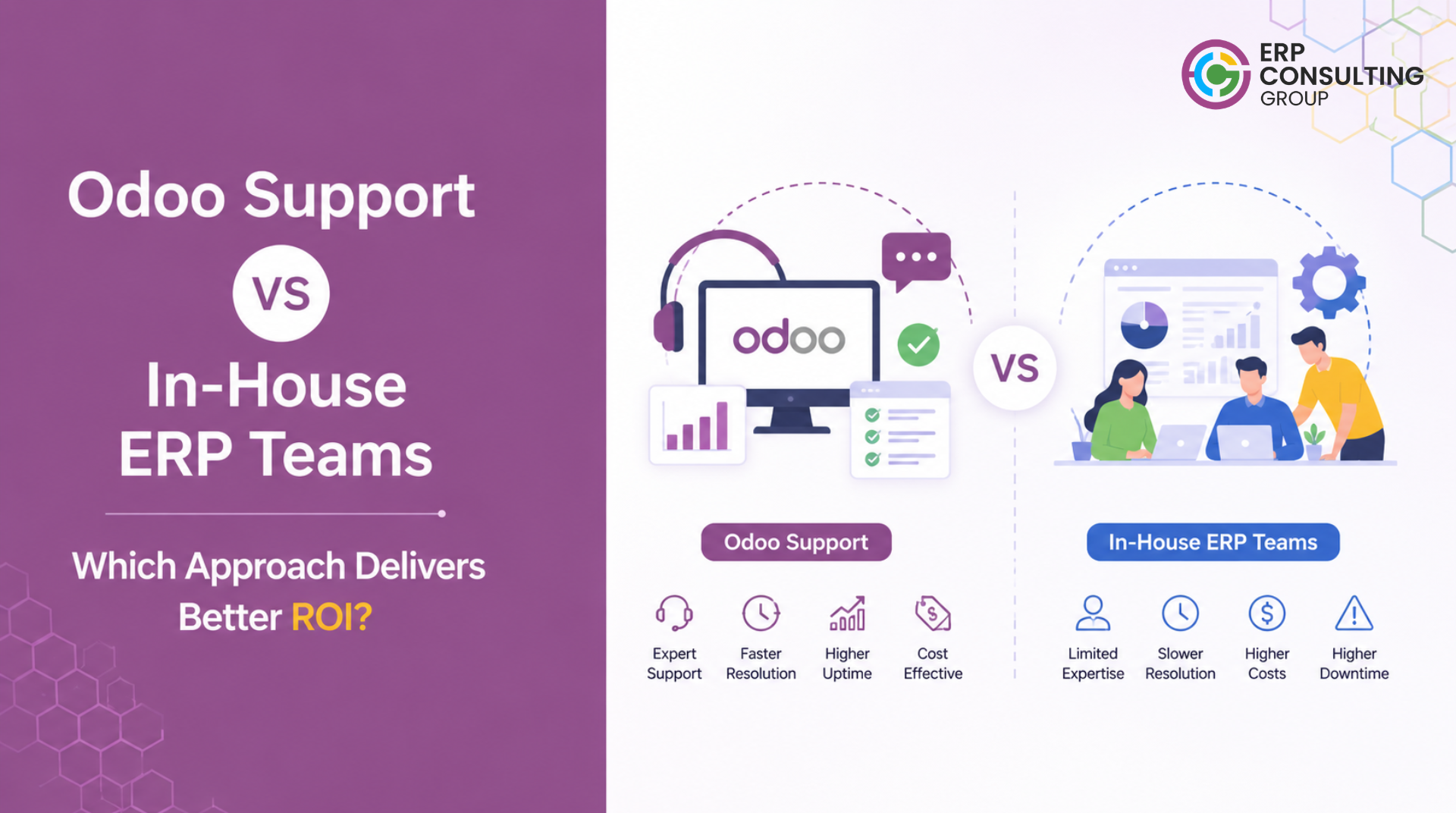
Businesses Face a Build-vs-Buy Decision They're Not Equipped to Make
When Odoo goes live and the implementation partner hands over the keys, businesses face a critical decision: who maintains this system going forward?
The two most common answers are: hire an internal ERP team, or engage an external Odoo support partner. Both feel logical. Both have real costs and real benefits. But very few businesses do the actual comparison before committing.
We hired an Odoo developer in-house because we thought it would give us more control. Eighteen months later, we were paying a full salary plus benefits and still calling external consultants for complex issues.
This guide gives you the framework to make this decision with clarity. We'll compare both models across cost, capability, availability, and long-term scalability and help you determine which approach or which combination actually delivers better ROI for your business.
What Each Model Actually Involves
The In-House ERP Team Model
You hire one or more Odoo-capable employees. They handle system administration, minor customizations, user support, and day-to-day ERP management. For major issues or upgrades, you either scale up internally or bring in external help.
The External Support Partner Model
You engage a certified Odoo partner on a retainer or AMC basis. Their team, which includes developers, consultants, and support staff, handles all maintenance, support, and technical requirements. You pay a defined fee. They deliver a defined service.
Cost Comparison The Real Numbers
Most businesses underestimate the true cost of an in-house Odoo team. Here is a realistic breakdown for a medium-complexity Odoo environment:
In-House Team (Annual Cost) | External AMC / Retainer (Annual Cost) |
1 Odoo Developer: USD 35,000–70,000 salary | AMC for medium complexity: USD 8,000–18,000 |
Benefits, insurance, PTO: +25–35% of salary | No benefits overhead |
Training and Odoo certifications: USD 2,000–5,000/year | Partner's team already certified |
Downtime during developer absence (illness, leave) | SLA-guaranteed continuity regardless of team changes |
Recruitment cost if developer leaves: USD 5,000–15,000 | Zero recruitment exposure |
Knowledge gap for complex/advanced Odoo modules | Access to full team of specialists |
Total estimated: USD 50,000–100,000+/year | Total estimated: USD 8,000–50,000/year |
Hidden Cost Alert: The most expensive moment with an in-house model is when your Odoo developer resigns. You lose institutional knowledge, face a recruitment gap, and often pay for both a new hire and external consultants simultaneously.
Capability Comparison What Can Each Model Actually Handle?
Requirement | In-House Team | External Partner |
Day-to-day user support | Strong on-site, immediate | Good remote, SLA-dependent |
Bug fixes and minor customizations | Good if developer is Odoo-proficient | Excellent certified developers |
Complex module development | Risky depends on single developer's depth | Strong team of specialists |
Odoo version upgrades | Very risky, highly technical, often outsourced anyway | Excellent core competency |
Third-party integration support | Limited | Strong cross-project experience |
Proactive monitoring | Often neglected, reactive by default | Built into structured AMC |
24/7 or after-hours coverage | Impractical without large team | Available with right partner |
Regulatory and compliance updates | Dependent on developer staying current | Partner tracks as part of service |
The Hybrid Model When It Makes Sense
The in-house vs. external debate does not have to be binary. Many mid-size and large businesses use a hybrid model effectively:
The Hybrid Approach:
Internal: A functional Odoo administrator or analyst who handles user requests, basic configurations, and daily coordination.
External: A certified Odoo partner on AMC for technical development, upgrades, integrations, and complex support.
Result: Speed of internal access combined with depth of external expertise
This model works particularly well for businesses with 30+ users, significant customization, and growth ambitions. The internal person provides business context and first-line support. The external team provides technical depth.
Real Example The Cost of Getting This Decision Wrong
Client Background: Manufacturing company. 40 users. Odoo 16 with 4 custom modules and an external logistics integration.
What They Did
They hired a single Odoo developer at a competitive salary, expecting full system ownership. For 14 months, it worked adequately. Then the developer resigned with two weeks' notice.
What Happened Next
The company had no documentation of custom modules. The outgoing developer had built critical workflows from memory. Hiring a replacement took 11 weeks. During that time, they paid emergency external consultant rates for critical fixes costing more in 3 months than an annual AMC would have cost.
What They Do Now
They switched to a hybrid model. An Odoo functional analyst was hired for user coordination and basic configuration. An external AMC was engaged for all technical work. System stability improved. Total annual cost decreased. And the risk of a single person holding critical knowledge was eliminated.
How to Decide A Decision Framework
Use this framework to determine the right model for your business:
Choose In-House If... | Choose External Partner If... |
You have 100+ users and need dedicated on-site ERP management | You have fewer than 50 users with manageable complexity |
Your ERP is deeply integrated with proprietary internal systems, requiring constant coordination | Your customization is moderate and well-documented |
You have budget for a team, not just one person | You cannot absorb the risk of developer attrition |
Your business has highly specialized niche requirements that no external partner has experience with | You want predictable, fixed annual ERP maintenance costs |
Once you've decided on external support, the next question is how to structure it. Read: Odoo AMC (Annual Maintenance Contract): Benefits, Pricing Models, and How to Choose the Right Partner
Our Recommendation
For most businesses operating Odoo at small to medium scale under 75 users, with moderate to complex customization, an external Odoo support partner on a structured AMC or retainer delivers better ROI than an in-house team. The math is simply better, and the capability is higher.
For larger enterprises, the hybrid model is often the optimal answer: combine internal coordination capability with external technical depth.
ERP Consulting Group: We work with businesses across both models. If you're considering building an internal team, we can help you define what that role should look like and what it should cover. If you're ready for an external support model, we can scope an AMC that fits your requirements precisely.
Want to compare your current support costs against an AMC model? Request a free cost comparison
 Recent Posts
 Free Consultation