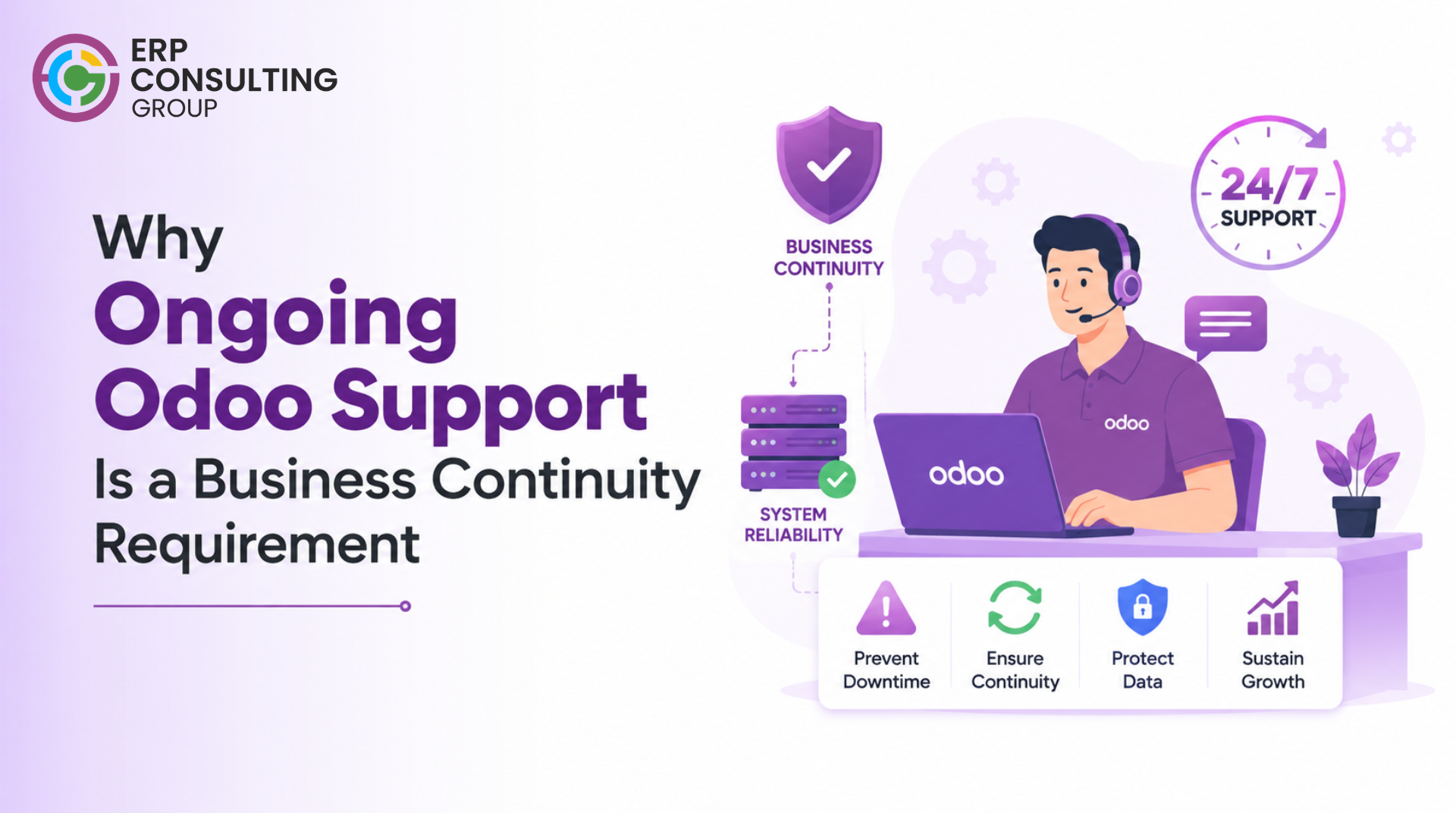
Businesses Treat ERP Support as Optional Until It Isn't
Business continuity planning covers disasters, data breaches, supply chain failures, and power outages. For most businesses, it doesn't cover ERP failure.
That's a dangerous oversight.
For a business running Odoo across its operations, purchasing, inventory, manufacturing, finance, and sales, the ERP is not a software tool. It is the operational backbone. When it fails, operations fail. And when support is not in place, recovery is slow, expensive, and entirely avoidable.
We had a critical report failure during our month-end close. Our finance team couldn't submit numbers to the board. We had no support in place. It took six days to find someone, get them access, and fix the issue. Six days.
This article is not about typical IT risk management. It is about one specific and underappreciated risk: what happens when your Odoo breaks and no one is responsible for fixing it.
What Business Continuity Actually Means for an ERP User
Business continuity means your operations can continue or recover quickly when something goes wrong. For businesses running Odoo, continuity depends on five things:
The Five Continuity Dependencies:
1. System availability Odoo must be accessible when your team needs it.
2. Data integrity Your data must be accurate, complete, and protected.
3. Process stability Workflows must function reliably across all modules.
4. Recovery capability When something breaks, you must be able to fix it quickly.
5. Compliance continuity: Financial and regulatory reporting must remain accurate.
Without an active Odoo support structure, all five of these can be compromised simultaneously by a single system event.
The Real Business Continuity Risks of Unsupported Odoo
Here are the scenarios we see most often when businesses run Odoo without a support structure:
Risk 1: The Unplanned Upgrade Conflict
Odoo pushes automatic updates to certain components. A conflict between an update and a custom module can silently break a critical workflow. Without monitoring, this isn't discovered until a user can't complete a task often during a peak period.
Risk 2: The Departed Developer Problem
The developer who built your custom modules is no longer available. No documentation exists. The next person to touch the code spends days just understanding what it does before they can fix anything. Meanwhile, operations wait.
Risk 3: The Data Corruption Cascade
A misconfigured workflow or a bad import pushes incorrect data through the system. Inventory balances are wrong. Invoices don't reconcile. The financial close is delayed. Fixing corrupted data retroactively is one of the most time-consuming and expensive ERP problems that exists.
Risk 4: The Security Breach on an Unpatched System
Odoo publishes security advisories and patches regularly. A business running an unpatched Odoo instance is exposed. ERP systems contain financial data, customer data, and vendor data all attractive targets. A breach doesn't just create IT problems; it creates legal liability.
Risk 5: The Compliance Gap
Tax laws change. Reporting requirements are updated. Without a support partner tracking these changes and updating your Odoo configuration accordingly, your system may produce non-compliant outputs without anyone realizing it until an audit.
Downtime Has a Real Cost Here's How to Calculate It
Most businesses have never calculated the cost of Odoo downtime. Here is a simple framework:
Factor | How to Estimate |
Revenue at risk per hour | Daily revenue / 8 working hours |
Staff cost during downtime | Number of affected users x hourly cost |
Customer impact cost | Delayed orders, failed invoicing, support calls |
Recovery cost | External consultant rates x hours required |
Reputational cost | Harder to quantify, but real in B2B relationships |
A business generating USD 500,000/month in revenue risks approximately USD 3,100 per hour of full operational downtime before recovery costs. A single 48-hour ERP failure can represent USD 150,000+ in combined direct and indirect costs. Most AMC contracts cost a fraction of that annually.
What Proper Odoo Support Looks Like as a Continuity Measure
Framing Odoo support as a continuity measure rather than an IT cost changes how you scope and evaluate it. Here is what continuity-grade support looks like:
Step 1: Documented System Architecture
- Every custom module documented with dependencies, logic, and maintainer notes.
- Integration maps for all connected systems.
- Data dictionary for non-standard fields and configurations.
Step 2: Proactive Monitoring and Alerting
- Automated alerts for system errors, failed processes, and performance degradation.
- Regular database health checks, not just reactive investigation.
- Uptime monitoring with defined escalation paths.
Step 3: Tested Backup and Recovery Procedures
- Daily backups with verified restoration testing.
- Defined RTO (Recovery Time Objective): How fast can you be back online?
- Rollback procedures for update conflicts.
Step 4: Defined SLAs with Escalation Paths
- Written response and resolution SLAs for different issue priorities.
- Named escalation contacts not just a generic helpdesk queue.
- After-hours coverage for critical system failures.
Real Example When No Support Became a Continuity Crisis
Client Background: Professional services firm. Odoo 15. 20 users. No active support contract after implementation partner relationship ended.
What Happened
A Python environment update on their VPS triggered an Odoo server crash. The system became inaccessible. No backup had been tested in 9 months. No documentation of their server configuration existed. The implementation partner was no longer engaged.
The Impact
The firm was unable to access client billing data, project records, or financial reports for 5 business days. Client invoicing was delayed. A board meeting had to be postponed due to missing financial data. Recovery required a specialist who rebuilt the environment from partial backups.
The Cost
Emergency recovery: USD 6,800. Delayed invoicing: approximately USD 40,000 in cash flow disruption. Reputational impact: two client relationships strained. Total business impact: estimated USD 80,000+. A proactive AMC covering monitoring, backups, and maintenance would have cost this business USD 4,800 annually.
Section 6: Building Odoo Support Into Your Business Continuity Plan
If your organization has a formal business continuity or disaster recovery plan, Odoo support should be explicitly included. Here is how to frame it:
Odoo Continuity Checklist for Your BCP:
Identify Odoo as a Tier 1 business system if it touches revenue, inventory, or finance.
Define RTO for Odoo failure: how many hours of downtime is acceptable?
Define your current support SLA or acknowledge the gap if none exists.
Document all custom modules and integrations.
Test backup restoration quarterly, not annually.
Define who to call at 11 pm on a Friday if Odoo goes down.
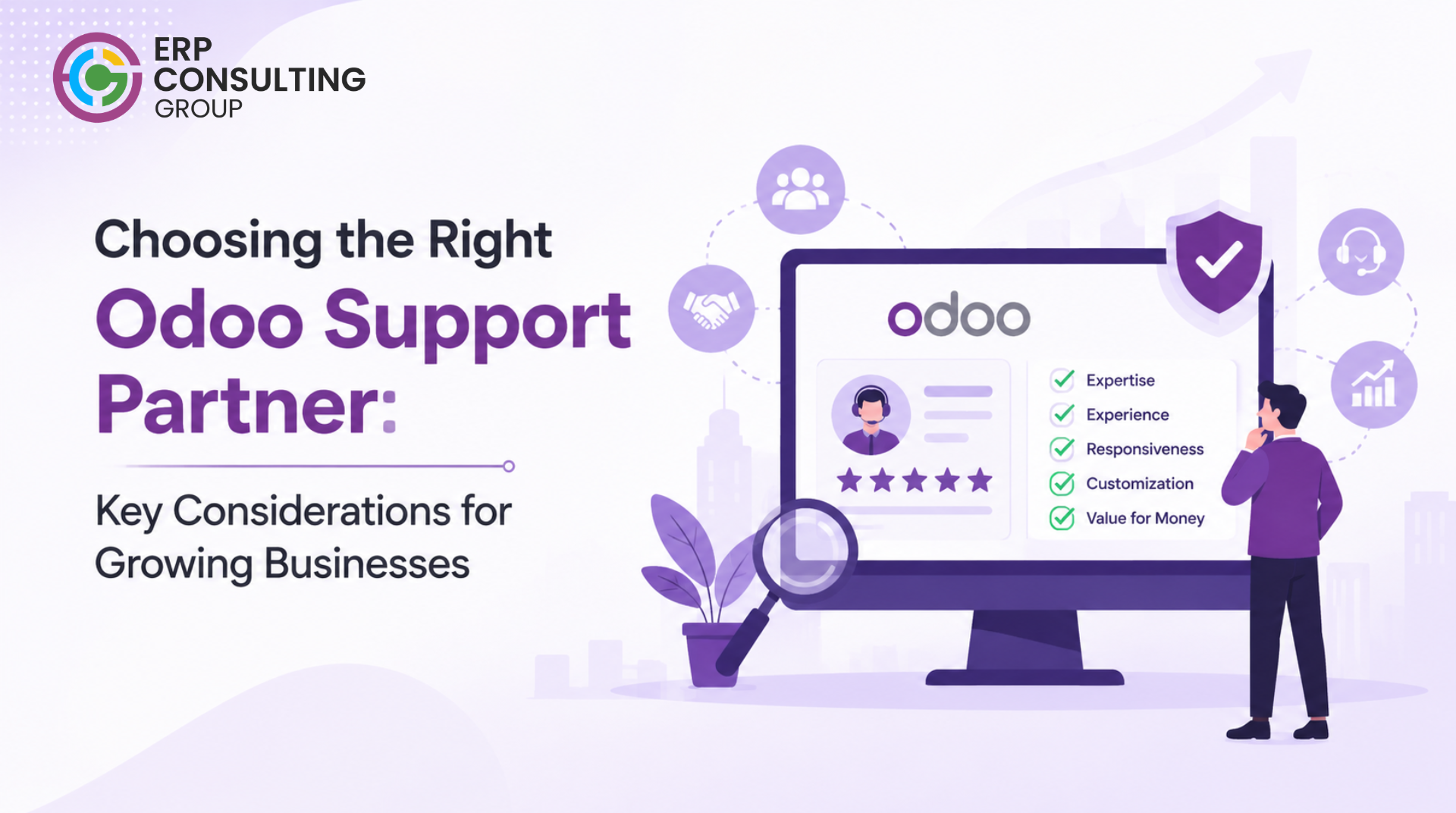
Once you decide to put a formal support structure in place, your next step is choosing the right partner. Read: Choosing the Right Odoo Support Partner: Key Considerations for Growing Businesses
Our Recommendation
Ongoing Odoo support is not an IT budget line item. It is a business continuity investment. Every day your Odoo runs without a structured support arrangement is a day of unmanaged operational risk.
The question is not whether something will eventually go wrong with your ERP; it will. The question is whether you have a plan to respond when it does.
ERP Consulting Group: We provide continuity-grade Odoo support that goes beyond reactive fixes. Our AMC offering includes proactive monitoring, tested backup procedures, documented architecture, and defined SLAs, so when something goes wrong, recovery is measured in hours, not days.
Is your Odoo setup prepared for a continuity event? Book a free Odoo risk assessment
 Recent Posts



 Free Consultation