Your Odoo Is Live But Who Is Keeping It Running?
You invested months in your Odoo implementation. The system went live. Your team was trained. For the first few weeks, everything worked.
Then reality set in.
A workflow broke after a routine update. A custom module stopped syncing. Your finance team couldn't generate the month-end report they needed. The developer who built your system had moved on.
We didn't realize how much ongoing effort Odoo needs. We thought go-live was the finish line it turned out to be the starting line.
This is the situation hundreds of businesses face every year. Not because Odoo is unreliable, but because ERP systems require ongoing care to stay reliable. Odoo is a living platform. It evolves, your business evolves, and without structured support and maintenance, the gap between the two grows quickly.
This guide covers everything you need to know about Odoo support and maintenance in 2026: what it includes, why it matters, what it costs to ignore it, and how to build the right support model for your business.
Why Odoo Systems Break Down Over Time
Odoo is one of the most capable open-source ERP platforms available today, but open-source also means frequently evolving. Odoo releases a major version every year and pushes updates regularly. Each update brings improvements, new features, and security patches. It also introduces potential conflicts with existing customizations.
Here are the five most common reasons Odoo environments degrade without ongoing support:
1. Version Drift
Businesses that don't update their Odoo instance fall behind. Custom modules built for Odoo 15 or 16 are not compatible with Odoo 17 or 18 without migration. Without proactive maintenance, version upgrades become expensive emergency projects rather than managed transitions.
2. Custom Module Conflicts
Most Odoo implementations involve custom code tailored workflows, third-party integrations, industry-specific modules. When Odoo pushes updates, these customizations can break silently. You may not notice until a critical process fails mid-month.
3. Performance Degradation
As your transaction volume grows, an Odoo instance not properly optimized begins to slow. Delayed reports. Laggy inventory views. Slow invoicing. These are not Odoo problems they are maintenance problems.
4. User-Driven Configuration Errors
People misconfigure settings. Workflows get altered by well-meaning but untrained users. Data gets corrupted through manual workarounds. Without a support structure to catch and correct these issues, small problems compound into large ones.
5. Unpatched Security Vulnerabilities
Odoo regularly patches security vulnerabilities. An unpatched system is an exposed system. ERP-targeted attacks increased significantly in 2025, particularly on businesses running outdated versions of open-source platforms.
The Business Impact of Neglected Odoo Maintenance
The cost of neglecting ERP maintenance is rarely visible until it becomes a crisis. Here is what businesses actually experience:
Risk Area | What Goes Wrong | Business Impact |
Operational Downtime | Critical module failure | Operations pause, teams resort to spreadsheets, data integrity issues follow |
Compliance Exposure | Tax/financial reports incorrect | Audit failures, regulatory penalties, incorrect VAT/GST submissions |
Staff Productivity Loss | Slow or broken workflows | Hours wasted daily on manual workarounds never visible in reports |
Emergency Costs | Deferred maintenance compounds | Emergency fixes cost 3x–5x more than a proactive monthly retainer |
Stalled Growth | No ERP capacity to expand | New business lines, markets, or teams cannot onboard into a broken system |
Section 3: What Odoo Support and Maintenance Actually Covers
Odoo support and maintenance is not a single service. It is a framework of activities that keeps your ERP healthy, aligned to your business, and ready to grow. A comprehensive support engagement includes four distinct types of maintenance:
3.1 Corrective Support (Break-Fix)
Resolving issues as they occur, a module stops working, a report crashes, an integration fails. Corrective support is the baseline, but it should not be the only thing you are paying for.
3.2 Preventive Maintenance
Regular health checks, database optimization, log reviews, and performance monitoring to identify problems before users notice them. Preventive maintenance is what separates good support from reactive fire-fighting.
3.3 Adaptive Maintenance
As your business changes new products, new processes, new regulations, your Odoo configuration needs to adapt. Adaptive maintenance covers minor reconfigurations, workflow updates, and small customization changes.
3.4 Perfective Maintenance
Improving the system over time. Optimizing slow reports, streamlining workflows, eliminating redundant steps. This turns a functional Odoo into a genuine competitive advantage.
Support Models: How Businesses Structure Odoo Maintenance
There is no single right approach. The right model depends on your business size, complexity, and risk tolerance.
Model | What It Includes | Best For |
Ad-Hoc / Pay-Per-Incident | Call when something breaks. No ongoing relationship. | Minimal Odoo setup, no customization, very low business risk |
Retainer-Based Support | Fixed monthly fee, set hours, defined SLAs, and preventive care included. | Growing businesses, predictable cost, reliable access |
Annual Maintenance Contract (AMC) | Comprehensive yearly agreement: support, maintenance, upgrades, training. | Complex Odoo environments best value per rupee |
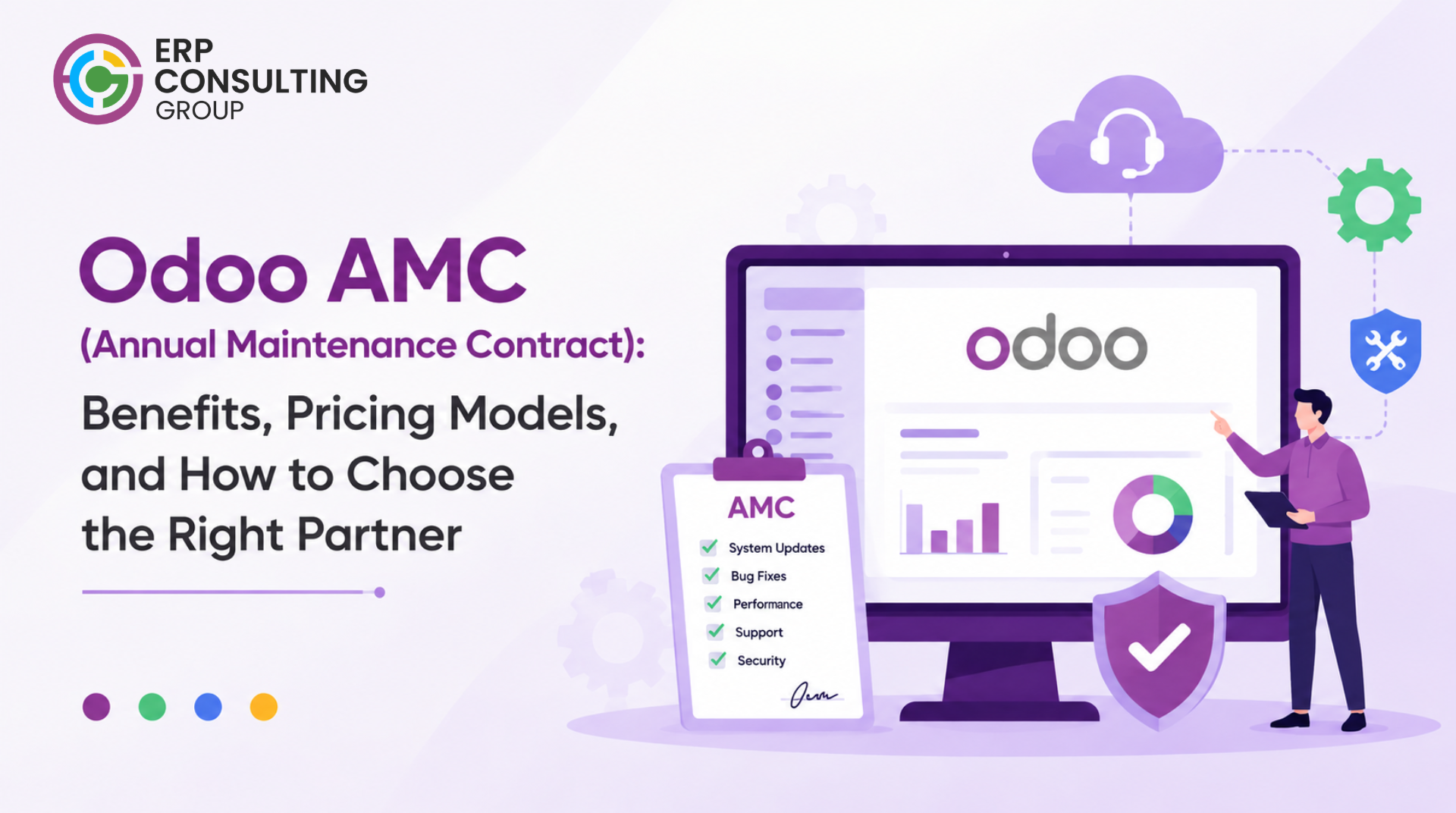
Want to understand the AMC model in depth? Read our full breakdown: Odoo AMC (Annual Maintenance Contract): Benefits, Pricing Models, and How to Choose the Right Partner
Real Example: How Proper Support Prevents Crises
Client Profile: Mid-size distribution company. Odoo 16. Customized inventory module. WooCommerce integration. 30 daily users.
The Situation
After an Odoo community update pushed automatically, the stock sync between WooCommerce and Odoo stopped working. Orders were being placed on the website for items that were out of stock. The team noticed two days later when customer complaints began.
Without Support
The company would have called a freelancer, waited 3–5 days for availability, spent several hours diagnosing the conflict, and lost revenue and customer trust in the interim.
With an Active Support Contract
The issue was flagged by the support partner's monitoring system within hours. A developer was assigned, the conflict identified, and a patch deployed within 24 hours. The team was notified proactively. No customer impact. No emergency billing.
The Lesson:
The support contract didn't just fix the problem. It prevented the problem from becoming a crisis.
Proactive monitoring caught what the team never would have seen until it was too late.
Evaluating Your Current Odoo Support Situation
Use these questions to assess where you stand today:
Quick Self-Assessment
When was your Odoo database last backed up, and was the backup tested?
Do you know which Odoo version you are running and whether it is current?
Do you have documentation of all custom modules and their dependencies?
If a critical process failed tonight, who would you call and how long would you wait?
Has your Odoo instance been reviewed for performance in the last 6 months?
If you answered 'I don't know' to more than two of these, your business is running on unsupported infrastructure. That is a business continuity risk, not just an IT inconvenience.
For a deeper view on business continuity implications, read: Why Ongoing Odoo Support Is a Business Continuity Requirement
Our Recommendation
Odoo support and maintenance are not optional for businesses that depend on their ERP. The question is not whether you need it, it's what level you need and who should provide it.
For most growing businesses, a structured AMC or retainer-based support model with a certified Odoo partner delivers the best combination of predictable cost, proactive care, and access to expertise.
ERP Consulting Group Approach: We provide dedicated Odoo support and maintenance services tailored to your business complexity, growth stage, and industry. Whether you need a basic retainer or a comprehensive AMC, we structure support around your actual needs, not a generic package.
Need help assessing your current Odoo support setup? Talk to our Odoo support team
 Recent Posts



 Free Consultation