
This is Part 6 of our series breaking down the 7 operational modules from The Complete Guide to Solar Business Management Software (2026)- this piece goes deeper on the sixth: DISCOM & Net-Metering Approval Tracking.
A system can be fully installed, commissioned, and working - and the sale still isn't actually closed.
Between a completed installation and a billable, net-metered connection sits a DISCOM approval process the installer doesn't fully control. The panels are up, the customer is happy, and the project still isn't finished from a business standpoint - because the meter hasn't been changed, the net-metering agreement hasn't been signed off, and the final milestone payment is often waiting on exactly that.
This companion piece to yesterday's article on subsidy tracking covers a genuinely separate workflow - one that most guides skip entirely, and where teams most often lose track of a project that looks, on paper, already finished.
Why the Sale Doesn't End at Installation
Installation Complete → Application to DISCOM → Document Verification → Site Inspection → Meter Change/Net-Metering Agreement → Approval → Final Payment/Subsidy Release
Until approval comes through, the customer isn't generating billing credits, the installer's final milestone payment is often held back, and any subsidy disbursement tied to net-metering confirmation is sitting behind it too.
Where This Stage Stalls
- Inspection scheduling depends entirely on DISCOM staff availability, which the installer can't control but is still expected to chase.
- Documentation errors surface late - a mismatch between installed capacity and application paperwork can send the file back after inspection has already happened.
- No internal visibility - the sales team has moved on to the next customer, and nobody at the company is actively watching this specific file's DISCOM status.
- Final payment terms are often tied to approval, so a stuck approval directly delays cash collection, not just paperwork.
The Business Impact of an Untracked Approval Stage
When this stage isn't actively tracked, three things compound. The customer starts calling the company for updates it doesn't have, because nobody proactively checked DISCOM status. The final milestone invoice - often 5-10% of contract value - sits uncollected longer than it needs to, simply because nobody flagged that approval had come through. And if the subsidy is also tied to net-metering confirmation, a stalled approval delays two payments at once instead of one.
The sale doesn't actually close at installation - it closes when the approval comes through, and that stage needs the same kind of active tracking as everything before it.ERP Consulting Group builds DISCOM and net-metering approval into RENEWvate as a defined project stage, so files awaiting inspection or documentation get flagged instead of forgotten.
A Worked Example: The Gap Between Installed and Paid
Consider a C&I installer that completed a 500 kW rooftop system on schedule, with the customer satisfied and the site fully commissioned. The final milestone invoice - worth 8% of contract value - is contractually tied to DISCOM approval and net-metering sign-off, which is standard practice for larger commercial contracts.
The DISCOM application goes in a week after commissioning. From there, nobody at the company is specifically assigned to monitor it. Six weeks pass. The project team has moved on to the next site. Sales has moved on to the next customer. Finance is still showing the final invoice as unbilled, but nobody's connected that specifically to a DISCOM approval that may or may not still be pending.
When someone eventually checks, in this scenario the approval had actually come through three weeks earlier - the inspection passed, the net-metering agreement was signed, and the file was simply sitting, fully approved, because nobody had gone back to close the loop and trigger the final invoice. Three weeks of a large receivable sitting uncollected, for no reason other than nobody was watching for the approval to land.
- Assuming that once installation is physically complete, the remaining approval process will resolve itself without active follow-up.
- Not assigning a specific owner to DISCOM follow-up once the project team's on-site work is finished.
- Submitting the application with a technical detail that doesn't exactly match the as-built system, triggering an avoidable rejection after inspection.
- Treating the final invoice as blocked indefinitely rather than checking approval status on a regular cadence.
- Not distinguishing, in internal reporting, between files genuinely awaiting DISCOM action and files that have already been approved but not yet actioned internally.
Why This Stage Is Different From Subsidy Tracking
It's worth being precise about the distinction from yesterday's article, because the two get conflated often. Subsidy tracking follows the customer's financial benefit through the government scheme. DISCOM and net-metering approval tracks the technical and regulatory sign-off that allows the system to actually export or offset power - meter replacement, net-metering agreement, sometimes a separate inspection. A project can have its subsidy approved and disbursed while net-metering approval is still pending, or the reverse. They need to be tracked as related but distinct workflows, not folded into one generic "approvals" status.
Building a Connected DISCOM Approval Workflow
The objective is the same as with subsidy tracking - not to control what the DISCOM does, but to make sure nothing on the company's side of the process becomes the reason a file sits idle.
Application Package Verification
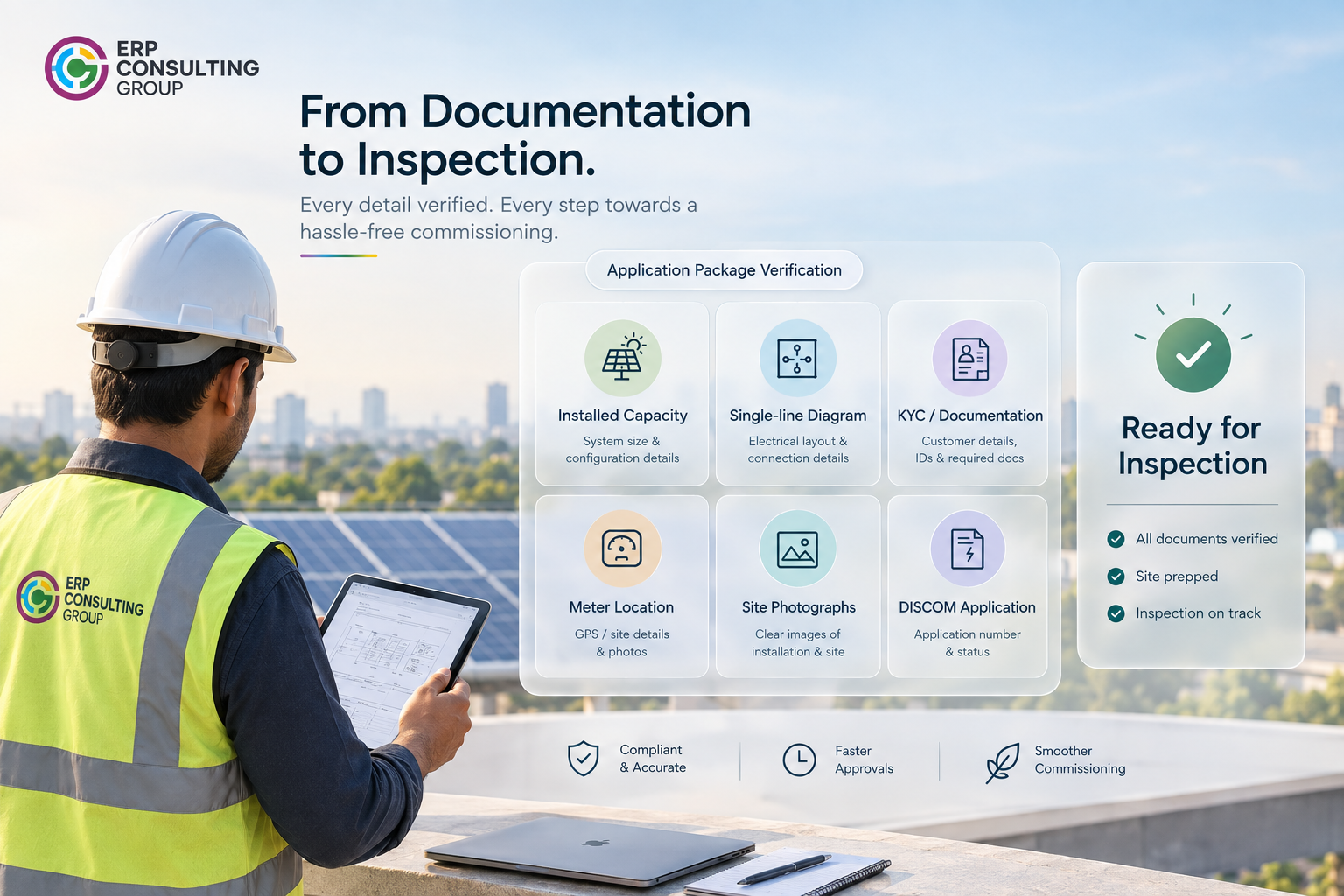
Before submission, the application package - capacity details, single-line diagram, KYC, and any DISCOM-specific forms - can be checked against DISCOM's actual requirements. Many rejections trace back to a mismatch between what was installed and what was originally applied for, often because a design change during installation was never reflected in the paperwork.
Inspection Readiness Tracking
Once an inspection is scheduled or expected, the site needs to be genuinely ready - correct labelling, accessible meter location, any required signage. A system that flags upcoming or overdue inspections gives the field team time to prepare, instead of discovering a readiness gap when the DISCOM inspector is already on site.
Approval-to-Invoice Linkage
The final milestone invoice, and any subsidy disbursement gated on net-metering confirmation, can be set to trigger only once approval is logged against the project. This removes the need for finance to separately check approval status before raising an invoice - the two stay connected by default.
What a Connected System Tracks Here
DISCOM Approval Tracking | Manual Follow-Up | Connected Workflow |
Application status | Tracked by memory or scattered notes | Logged against the specific project record |
Inspection scheduling | Chased reactively when the customer asks | Visible as a pending step with an expected window |
Site readiness | Discovered as a gap during inspection | Checked and confirmed before inspection is scheduled |
Documentation errors | Discovered after rejection | Checked against requirements before submission |
Payment linkage | Final invoice raised separately from approval status | Final milestone linked to approval confirmation |
Subsidy linkage | Tracked in a different tool, or not at all | Net-metering confirmation and subsidy status connected |
Multi-project visibility | Each file checked individually | All pending approvals visible in one view, sorted by age |
Executive Summary
- Treat DISCOM/net-metering approval as its own tracked stage, not an afterthought once installation is done.
- Submit complete documentation the first time - errors caught after inspection cost more time than errors caught before submission.
- Link the final milestone invoice to approval confirmation, so collection doesn't depend on someone remembering to check.
- Keep subsidy and net-metering status connected where both apply, since a stall in one often stalls the other.
The sale doesn't actually close at installation. It closes when the approval comes through - and that's the stage most businesses aren't watching.
Deep-Dive FAQ
Can a company speed up DISCOM inspection timelines?
Not directly - inspection scheduling is controlled by the DISCOM, not the installer. What a company can control is submitting complete, error-free documentation the first time, and following up proactively rather than waiting for the customer to ask. Typical timelines vary meaningfully by state and DISCOM, so treat any specific turnaround figure as needing verification against your own operating region.
Should this be tracked as part of the project record or as a separate compliance log?
Ideally the same record. When DISCOM approval status lives apart from the project and payment record, someone has to manually match the two before an invoice can be raised - exactly the kind of reconciliation work a connected workflow removes.
Does this apply differently for C&I versus residential rooftop?
The core workflow is similar, but C&I and open-access projects often carry additional steps - larger capacity approvals, sometimes a different DISCOM department - and typically higher payment amounts riding on the approval, which raises the cost of letting a file go untracked.
What's the most common reason a completed installation fails DISCOM inspection?
A mismatch between what's physically installed and what was originally submitted in the application - often because a design change (a different inverter model, an adjusted capacity, a relocated meter point) happened during execution and was never reflected in the paperwork sent to the DISCOM. Keeping the application package linked to the live project record, rather than a static document created once at the start, reduces how often this happens.
Who typically owns DISCOM follow-up - the sales team, the project team, or a separate function?
Most solar businesses find it works best with the project or a dedicated post-installation team, rather than sales, since by this stage the salesperson has usually moved on and the relevant technical documents sit with whoever executed the installation. As with subsidy tracking, the specific role matters less than making sure exactly one person is clearly accountable for each file.
Should the final milestone invoice always be contractually tied to DISCOM approval?
This is a commercial decision each business needs to make based on its own risk appetite and contract negotiations, not a universal rule. Tying it to approval protects against disputes over whether the system is genuinely operational, but it also means the company's own cash collection becomes dependent on a timeline it doesn't fully control - which is exactly why active tracking of this stage matters more, not less, when the payment structure works this way.
How should a business report on this stage to management without overstating how much control it has?
Separate reporting into what's waiting on the DISCOM versus what's waiting on an internal action - a document to prepare, an invoice to trigger once approval is confirmed. This keeps the reporting honest about what the business can actually influence, rather than presenting every stuck file as equally within the company's control.
Ready to Connect Your Site Survey to Project Execution?
ERP Consulting Group's RENEWvate tool tracks DISCOM and net-metering approval as a defined stage against each project, flags files awaiting inspection or documentation, and links final milestone billing to approval confirmation. We can walk through your current DISCOM process and show what proactive tracking would look like for your team. Start with your process, not a generic software demo - Book a Free Strategy Session or email info@erpconsulting24.com. |
This article is part of our Complete Guide to Solar Business Management Software (2026) - read the full guide for the other modules, including subsidy application tracking and GST-compliant invoicing.
 Recent Posts




 Free Consultation