
This is Part 8 of our series breaking down the 7 operational modules from The Complete Guide to Solar Business Management Software (2026) - this piece goes deeper on the eighth and final: AMC & After-Sales Service.
Solar equipment carries some of the longest warranty periods any business will ever service - panels commonly warrantied for 25 years, inverters for 5 to 10. Most solar businesses track this the same way they track everything else early on: informally.
A spreadsheet lists which customer has an AMC. A folder somewhere holds the original warranty documents. A service call gets logged wherever the person who answered the phone happened to write it down. This works while the installed base is small. It stops working once a company has thousands of systems in the field, each carrying its own warranty clock and service history.
A Worked Example: The Renewal That Never Got Offered
Consider a business with roughly 2,000 residential systems installed over the past four years, a comfortable installed base by most standards. A meaningful share of those original inverter warranties - typically shorter than the panel warranty - are approaching expiry within the next twelve months.
Without a system flagging these expiries ahead of time, the business only finds out a warranty has lapsed when a customer calls with a fault and is told the free coverage has ended. At that point, the conversation is defensive - the customer is frustrated, and the company is explaining a lapse rather than offering a renewal. Multiply that across even a modest fraction of a 2,000-system base reaching expiry each year, and it's a meaningful number of AMC conversations the business never got to have on its own terms, simply because nobody was tracking expiry dates as a forward-looking list.
The revenue lost here isn't from bad service. It's from a proactive conversation that should have happened months earlier, replaced by a reactive one that happens only after something's already gone wrong.
Common Mistakes That Cost Renewal Revenue
- Tracking AMC status only for customers who already have one, with no visibility into which non-AMC systems are approaching warranty expiry.
- Treating warranty and AMC records as archival paperwork rather than an active pipeline of renewal opportunities.
- Losing component-level detail (which specific inverter, which batch of panels) between the sales record and the service team, forcing every claim to start with a site visit just to identify what's installed.
- Not logging routine service visits with the same discipline as AMC-covered visits, losing valuable pattern data on which components tend to fail and when.
- Waiting for the customer to initiate a renewal conversation instead of proactively reaching out ahead of expiry.
What Gets Missed When AMC Is Tracked Informally
- Renewal dates are missed - an AMC lapses quietly, and the business loses a recurring revenue line without ever deciding to.
- Warranty claims take longer to process, because nobody can quickly pull up which component, batch, or serial number was originally installed at a given site.
- Service history is fragmented - a technician visiting a site for the third time has no easy way to see what was done on the first two visits.
- There's no visibility into which systems are approaching the end of their manufacturer warranty window - exactly the moment a customer is most receptive to an AMC conversation.
Reframing After-Sales as a Revenue Line, Not Just a Cost
An AMC and after-sales function costs money to run - technicians, spare parts, scheduling. But every AMC contract is also recurring revenue, and every system nearing the end of its free warranty period is a renewal or upsell conversation waiting to happen, if the business knows it's coming. Businesses that treat this module purely as a service obligation tend to miss both the renewal and the upsell. Businesses that connect it back to the original sale tend to catch both.
Original Installation → Warranty/AMC Record → Service History → Renewal Trigger → Recurring Revenue
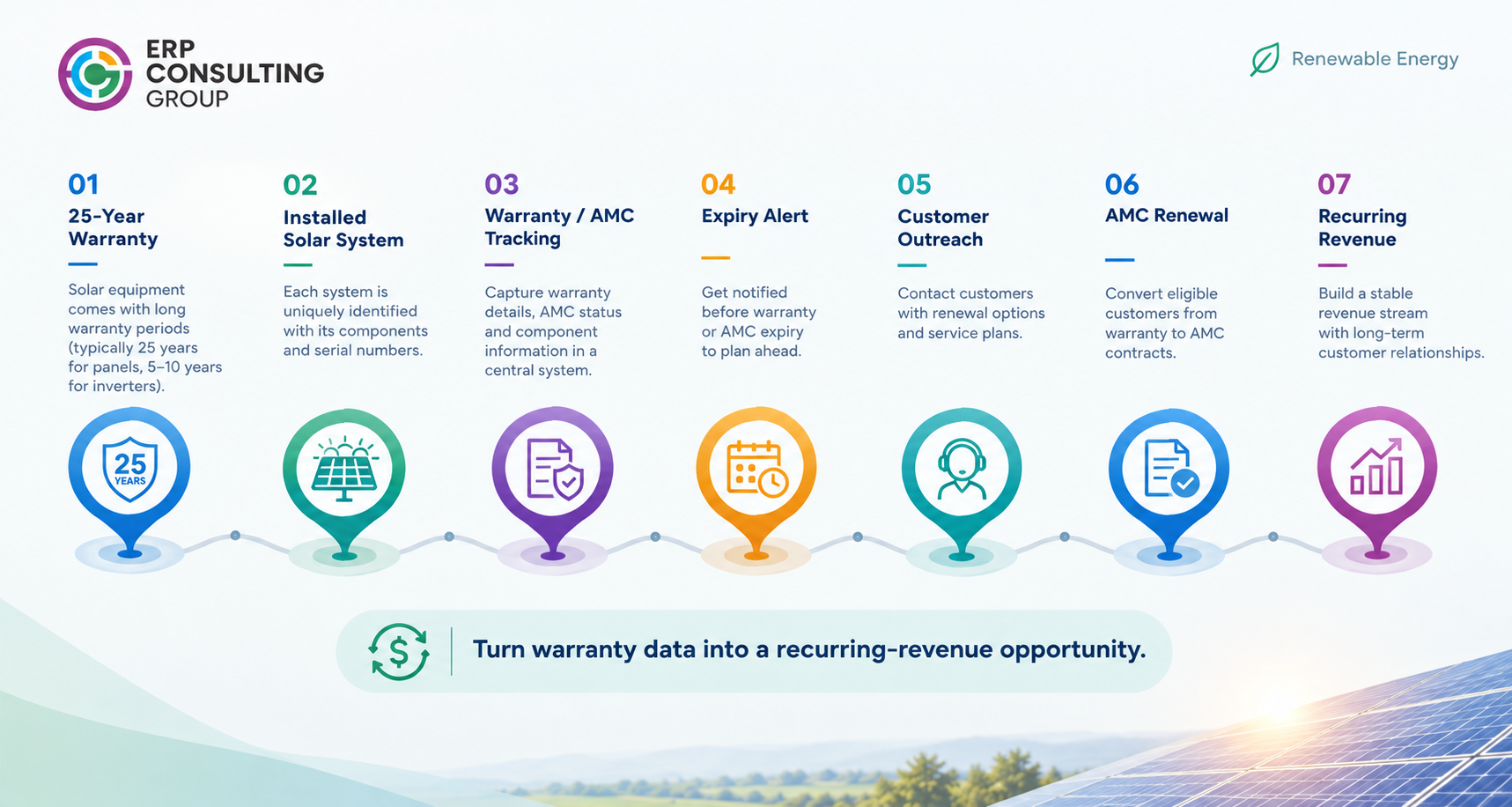
What a Connected Warranty & AMC Record Looks Like
A warranty claim is far faster to resolve when the system already knows which batch of panels or which inverter serial number was installed at that specific site - information that, ideally, should already exist from the point of installation. ERP Consulting Group links warranty and AMC records back to the original installation and serial numbers inside RENEWvate, so claims and renewals draw on that history instead of starting from a blank page.
AMC & After-Sales | Tracked Informally | Connected to the Original Sale |
Warranty records | Paper/PDF filed separately per customer | Linked to the original installation and serial numbers |
Renewal dates | Missed unless someone happens to check | Visible ahead of expiry as a flagged renewal |
Service history | Scattered across visits and technicians | Logged against the site, visible on the next visit |
Claims processing | Slower - component/batch info hard to locate | Faster - component and batch history attached to the record |
Revenue visibility | AMC treated as a separate service ledger | AMC and service tied back to the original project |
Spare parts | Ordered reactively once a fault is confirmed | Common failure patterns visible across the installed base |
Manufacturer coordination | Handled case-by-case as claims arise | Batch/serial data ready to share when a claim is raised |
Building a Connected AMC & Service Workflow
The objective isn't to add a new department. It's to make sure the service side of the business inherits the information the sales and installation side already generated, instead of starting fresh for every customer interaction.
Warranty Capture at Handover
At the point of commissioning, the specific components installed - panel batch/serial, inverter serial, structure supplier - along with their individual warranty terms, can be recorded against that installation. This becomes the reference point for every future service interaction at that site.
Renewal and Expiry Visibility
As systems approach the end of their manufacturer warranty or an existing AMC term, they can be flagged ahead of time - not on the day of expiry, but with enough lead time to have a genuine renewal conversation with the customer before the relationship goes cold.
Service History as a Running Record
Every service visit, whether under AMC or a standalone paid call, can be logged against the site - what was reported, what was found, what was replaced or repaired. The next technician visiting that site, or a different technician entirely, starts with that history instead of asking the customer to explain the problem from scratch again.
Executive Summary
- Connect warranty and AMC records back to the original installation and serial numbers, so claims don't start from a blank page.
- Flag renewals and warranty-expiry windows ahead of time - a missed renewal is lost revenue nobody decided to lose.
- Log service history against the site, not the technician's memory, so every visit builds on the last.
- Treat AMC as a revenue line connected to the original sale, not a standalone cost centre.
Twenty-five years is a long time to leave a warranty record sitting in a folder. The businesses that connect it back to the original sale tend to be the ones still capturing the renewal.
Deep-Dive FAQ
Is AMC tracking really worth the effort for a smaller installer?
It scales with installed base size. A company with a few dozen systems in the field can often manage this manually without much pain. Once the installed base runs into the hundreds or thousands, missed renewals and slow claims start showing up as real, avoidable revenue loss - that's the point where structured tracking starts paying for itself.
How does this connect back to the sales and inventory data covered earlier in this series?
Directly. A warranty claim resolves faster when the system already knows which batch of panels or which inverter serial number was installed at that site - information that, per the inventory tracking module earlier in this series, should already be captured at installation. When that data exists, AMC and warranty claims draw on it instead of starting over.
What does 'honestly-labeled proof' mean when businesses cite results here?
Any specific improvement number - turnaround time reduction, renewal rate, claim processing speed - should be sourced from an actual, verifiable deployment and labeled as such, not presented as a typical or guaranteed outcome. Ask any vendor citing a specific result to show where the number came from before treating it as representative of what your business would see.
Should AMC pricing be standard across all customers, or tailored per system?
This depends on the business's own commercial strategy, but having accurate installed-base data - system size, component ages, historical service frequency at that site - makes it possible to price AMCs based on genuine risk and service cost rather than a flat rate applied uniformly regardless of what's actually installed.
What's a reasonable way to start if AMC has never been tracked systematically before?
Start with the installed base that still has active or recently expired warranties, since that's where the nearest renewal opportunities sit. Building a clean baseline - which systems, which components, which warranty end dates - for that group first is more useful early on than trying to backfill history for every system the company has ever installed.
Should AMC and standalone paid service calls be tracked in the same system?
Generally yes. Even customers without an active AMC generate valuable service history and represent renewal or upsell candidates. Splitting AMC and non-AMC service records across different tools recreates the same fragmentation problem this article describes, just at a smaller scale.
How far in advance should a renewal conversation start, relative to warranty or AMC expiry?
There's no universal answer, but starting only after expiry is generally too late, since the customer has already experienced a coverage gap. Many businesses find a lead time of one to three months gives enough room for a genuine conversation without feeling premature - though the right window depends on the customer relationship and how quickly renewal decisions typically get made in your specific market.
Ready to Evaluate Your Current Setup?
ERP Consulting Group's RENEWvate tool links warranty and AMC records to the original installation, serial numbers, and service history, and flags renewals before they lapse. We can review how your team currently tracks AMC and warranty status and show what proactive renewal visibility would look like for your installed base. Start with your process, not a generic software demo - Book a Free Strategy Session or email info@erpconsulting24.com. |
This article is part of our The Complete Guide to Solar Business Management Software (2026) - read the full guide for the other modules, including subsidy tracking, DISCOM approval tracking, and GST-compliant invoicing.
This completes all 8 modules from The Complete Guide to Solar Business Management Software (2026). The guide will be updated to link out to every cluster article in this series.
 Recent Posts



 Free Consultation